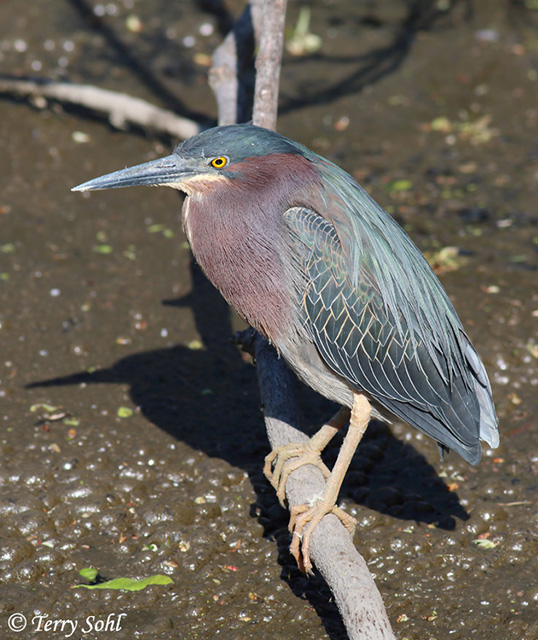
Green Herons are less gregarious heron than many heron and egret species, and at times, are quite shy and difficult to approach. Green Herons are generally solitary, nesting as isolated pairs or small groups, never in the large breeding colonies of other herons and egrets. Despite their more solitary nature, they are a quite common species throughout much of the eastern half of the United States.
Habitat
The Green Heron favors wooded wetlands, marshes, ponds, slow-moving streams, river edges, and lake shorelines with dense vegetation for concealment. It is especially common in habitats with overhanging branches, shrubs, cattails, or thick shoreline cover where it can hunt quietly from low perches.
Diet
The Green Heron feeds primarily on small fish, but it also eats frogs, tadpoles, crayfish, aquatic insects, spiders, snakes, small rodents, and other aquatic animals.
Behavior
The Green Heron is a solitary and secretive wading bird that often hunts quietly along the edges of ponds, streams, marshes, and wetlands. It stands motionless or stalks slowly through shallow water before striking rapidly at fish and other prey with its sharp bill. Unlike many larger herons, it frequently perches in shrubs and trees overhanging the water and is one of the few bird species known to use bait, such as insects or feathers, to attract fish.
Nesting
May and June. They often are solitary nesters, or sometimes nest in small groups. The nest itself is a platform of sticks, placed in a tree or shrub. The female usually lays between 3 and 5 eggs, and both parents help to incubate them. When the eggs hatch, both parents help to feed the young. The young may fledge as early as 3 weeks after hatching, but typically remain in the care of the parents for a few weeks after fledging.
Song
Crisp skeeow in flight. Can also give a low irregular series of clucking notes.
1Click here to hear the calls of an agitated Green Heron.
2Click here to hear the shorter flight call of a Green Heron.
Migration
Summers throughout most of the eastern half of the United States, near the West Coast, and in scattered locations elsewhere in the West. Winters near the U.S. West Coast, the Gulf Coast, Mexico, Central America, and South America. Some southern and western populations in the United States are permanent residents.
Interactive eBird Map
Click here to access an interactive eBird map of Green Heron sightings
Similar Species
Generally distinctive if seen well, but could potentially be confused with the following stocky wading birds that all could potentially be found in the same habitat.
- Least Bittern - The general profile and structure of a Least Bittern is similar to that of a Green Heron, although Least Bitterns are somewhat smaller. If seen well, plumage differences are readily apparent. Least Bitterns have a dark back and crown, with cinnamon colored flanks and face, while Green Herons have a chestnut-colored neck and flanks. The bill of a Least Bittern is yellow, while that of a Green Heron is dark.
- Black-crowned Night-heron - Another stocky wading bird that shares a similar overall structure with the Green Heron, Black-crowned Night-herons have a dark back and crown, gray wings, and white underparts, compared to the chestnut-colored neck and breast of a Green Heron.
- Little Blue Heron - While not nearly as stocky as a Green Heron, Little Blue Herons do share some plumage similarities, with a purplish neck and breast and dark upperparts that could potentially be confused with the plumage of a Green Heron. Little Blue Herons are much more slender and have a much longer neck than a Green Heron, yet they may sometimes constrict their neck close to the body and strike a pose that makes them look similar to a Green Heron. Note in South Dakota, Little Blue Herons are but rare visitors.
Status
Populations of Green Heron are generally stable in North America, although there are undoubtedly some local declines due to habitat loss. The species may be increasing its range to the north and west in recent decades. The IUCN lists the Green Heron as a species of "Least Concern".
South Dakota "Hotspot"
The Madison Waterfowl Production Area, just to the west of Lake Madison, is a wonderful place to see these sometimes shy birds, sometimes relatively out in the open. Water in the WPA is generally pretty shallow, often allowing Green Herons to forage well away from the shoreline vegetation which often hides their presence. In the spring, late summer and early fall, it is also a wonderful location for viewing Great Egrets, American White Pelicans, various shorebirds, Common and Forster's Terns, Franklin's and Bonaparte's Gulls, Great Blue Herons, and the occasional Snowy Egret.
The Outdoor Campus in Sioux Falls often has Green Herons that are quite used to people, and seem to be a little more approachable than Green Herons you may find elsewhere.
Further Information
- eBird - Green Heron
- Audubon Field Guide - Green Heron
- Cornell Lab of Ornithology - All About Birds: Green Heron
Photo Information
May 17th, 2014 - Outdoor Campus in Sioux Falls, South Dakota - Terry Sohl
Audio File Credits
1Paul Marvin - Recorded in Everglades National Park, Florida on May 26th, 2014. Original recording and information from xeno-canto.
2Paul Marvin - Recorded in Brevard County, Florida on July 8th, 2016. Original recording and information from xeno-canto.
