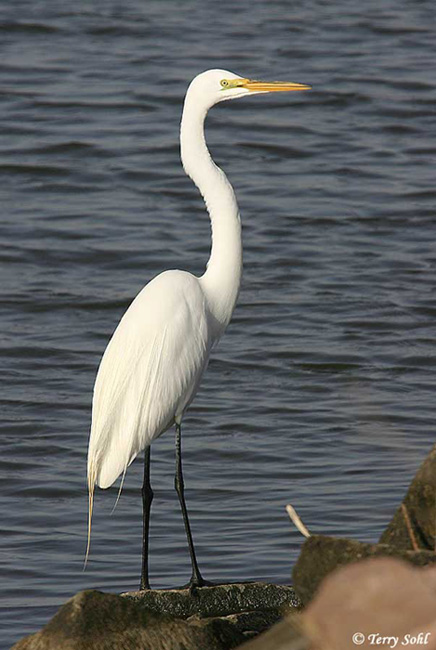
Great Egrets are the largest of the white egrets found in the state. A very widespread species, Great Egrets are found on every continent except Antarctica. After playing a key role in it's recovery after nearly being exterminated by 1900, the Audubon Society chose the Great Egret as its symbol. Note the long lacy plumage in the breeding bird on the right, and the green lores of another breeding bird in the photo on the bottom. Non breeding birds lack the lacy plumage and green lores in front of the eyes.
Habitat
The Great Egret inhabits a wide variety of freshwater and coastal wetlands, including marshes, swamps, lakes, rivers, ponds, estuaries, mudflats, mangroves, and shallow coastal lagoons. It prefers areas with shallow water where it can wade while hunting fish and other aquatic prey. The species also frequents flooded fields, reservoirs, and wet meadows during migration and throughout the nonbreeding season.
Diet
Mostly fish. Also eats crustaceans, frogs, salamanders, snakes, and aquatic insects. May chase grasshoppers in open fields.
Behavior
Forages by standing still or walking slowly, waiting for prey to approach, and the stabbing it with a quick thrust of the bill. While they primarily feed along wetlands and water features, they will occasionally also feed in open fields and even follow cattle like Cattle Egrets.
Nesting
Mid-June to July. They usually nest in colonies, sometimes mixed with other wading birds, but they will also sometimes build solitary nests. The nest is a platform of sticks built in a tree or tall shrub. The female usually lays 3 or 4 eggs, and both parents help to incubate them. When the eggs hatch, both parents help to feed the young. The young fledge after about 6 or 7 weeks.
Song
The Great Egret gives harsh, croaking calls often described as deep raspy “kraak” or “fraaank” notes, especially in flight or around nesting colonies. Although usually quiet while feeding, it becomes much more vocal during courtship and territorial disputes.
- Click here to hear the croaking alarm call of a disturbed Great Egret1
- Click here to hear the throating calls of a bird in flight2
Migration
Great Egrets in the interior of the United States are nearly all migrants, moving southward or towards the coastlines in winter. Some Great Egrets may be present at all season along the Gulf and Atlantic coasts of the US, as well as portions of the desert Southwest and California. They are found along the coastlines of Mexico, central America, and South America at all seasons, as well as the Caribbean.
Interactive eBird Map
Click here to access an interactive eBird map of Great Egret sightings
Similar Species
We have three "white egrets" that are commonly found in South Dakota (primarily in eastern South Dakota), plus another species that could potentially be tricky (but is rare in the state). Click here for more information on differentiating the white egrets.
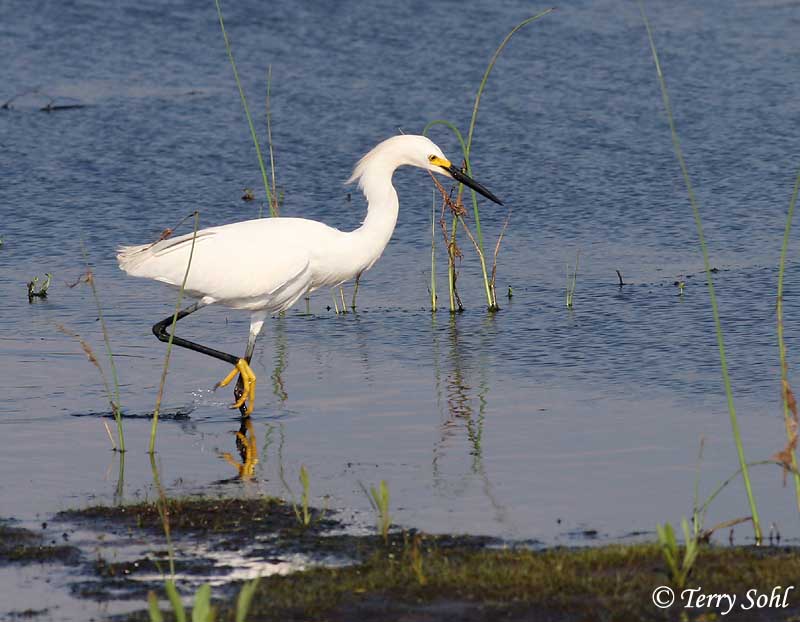
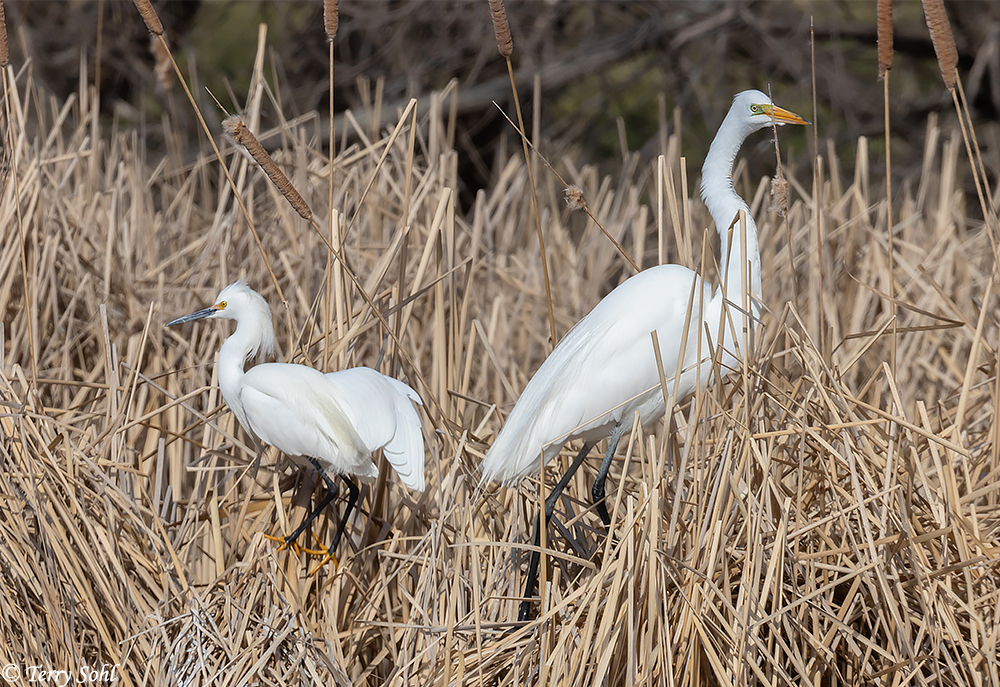
- Snowy Egret - Snowy Egrets are considerably smaller than a Great Egret. They have distinctive yellow feet on black legs, while Great Egrets have all black legs and feet. The bill of a Snowy Egret is black, while that of a Great Egret is yellow.
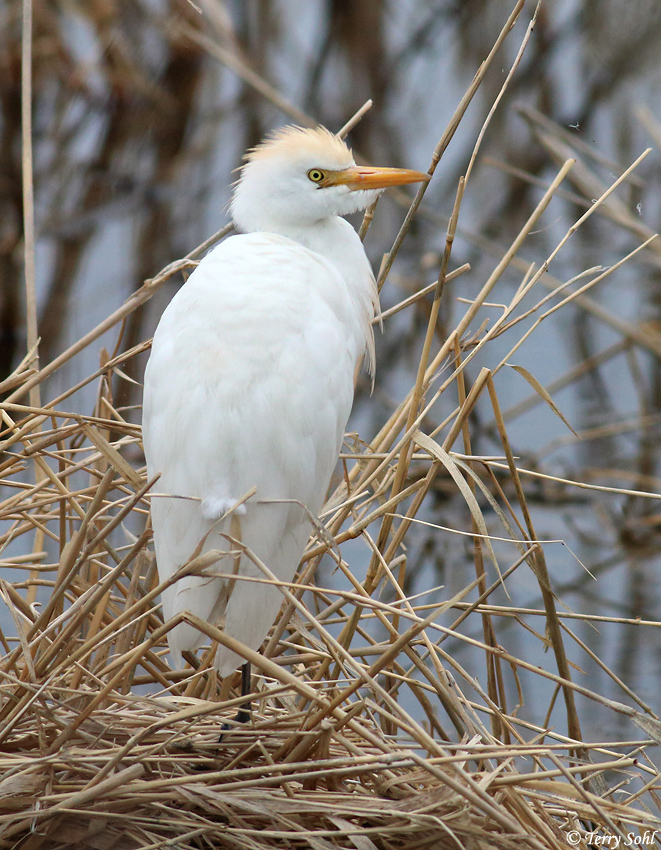
- Cattle Egret - Cattle Egret are also considerably smaller than a Great Egret, and noticeably stockier with a much shorter neck and shorter legs. The legs of a Cattle egret are yellowish or pinkish, compared to the black legs of a Great Egret.
- Little Blue Heron. Little Blue Herons are but rare visitors to South Dakota, and as the name implies...they're bluish, not white! So why are they on this list? Because the juvenile Little Blue Heron is pure white, and eventually molts into its more typical plumage. A juvenile Little Blue Heron is smaller than a Great Egret, has yellowish-green legs (black on a Great Egret) and has a grayish-blue bill (black on a Great Egret).
 |
 |
 |
 |
| Snowy Egret | Snowy Egret (next to larger Great Egret) | Cattle Egret | Little Blue Heron (juvenile) |
Conservation Status
Was nearly extinct by 1900 due to demand for it's plumes, along with many of the egrets and herons. Thanks to early conservation efforts by groups like the Audubon Society, they (and other egrets) have gradually recovered since. Today the IUCN lists the Great Egret as a species of "Least Concern".
Further Information
- eBird - Great Egret
- Audubon Field Guide - Great Egret
- Cornell Lab of Ornithology - All About Birds: Great Egret
Photo Information
April 25th, 2004 - Kingsbury County, South Dakota - Terry Sohl
Audio File Credits
- 1Matthias Hemprich. Recorded in southern Germany on October 15th, 2017. Original recording and information from xeno-canto.
- 2Bruce Lagerquist. Recorded in Brevard County, Florida on April 2nd, 2019. Original recording and information from xeno-canto.
