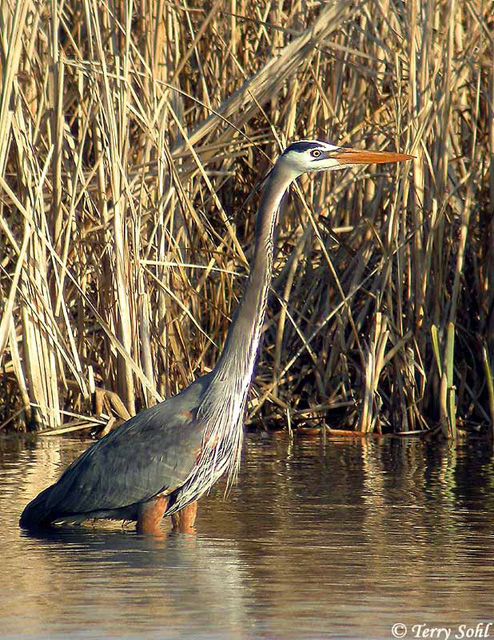
The largest and most widespread heron, Great Blue Herons are familiar to many in North America. Vary adaptable, the Great Blue Heron can be found living in a wide variety of environments, from mangrove swamps in Florida to the coastline of Alaska. They are similarly very adaptable in diet, and eating a wide variety of items. In Florida and parts of the Caribbean, there's a form of the Great Blue Heron with nearly all white plumage, sometimes called the Great White Heron.
Habitat
The Great Blue Heron inhabits a wide variety of wetland habitats including marshes, lakes, rivers, ponds, reservoirs, estuaries, and coastal shorelines. It prefers shallow water areas with abundant fish and nearby trees or secluded sites for nesting colonies.
Diet
Variable, includes fish, frogs, salamanders, rodents, snakes, birds, and large insects. Birds in certain locations may specialize in a specific prey item.
Behavior
Primarily forages by standing still in the water or walking slowly, and then striking quickly with it's bill when prey items are spotted. They will hunt day or night.
Nesting
April and May. Great Blue Herons are colonial nesters, occasionally in mixed colonies with other wading bird species. The nest is a large platform of sticks, and is sometimes placed in a tree, in dense shrubs, in thick wetland vegetation, or on the ground, depending upon location and predator abundance. The female usually lays 3 to 5 eggs, and both parents help to incubate them. When the eggs hatch, both parents help raise and feed the young. The young stay at the nest for a long period of time, for 2 months or more, before fledging.
Song
The most commonly heard vocalization is the flight call of a bird that's been flushed and takes flight. Young at the nest will give a series of chattering croaks.
- Click hear to hear the flight call of a Great Blue Heron1
- Click here to hear the calls of young at the nest2
Migration
The Great Blue Heron is a partial migrant, with migration varying by latitude. Birds breeding in Canada and the northern United States typically migrate south to the southern United States, Mexico, the Caribbean, and Central America for the winter, while populations in milder climates often remain year-round residents. Migration occurs primarily at night, with individuals traveling alone or in small groups between breeding and wintering areas.
Interactive eBird map
Click here to access an interactive eBird map of Great Blue Heron sightings
Similar Species
Superficially similar to Sandhill Crane, Great Egret, or other large cranes and egrets, but generally distinctive compared to other North American Egret and Heron species. Most similar to the Gray Heron, the Old World ecological counterpart of the Great Blue Heron.
Conservation Status
Generally stable throughout its range, Great Blue Herons are found across a very wide geographic area, and are common in many areas. The IUCN lists the Great Blue Heron as a species of "Least Concern".
Further Information
- eBird - Great Blue Heron
- Audubon Field Guide - Great Blue Heron
- Cornell Lab of Ornithology - All About Birds: Great Blue Heron
Photo Information
May 2nd, 2003 -- Western Minnehaha County -- Terry L. Sohl
Audio File Credits
- 1Lauren Harter. Recorded in Yuma County, Arizona on May 30th, 2016. Original recording and information available from xeno-canto.
- 2Mike Nelson. Recorded in Palm Beach County, Florida on April 12th, 2013. Original recording and information available from xeno-canto.
