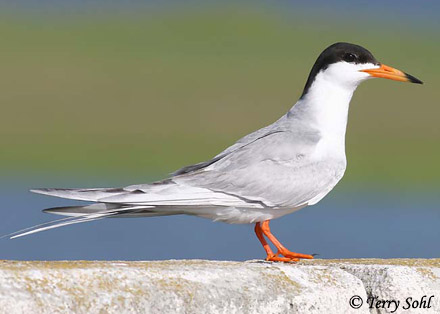
Forster's Terns are generally the most common of the black-capped, gray-backed, white bodied terns found in the state. Very similar to the Common Tern, the Forster's Tern is also the more common breeder in the state, generally being found around freshwater marshes, and often nesting on the top of muskrat houses. Differentiating between Forster's Terns and Common Terns can be difficult unless seen well (see identification tips down below). Forster's Terns may also sometimes be seen with Black Terns, with mixed nesting colonies of the two species relatively common.
Habitat
The Forster's Tern inhabits freshwater and brackish marshes, shallow lakes, prairie potholes, wetlands, estuaries, and coastal lagoons. During the breeding season, it favors marshes with extensive emergent vegetation such as cattails, bulrushes, and reeds that provide nesting sites and shelter. Outside the breeding season, it is commonly found in coastal bays, estuaries, salt marshes, and other nearshore marine habitats.
Diet
The Forster's Tern feeds primarily on small fish, which it captures by hovering and plunge-diving into shallow water. It also consumes aquatic insects, crustaceans, tadpoles, and other small aquatic animals when available. Most foraging occurs over marshes, lakes, estuaries, and coastal waters, where the bird hunts with agile, buoyant flight.
Behavior
The Forster's Tern is a graceful and highly aerial bird that spends much of its time flying over wetlands and open water in search of prey. It commonly hovers before plunge-diving to capture fish and often nests in loose colonies with other terns and marsh-nesting birds. During the breeding season, adults aggressively defend nesting areas and will dive at intruders that approach too closely.
Nesting
June and July in South Dakota. The nest of a Forster's Tern is typically placed on the ground in the cover of vegetation, including dead marshland vegetation, nearby meadow grasses, or even on the top of a Muskrat lodge. The nest consists of a small platform of grasses, lined with finer vegetative material. The female lays between 1 and 3 eggs, with both sexes helping to incubate them. The young hatch after about 24 days.
Song
A variety of vocalizations, including a sharp kyeer and a grating grreee.
- Click here to hear the sharp kyeer calls of a Forster's Tern1
- Click here to hear the agitated grating greeee calls of a Forster's Tern2
Migration
Summers in scattered locations throughout the U.S. (including parts of northeastern South Dakota) and southern Canada. Winters along U.S. coastlines and points south, but is generally not as much of a long-distance migrant as its close relatives.
Interactive eBird Map
Click here to access an interactive eBird map of Forster's Tern sightings
Similar Species
Similar in appearance to multiple other tern species, with one in particular potentially causing an identification concern in South Dakota
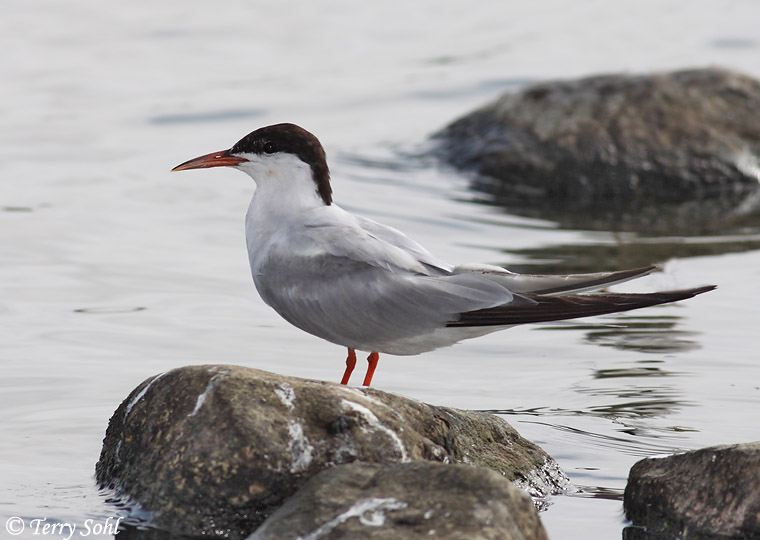
- Common Tern - Both Common Terns and Forster's Terns may be present in South Dakota at the same time. In breeding plumage, Common Terns have a thinner, dark reddish bill, while the bill of a Forster's Tern is slightly thicker are more orangish. The breast of a breeding plumage Common Tern is grayish in tone, while it's whiter on a Forster's Tern. In flight, Common Terns appear to have a darker wingtip than a Forster's Tern. For non-breeding birds, the extent of black on the head differentiates the species. On a Common Tern, the black is more extensive and may extend to the back of the nape. On a Forster's Tern, the black is confined to an oval-shaped mask on the face.
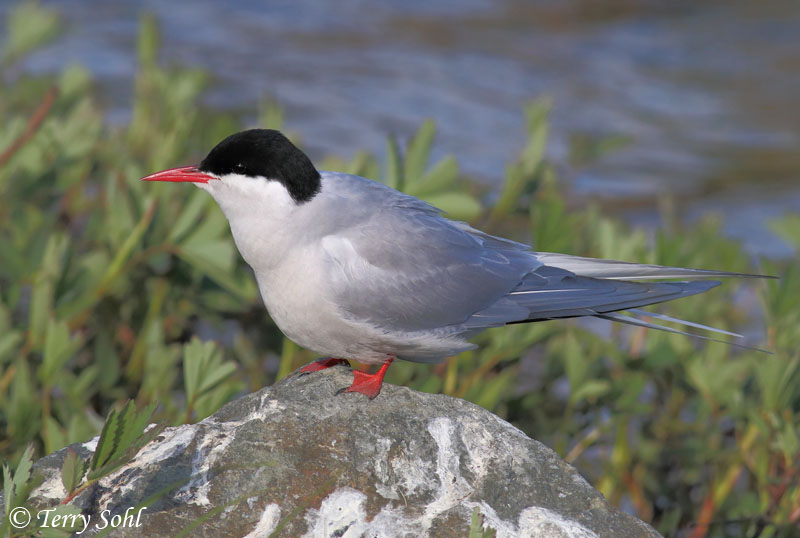
- Arctic Tern - An extremely rare visitor to South Dakota, with sightings occurring near the dams on the Missouri River Basin. Breeding plumaged Arctic Terns have a thin reddish bill (orangish on a Forster's Tern). At rest, the very short (and reddish) legs are obvious on an Arctic Tern (compared to orange, longer legs on a Forster's Tern). On non-breeding plumaged birds, the black mask on an Arctic Tern extends backward to the back of the neck, while the black on a Forster's Tern is confined to a black facial oval.
 |
 |
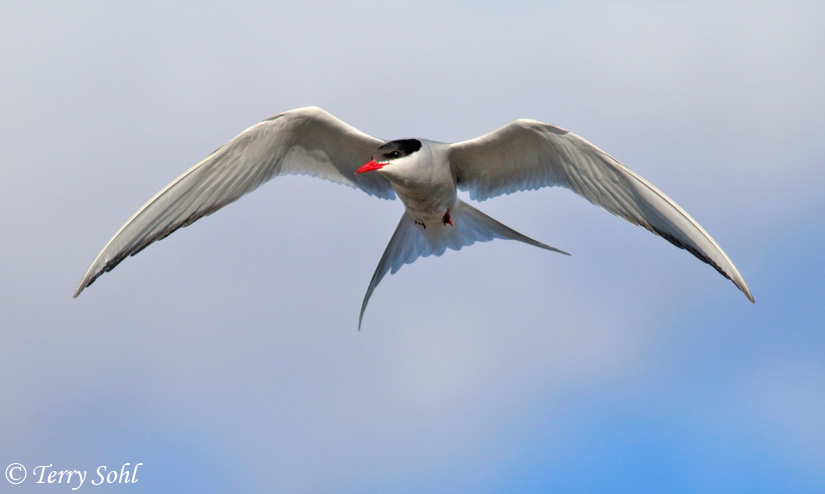 |
| Common Tern | Arctic Tern | Arctic Tern |
Conservation Status
Has declined in portions of its range, probably due to habitat loss. However, overall populations are stable or may actually be increasing, and they are found across a very broad geographic range. The IUCN considers the Forster's Tern to be a species of "Least Concern".
Photo Information
June 23rd, 2005 - Assateague Island in Virginia - Terry Sohl
Audio File Credits
-
1David Darrell-Lambert. Recorded in Essex County, Ontario on May 14th, 2019. Original file and recording from xeno-canto.
-
2Paul Marvin. Recorded in Barton County, Kansas on May 24th, 2015. Original file and recording from xeno-canto.
