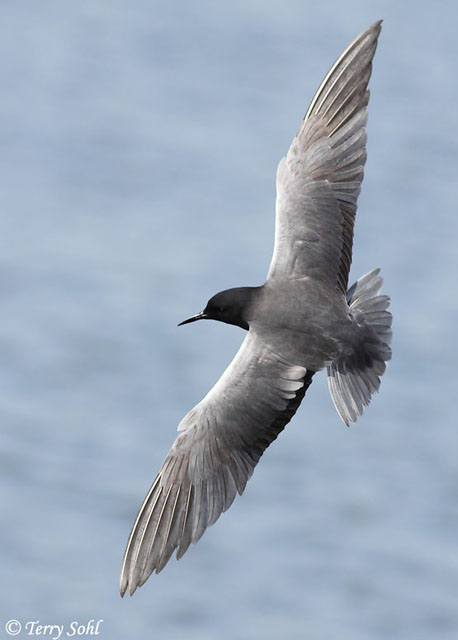
A black bodied tern that is easily identifiable in South Dakota, especially in its dark breeding plumage. The bird at the right is an adult, breeding plumaged bird, with a black body and silvery-gray wings. Non-breeding birds are much lighter in coloration, with white underparts and head, gray wings, and a small amount of black on the back of the head. Black Terns lead a unique life, nesting on freshwater marshes in the interior of North America, while wintering at sea around South America. They gracefully pluck food items in flight from the surface of the water. They will also chase flying insects, doing much of their foraging over aquatic habitats, but they will also forage over nearby terrestrial habitats. As with some other gull and tern species, they will sometimes follow farm equipment to pursue insects that are stirred up.
Habitat
Diet
Behavior
Forages while in flight, dipping down to the water's surface to grab food, or also by catching insects in mid-air.
Nesting
Interactive eBird Map
Song
- Click here to hear the call of a Black Tern1
- Click here to hear more calls of a Black Tern2
Migration
Summers in much of the northern Great Plains, the Great Lakes, and western U.S., as well as southern Canada. Winters along northern coasts of South America.Similar Species
Generally distinctive compared to other tern species in North America. Very similar to the White-winged Tern, a Eurasian species that is a rare vagrant to North America.South Dakota "HotSpot"
Black Terns are not particularly difficult to find in the eastern part of the state. They usually start arriving in early- to mid-May, and and migrating birds can be found into September. The wetland habitats of the Prairie Pothole region in eastern South Dakota are great locations to look. The area around Lake Thompson in Kingsbury County and the Highway 81 lakes north of Madison have always been good places to find Black Terns during the right time of year.
Conservation Status
Populations have declined sharply in the past 40 years, likely due to drainage of wetlands required for nesting. Farm chemical runoff is another possible reason. Despite population declines, they are still found over a wide geographic area, and are common in some areas. The IUCN lists the Black Tern as a species of "Least Concern".Further Information
- eBird - Black Tern
- Audubon Field Guide - Black Tern
- Cornell Lab of Ornithology - All About Birds: Black Tern
Photo Information
May 14th, 2010 - Lake Whitewood in South Dakota -- Terry SohlAdditional Photos
Click on the image chips or text links below for additional, higher-resolution Black Tern photos.Audio File Credits
- 1Ad Postma. Recorded in the Netherlands on June 18th, 2018. Original recording and information available from xeno-canto.
- 2Isain Contreras Rodriguez. Recorded in Sinaloa, Mexico on June 19th, 2020. Original recording and information available from xeno-canto.

ALL PHOTOS COPYRIGHTED. Click below if you have interest in any of these photos for: