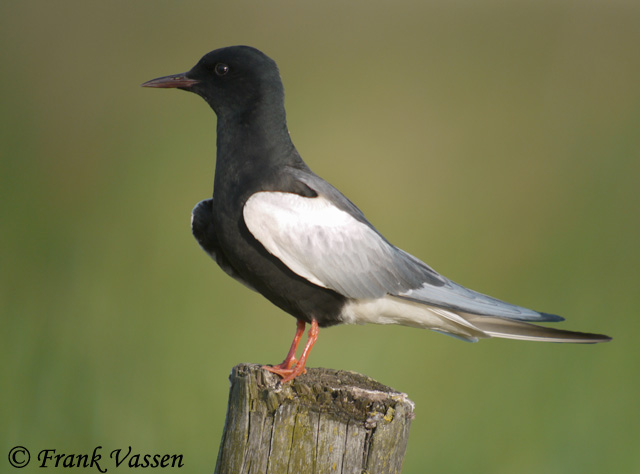
ID Keys: Breeding plumage: black body, head, and neck, wings white
above and dark below. Non-breeding birds white with gray wings,
small amount of black on head.
The
White-winged Tern is a Eurasian species that is very similar to North
America's Black Tern. Here, they are
but rare vagrants, with most sightings occurring near the Great lakes and
along the north Atlantic Coast of the United States. When seen in
North America, they are typically found in flocks of Black Terns.
There is a record of a White-winged Tern breeding with a Black Tern in
Canada. Hybrids of the two species have also been noted in Europe.
Habitat
Found on freshwater wetlands and lakes
during the summer breeding season. In winter and in migration, may be
found in and around a variety of aquatic habitats, including coastal areas.
Diet
Mostly feeds on insects, but will also
sometimes take other small food items such as amphibians and small fish.
Behavior
Foraging is done while in flight, with
birds capturing insects in mid-air, dipping down to grab food items at the
water's surface, or hovering while grabbing food items from the water's
surface or wetland vegetation.
Nesting
Colonial nester, breeding in small
colonies of up to 100 pairs. The nest of a White-winged Tern is a
depression on a mound of wetland vegetation. The female lays 2 or 3 eggs.
Song
Has a short, harsh 'kek' call.
Migration
Breeding range is in central Europe
through central Asia, and locally in eastern Asia. Winter range of the
White-winged Tern includes Africa, the Middle East, India, Southeastern
Asia, and the Australian region.