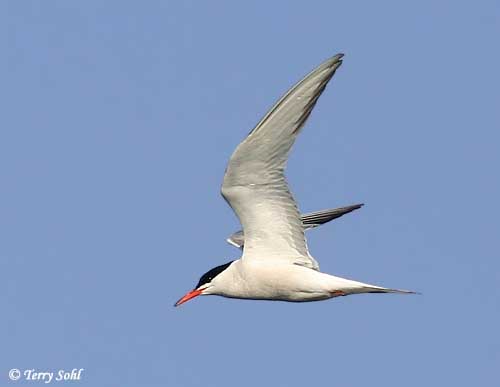
The Common Tern are so-named because they are the most common tern in much of the Northeastern U.S. In much of the inland portion of the continent, they are outnumbered by the very similar Forster's Tern. They were hunted to near extinction in the 1800s for their "fashionable" feathers, but rebounded in the 1900s. As larger predatory gulls have learned to co-exist with human populations and thrive on their refuse, the Common Tern has once again suffered population declines from predation in the latter half of the twentieth century.
Habitat
The Common Tern inhabits a wide variety of coastal and inland aquatic environments, including ocean shorelines, estuaries, bays, beaches, salt marshes, large lakes, reservoirs, rivers, and wetlands. It nests on sandy or gravelly islands, beaches, dredge-spoil islands, and other open sites with sparse vegetation near water. During migration and winter, Common Terns occur along coasts and large inland waters where small fish are abundant.
Diet
The Common Tern feeds primarily on small fish such as minnows, herring, sand lance, smelt, and other schooling species. It also eats aquatic insects, shrimp, crustaceans, squid, and other small marine or freshwater prey. Common Terns typically hunt by hovering over the water and then plunge-diving to capture prey near the surface.
Behavior
Primarily feeds by hovering over water to spot prey, and then plunging below the surface to catch it. They are also accomplished thieves and will sometimes steal fish and other prey from other Common Terns or other gull and tern species.
Nesting
June in South Dakota. Common Terns are colonial nesters, using areas near water with a surface of sand, gravel or small pebbles. The nest is a simple scrape on the ground, lined with vegetation, bits of shell or stone, or other material. The female lays between 1 and 3 eggs, and both she and the male help to incubate them. The young hatch from the nest after 21-25 days.
Song
The Common Tern gives a variety of sharp, penetrating calls, most notably a harsh, rolling “keer,” “kee-arr,” or “kree-ah” that carries long distances over water. Around nesting colonies, birds are often highly vocal, producing repeated alarm calls, chatter notes, and scolding vocalizations used for communication and defense of nesting territories.
Click here to listen to the flight call of a Common Tern (audio courtesy of Jerome Fischer).
For a harsh descending alarm call (click here to hear it, audio courtesy of Annette Hamann).
Migration
The Common Tern breeds across much of North America, Europe, and Asia in coastal and inland wetland habitats. After breeding, North American populations migrate south along the Atlantic, Gulf, and Pacific coasts to winter primarily along the coasts of Central and South America, while Eurasian populations winter in Africa, southern Asia, and Australia. This species is a long-distance migrant, and some individuals travel thousands of miles between northern breeding grounds and tropical wintering areas. In South Dakota, Common Terns occur primarily as migrants and rare localized breeders near suitable lakes, reservoirs, and large wetlands.
Similar Species
Forster's Tern. Forster's Terns are slightly paler overall and, in nonbreeding plumage, show a distinctive black ear patch separated from the eye, whereas the Common Tern retains a darker cap extending through the eye. Common Terns also tend to have a slightly darker gray body and a deeper red-orange bill with a more noticeable black tip during much of the breeding season.
Arctic Tern. Arctic Terns have a shorter bill, shorter legs, and noticeably longer tail streamers that often extend well beyond the wingtips when perched. Common Terns typically show a darker wedge on the outer primaries, while Arctic Terns appear paler and more uniformly gray beneath the wings, with a buoyant, graceful flight style.
Conservation Status
Numbers are much lower than historical levels due to hunting in the 1800s. Numbers rebounded in the first part of the 1900s, but the expansion in range and numbers of the large predatory gulls in the latter half of the century again caused reductions in their numbers. However, they are still found over a very broad geographic area, and they are common in parts of their range. The IUCN considers the Common Tern to be a species of "least concern".
Photo Information
July 18th, 2004 -- Below Oahe Dam -- Terry Sohl
Interactive eBird Map
Click to access the interactive eBird species sightings page for Common Tern
