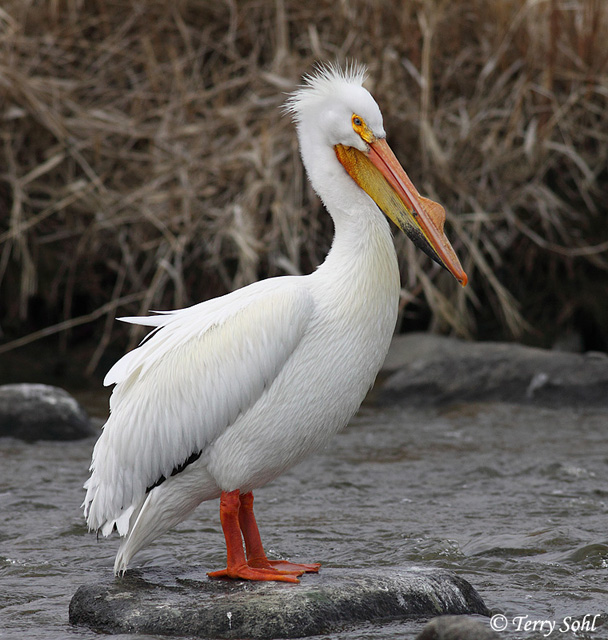
The American White Pelican is one of the largest birds found in South Dakota, and one of the heaviest flying birds in the world. They are migrants through most of the state, but do nest in some of the northeastern counties. Unlike their cousins, the Brown Pelican, American White Pelicans do not plunge dive, but feed by dipping their large pouched bill into the water and scooping up fish. Their massive bill and expansive pouch can hold up to 3 gallons of water, with the bird tipping the bill downward after a feeding scoop to drain water, prior to swallowing whatever fishy goody may have been caught inside.
Note the raised bump on the top of the beak, shown in the bird to the right and in many of the photos below, is only present during the breeding season.
Habitat
The American White Pelican inhabits large lakes, reservoirs, marshes, rivers, and shallow wetlands with abundant fish and open water for feeding. During breeding season it favors isolated islands in large inland lakes or prairie wetlands, while migrants and summering birds often gather on broad lakes, river systems, and reservoirs across the Great Plains and western North America.
Diet
The American White Pelican feeds primarily on fish such as carp, minnows, suckers, and perch, which it captures by cooperative group feeding in shallow water. It also occasionally eats salamanders, crayfish, and aquatic invertebrates.
Behavior
American White Pelicans feed by dipping their bill into the water and scooping up prey. They will often forage together in groups, lining up and driving prey fish to shallower waters for easier capture. While one of the heaviest flying birds, American White Pelicans are graceful in flight, often soaring on thermals in slow, ponderous, spiraling flight. The beautiful flight of an American Pelican was described by poet Aldo Leopold as follows:
Nesting
May through August. American White Pelicans are colonial nesters, usually nesting on isolated islands and sandbars that provide protection from predators. The nest of an American White Pelican is a depression on the ground, with a built-up rim of mud, rocks, and plants. The female lays 2 eggs, and both parents help to incubate them. Incubation lasts about a month, and when the eggs hatch, both parents help to feed the young. The young fledge at about 10 weeks.
Interactive eBird Map
Click to access an interactive eBird map of American White Pelican sightings
Song
Adult American White Pelicans are mostly silent, unless around the nesting site, or when feeling substantially threatened. Their vocalizations primarily consist of low, grunting or croaking noises. Young American White Pelicans at nesting colonies can be very vocal.
Migration
The American White Pelican migrates in large flocks between inland breeding colonies of the northern Great Plains and western North America and wintering areas along the Gulf Coast, southern Atlantic Coast, Mexico, and parts of Central America. During migration it commonly stops at large lakes, reservoirs, rivers, and wetlands throughout the central United States.
Similar Species
Brown Pelican, in terms of general structure. However, plumage differences are obvious and the two are not likely to be confused with each other if seen well. Surprisingly, the American White Pelican is white, while the Brown Pelican is darker. You could even say it has a brownish hue to it. :-)
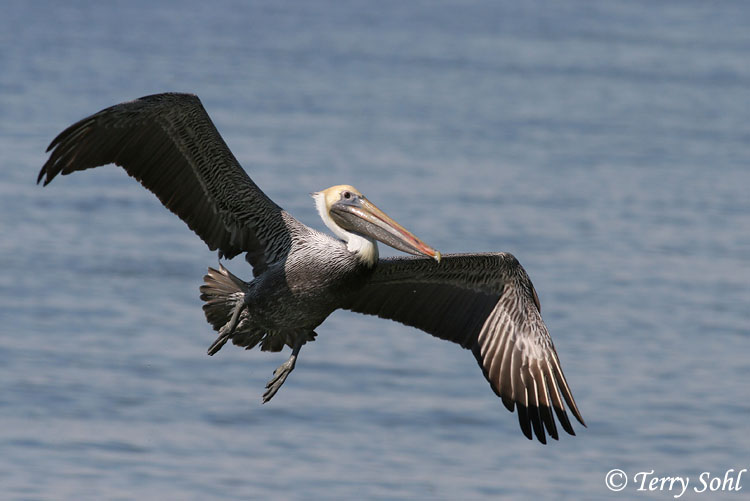 Brown Pelican
|
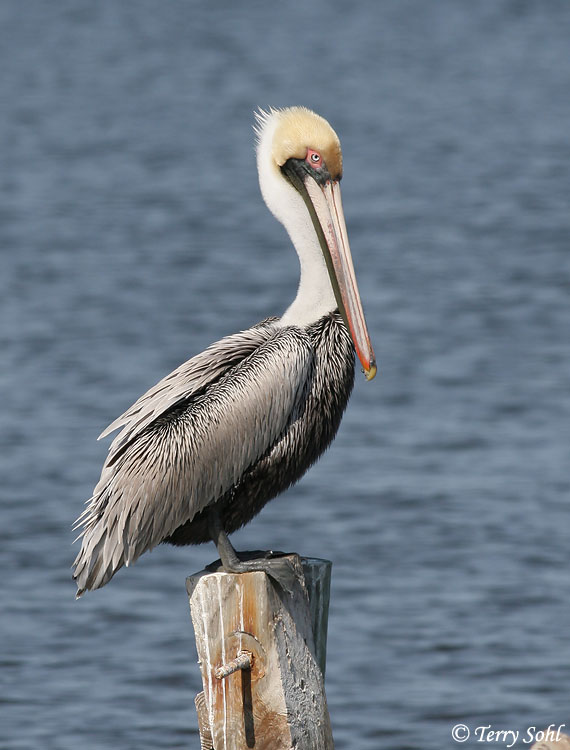 Brown Pelican
|
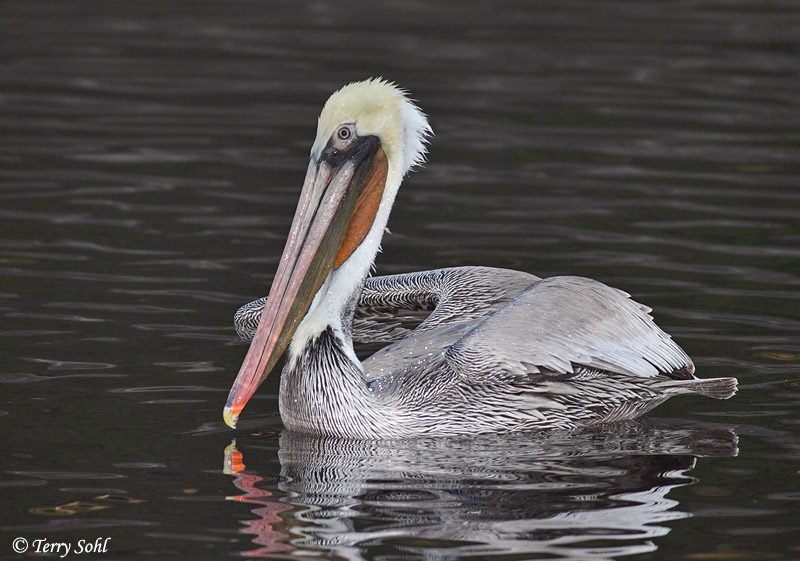 Brown Pelican
|
South Dakota Hotspot
In eastern South Dakota in April and May, American White Pelicans are typically rather easy to find as they migrate to their breeding grounds. The larger lakes of the prairie potholes region of eastern South Dakota are good places to look, but smaller ponds and wetlands too will often hold American White Pelicans, provided there is adequate space for retaking flight and prey are available. During the breeding season they can be found in and around many of the water bodies in the northeastern part of the state, including Sand Lake National Wildlife Refuge. In migration and during the post-breeding summer months, American White Pelicans are also often found below some of the Missouri River dams.
Status
Due to habitat loss and disturbance at nesting colonies, populations declined substantially up through the middle part of the 20th century. Numbers have increased in the past few decades. The species is listed as Least Concern in BirdLife International’s IUCN-associated data.
Further Information
- eBird - American White Pelican
- Audubon Field Guide - American White Pelican
- Cornell Lab of Ornithology - All About Birds: American White Pelican
Photo Information
April 21st, 2013 -- Lake Vermilion, South Dakota -- Terry L. Sohl
Audio File Credits
1 Andrew Spencer. Recorded in Weld County, Colorado on June 27th, 2009. Original recording and information available from xeno-canto.
