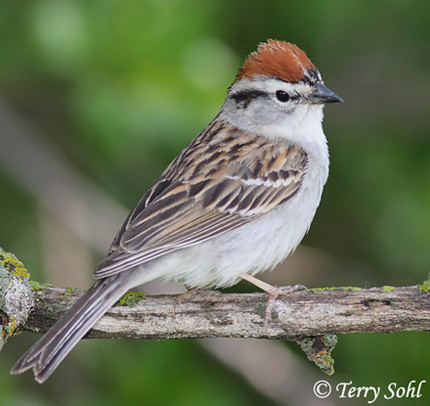
Chipping Sparrows are a very tame sparrow, well adapted to human presence. They now reside and nest in a very wide variety of habitats, including in urban settings. The name comes from the sparrow's song, as their rapid trilling is a very common sound in South Dakota during the summer months. These little birds are unfortunately common hosts to Brown-headed Cowbird parasitism, and it is not uncommon to see unwitting Chipping Sparrow parents raising Cowbird chicks that weigh three times as much as the parents.
Habitat
Found in semi-open habitats, usually with tree and other vegetative cover interspersed with open areas. This may include shelterbelts, riparian areas, woodland edges and clearings, and suburban parks, yards, and gardens.
Diet
They will feed on the seeds of grasses and weeds at all seasons, but the diet during the summer breeding season is mostly insects and spiders. Waste grain will be taken if available, and occasionally they may feed on small fruits and berries.
Behavior
Does most of its foraging on the ground, but will also forage in shrubbery and underbrush, as well as in lower levels of trees. While pairs are intolerant of other Chipping Sparrows during the breeding season, they will form loose flocks in migration and in winter.
Nesting
Mid-May through Mid-August. The nest of a Chipping Sparrow is a small cup, built in thick vegetation, and placed between 3 and 15 feet from the ground. The female alone builds the nest, constructed of grasses, weeds, roots, and other vegetative material. She lays between 2 and 6 eggs, and she alone incubates them. The young hatch after about 12-14 days, and fledge from the nest about 2 weeks after hatching. Chipping Sparrows will often raise more than one brood each summer, if conditions are favorable.
Song
The most common vocalization of a Chipping Sparrow is a repetitive, monotone trilling. The speed of the trilling may vary. Chip notes are also used as contact calls between birds,
- Click here to hear the trilling song of a Chipping Sparrow, recorded in Placer County, California1
- Click here to hear the chip calls of a Chipping Sparrow, recorded in Placer County, California2
Migration
Neotropical migrant, wintering in parts of the far southern U.S. through Mexico and Central America. In summer they are found throughout much of North America.
Similar Species
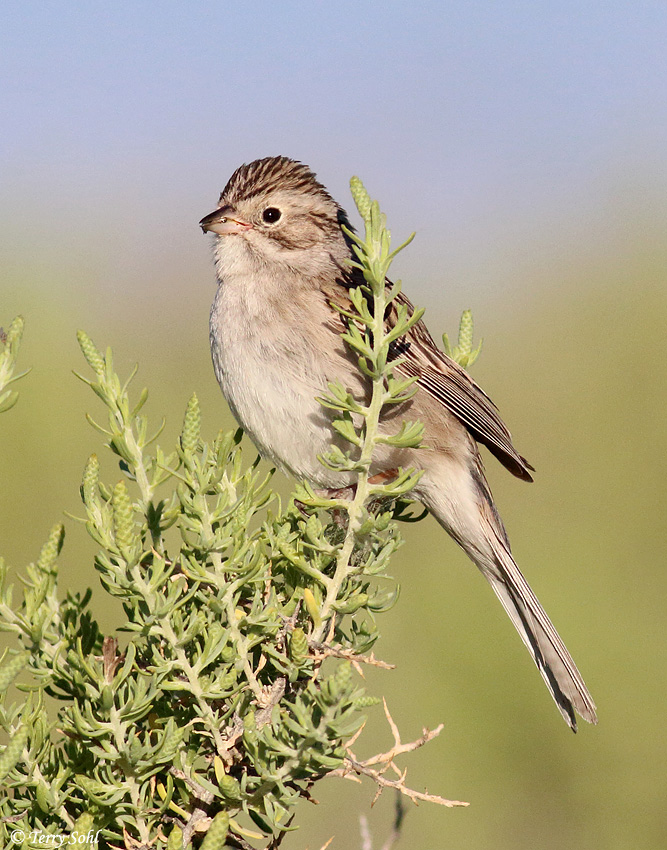
With the bright rufous-colored crown of a breeding plumage bird, along with the other plumage patterns on the head, Chipping Sparrows are relatively distinctive during the summer months. Young birds and winter plumage birds are perhaps more likely to be confused with another sparrow species. Here are some other species that may cause identification issues:
- Clay-Colored Sparrow - Chipping sparrows have a distinct dark eyeline both in front of and behind the eye, and rather distinct, thin white arcs around the eye. Clay-colored Sparrows lack the strong eyeline in front of the eye, and have less distinctive arcing around the eye. Clay-colored Sparrows in breeding plumage also have a thin dark "mustache" on the lower part of the cheek, while Chipping Sparrows. have gray cheeks and a white chin, but no distinct mustache between them.
- American Tree Sparrow - Seasonality is one way to differentiate between American Tree Sparrows and Chipping Sparrows, as American Tree Sparrows are only in South Dakota in the winter months, while Chipping Sparrows are a summer breeding resident. While they both share a rufous-colored crown, the American Tree Sparrow has a distinctive spot in the middle of its chest, the stripe behind the eye is rufous (black on a Chipping Sparrow), and the bill is two-toned with a yellow lower bill (more uniform black on a Chipping Sparrow).
- Field Sparrow - Field Sparrows are another summer breeding sparrow in South Dakota, and while they share the same rufous coloring on the crown, Field Sparrows have a much plainer face without an obvious eye-stripe (although they do have rufous coloring behind the eye). Field Sparrows also have an obvious white eye-ring, and a all-pinkish bill (black on a Chipping Sparrow).
- Brewer's Sparrow - Perhaps the species most easily confused with a Chipping Sparrow is a Brewer's Sparrow. Non-breeding plumage Chipping Sparrows lack the obvious rufous cap, and have a similar general appearance to a Brewer's Sparrow. A Chipping Sparrow however has a stronger dark eyeline. In general, Brewer's Sparrows are somewhat paler with less distinctive markings than a Chipping Sparrow.
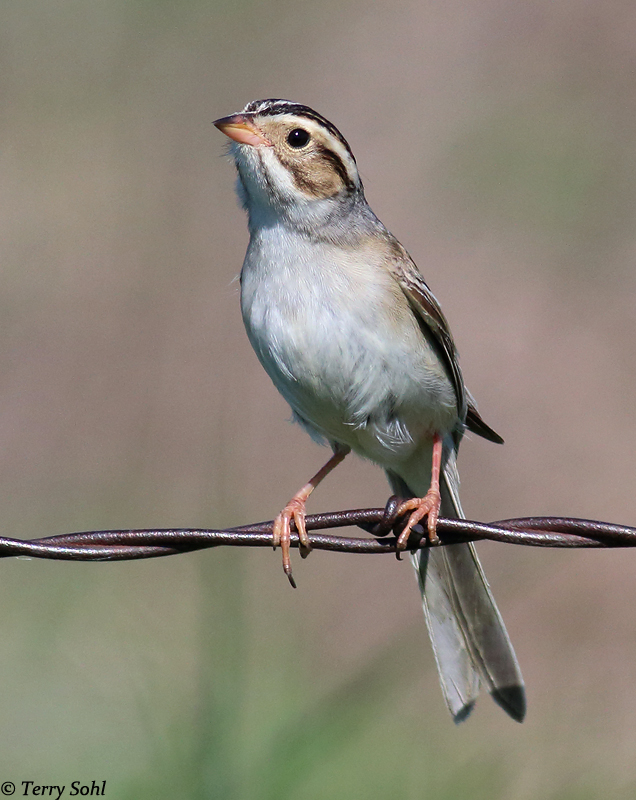 | 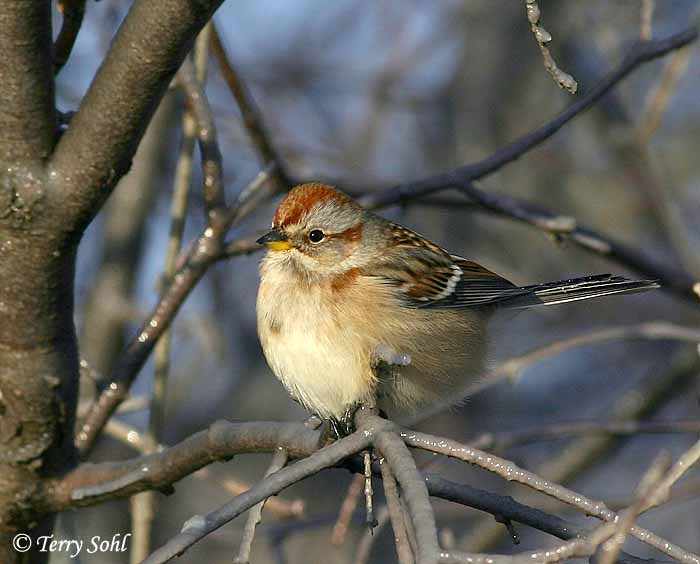 | 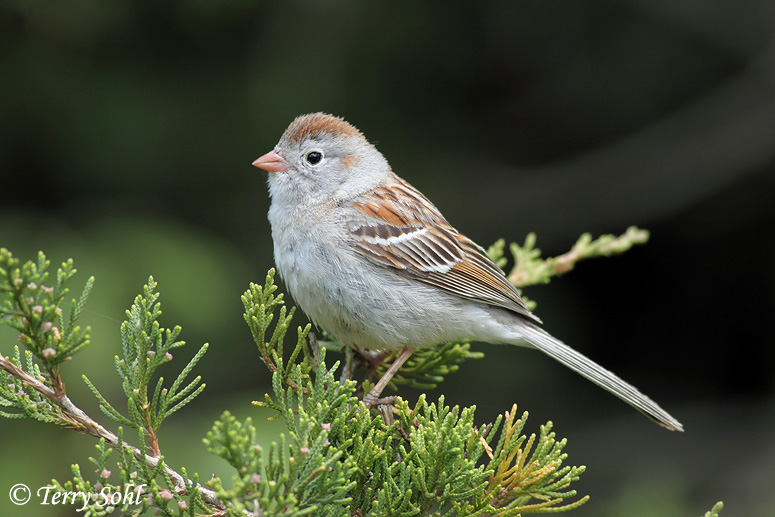 |  |
| Clay-colored Sparrow | American Tree Sparrow | Field Sparrow | Brewer's Sparrow |
Bird Feeders
Will attend feeders for various seeds and breadcrumbs.
Conservation Status
Chipping Sparrows are found across much of North America, and are quite common in many parts of their range. Breeding Bird Survey, Christmas Bird Count, and other records indicate the species is stable, or increasing in many areas. The IUCN considers the Chipping Sparrow to be a species of "least concern".
Photo Information
May 26th, 2011 - Beaver Creek Nature Area near Brandon, South Dakota - Terry Sohl
Audio Clip Credits
- 1Ed Pandolfino, XC444640. Accessible at www.xeno-canto.org/444640
- 2Ed Pandolfino, XC444639. Accessible at www.xeno-canto.org/444639
Interactive eBird Map
Click to access the eBird species page for Chipping Sparrow
