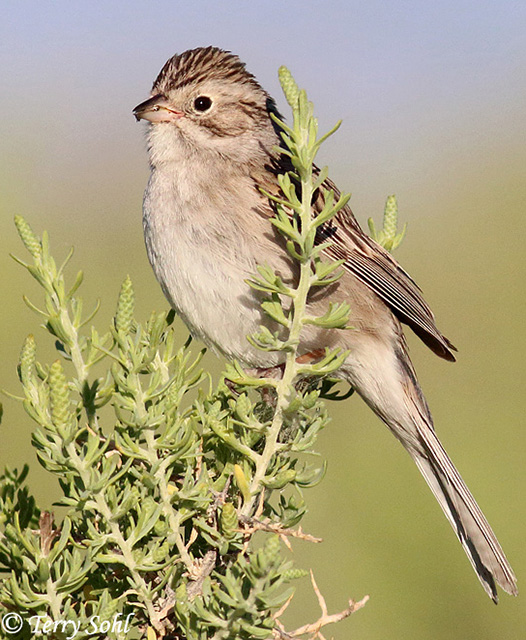
The Brewer's Sparrow is a rather non-descript resident of sagebrush flats of the western U.S. Quite common throughout the West, a jumbled chorus of multiple singing males is a common sound near sunrise and sunset. They usually don't spend a great deal of time on their summer breeding grounds, with some spending more than nine months a year on their wintering grounds. Populations of Brewer's Sparrows are found in two distinct habitats. Most are found in dry sagebrush habitats, but there is a "timberline" form of the Brewer's Sparrow that lives in higher elevation alpine meadows. The timberline Brewer's Sparrows are found in high elevation areas of the Rocky Mountains of the western US and southwestern Canada, but there's one disjunct population that breeds hundreds of miles north from other breeding locations, in the Yukon area of Alaska. Some have called for the timberline form of the Brewer's Sparrow to be split into a distinct species.
Habitat
Sagebrush, other brushy grasslands, open woodland, or shrubby forest edges. Note the "timberline" form of a Brewer's Sparrow is found in high alpine meadows in the western part of North America.
Diet
The spring and summer diet is primarily insects, while the fall and winter diet is primarily seeds. Used to dry habitats, they can survive for long periods without drinking.
Behavior
Primarily forages on the ground or low in brush and shrubbery. Brewer's Sparrows are sociable in most seasons other than when nesting, foraging in flocks.
Nesting
June and July. The nest is a small cup built of grasses, weeds, twigs, and other fine vegetative material. The female usually lays 3 or 4 eggs. Upon hatching, both parents help to feed the young. The young leave the nest within 10 days, but are still fed by the parents for a short time after fledging. In some areas, Brewer's Sparrows may raise more than one brood per breeding season.
Song
A descending series of varied trills and buzzes. The call is a thin, quiet tseet.
1Click here to hear the song of a Brewer's Sparrow
2Click here to hear the call of a Brewer's Sparrow
Migration
Summers throughout much of the western U.S. and portions of western Canada. Winters in the southwestern U.S., Mexico, and southward.
Interactive eBird Map
Click to access an interactive eBird map of Brewer's Sparrow sightings
Bird Feeders
Will come to feeders for baby chick feed, seeds.
Similar Species
Potentially confused with a number of other sparrow species:
- Clay-colored Sparrow - Probably the species most likely to be confused with a Brewer's Sparrow, Clay-colored Sparrows share many of the same plumage characteristics and patterns. Clay-colored Sparrows tend to be more richly colored, with buffy tones on the face, while the Brewer's Sparrow tends to be more drab and pale. Range is another key factor, as Clay-colored Sparrows may be found throughout South Dakota, while Brewer's Sparrows are (typically) confined to the far western edge of the state.
- Chipping Sparrow - As with the Clay-colored Sparrow, Chipping Sparrows are a widely dispersed species that may be confused with a Brewer's Sparrow. Chipping Sparrows tend to have more contrasting patterns in the plumage than a Brewer's Sparrow (which is again is generally more pale and plain looking). Chipping Sparrows also have a distinctive black line that extends not only behind the eye, but in front of the eye to the bill. Brewer's Sparrows have a darker marking found only behind the eye.
- Field Sparrow - A plain little sparrow, one that generally appears to have even simpler plumage characteristics than the Brewer's Sparrows. Field Sparrows have an obvious white eye ring that is more apparent than any eye ring found on a Brewer's Sparrow. The cap is one color of warm brown, with a similar colored mark behind the eye, while on a Brewer's Sparrow, the cap is flecked with contrasting light and dark tones.
Conservation Status
Populations are widespread, found across a very broad geographic area, with high population counts in parts of their range. Overall numbers are relatively stable, although consistent surveys such as the Breeding Bird Survey may show some modest declines in recent decades. The IUCN lists the Brewer's Sparrow as a species of "Least Concern".
Further Information
- eBird - Brewer's Sparrow
- Audubon Field Guide - Brewer's Sparrow
- Cornell Lab of Ornithology - All About Birds: Brewer's Sparrow
Photo Information
June 19th, 2018 - Alamosa National Wildlife Refuge, Colorado - Terry Sohl
Audio File Credits
1Ed Pandolfino. Recorded in Sierra County, California on June 1st, 2013. Original recording and information from xeno-canto.
2Andrew Spencer. Recorded in Gunnsion County, Colorado on July 5th, 2012. Original recording and information from xeno-canto.
