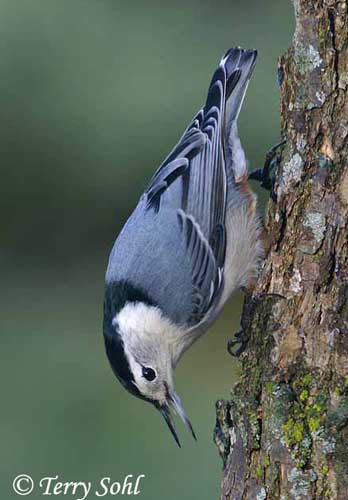
ID Keys: White face and neck, black head stripe and nape, blue-gray
upperparts
White-breasted
Nuthatches are a very common visitor to home feeders,
often forming mixed flocks with Brown Creepers, Chickadees, and Downy
Woodpeckers during the winter months. White-breasted Nuthatches are often seen foraging upside-down on tree trunks,
as in the photo on the right. They will take seeds and wedge them into
crevices in a tree's bark, using it to hold the food item while they break it
open with their beaks.
Habitat
Forests, woodlots, groves,
residential areas.
Diet
Mostly insects, also seeds. Eats mostly insects during summer,
supplementing with seeds in the winter.
Behavior
White-breasted Nuthatches nest in
cavities, and are usually quite territorial towards other nuthatches.
They will cache excess food in the cracks and crannies of tree bark for
retrieval at a later date.
Nesting
May through July. The nest of a
White-breasted Nuthatch is built in a cavity in a tree, and is a cup built of
grasses, strips of bark, twigs, and other material. The female usually
lays between 5 and 8 eggs, and she alone incubates them, with the male bringing
her food during the incubation period. When the eggs hatch, both parents
help tend to the young and feed them. The young fledge after about 3
weeks.
The species is very widespread and common, and faces no
immanent threats to their populations. Populations are thought to be
increasing in many areas, especially as they've become very accustomed to taking
advantage of feeders.
The IUCN lists the
White-breasted Nuthatch as a species of "Least Concern".
Feeders
Will attend feeders for suet, assorted
seeds, and peanuts.