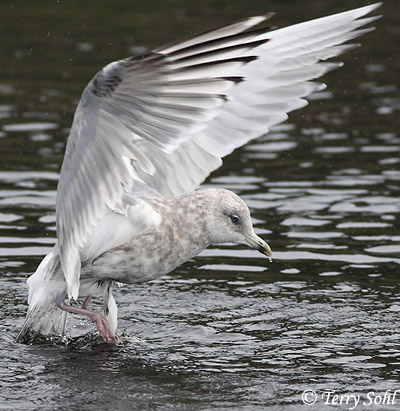
ID Keys: Light mantle, dark eyes, limited dark in wing-tips, shorter
thinner bill than similar species, pink legs
The Thayer's Gull was once
considered a slightly smaller sub-species of the Herring
Gull, and is very similar. Its status has been in flux for a number of
years, with some
still considering a race of Herring Gull, and others calling it and the
Iceland
Gull different races of the same species. Thayer's Gulls are typically
darker on the wingtips than Iceland Gulls, while Iceland Gulls may have very
little darker feathering in the wingtips. The "Kumlien's Gull" is
considered to be a hybrid of Thayer's and Iceland Gulls, and some consider
them all one species, ranging from the darker Thayer's in the west to the
lighter Iceland in the east. Thayer's Gulls also readily interbreed
with multiple other species on the West Coast, including Glaucous-winged and
Western Gulls, making identification of Thayer's Gulls and hybrid gulls even
more difficult. (NOTE: In 2017, the American Ornithological Union
officially eliminated Thayer's Gull as a distinct species, instead declaring
them to be a sub-species of the Iceland Gull).
Habitat
Summer habitat is rocky island
coasts in the Arctic. Winters primarily along coastal areas, including
areas well offshore. Will forage inland from the coast, but rarely found well
inland.
Diet
Wide variety of items,
including fish, squid, crustaceans, eggs and young birds, berries, carrion, and
refuse.
Behavior
Uses a variety of foraging techniques,
from dipping from the water's surface while in flight to grabbing food items
while swimming or walking on land. They will also forage at landfills
and refuse piles.
Breeding
Non-breeder in South Dakota. In their normal breeding range, Thayer's Gull nests on rocky Arctic cliffs, coastal ledges, and barren tundra islands, usually in loose colonies. The nest is a shallow scrape lined with moss, grasses, feathers, or seaweed, where the female generally lays 2–3 mottled eggs in early summer. Both adults share incubation and vigorously defend the site, while the chicks remain near the nest area under parental care until fledging several weeks later.
Song
Familiar gull's kee-yow
Migration
Summers in high Arctic. Most winter along the Pacific Coast. Rarely
ventures inland.