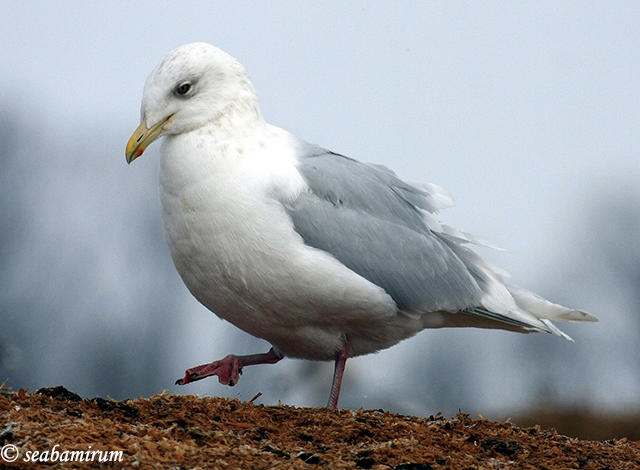
The Iceland Gull is a pale northern Gull, normally found in the Arctic in summer, and the northern Atlantic coast in winter. It only actually occurs in Iceland during the winter months. They are very closely related to the Thayer's Gull, and many believe them to be slightly different races of the same species. Iceland Gulls are typically found further east in North America, while Thayer's Gulls are typically found further west.
Habitat
The Iceland Gull breeds on rocky coastal cliffs, offshore islands, tundra, and fjords of Greenland and the eastern Canadian Arctic. During winter, it inhabits coastal shorelines, estuaries, harbors, beaches, mudflats, rivers, reservoirs, and large inland lakes. It is frequently found around fishing ports, landfills, and other areas where food is abundant, often associating with other gull species.
Diet
The Iceland Gull feeds primarily on fish, marine invertebrates, carrion, and the eggs and chicks of seabirds. It also consumes crustaceans, mollusks, insects, worms, berries, and a variety of human food waste when available. Like many gulls, it is an opportunistic feeder that readily scavenges around fishing vessels, harbors, beaches, landfills, and coastal shorelines.Behavior
The Iceland Gull is a graceful, adaptable gull that forages by walking along shorelines, swimming, surface-dipping, and scavenging. It often follows fishing boats, gathers at harbors and landfills, and associates with mixed flocks of other gulls during winter. Although generally less aggressive than many large gulls, it will readily steal food when opportunities arise and frequently roosts communally on beaches, sandbars, and open water.
Nesting:
The Iceland Gull nests on rocky coastal cliffs, offshore islands, ledges, and tundra near the Arctic coast, often in loose colonies or as isolated pairs. The nest is a shallow scrape or mound constructed from grasses, mosses, seaweed, feathers, and other vegetation. The female typically lays 2–3 olive or buff-colored eggs marked with dark brown spots, and both parents share incubation and vigorously defend the nest and chicks from predators.
Song
Clew-clew-clew, similar to a Herring Gull.Migration
The Iceland Gull is a partial migrant that breeds in Greenland and the eastern Canadian Arctic, then moves south after the breeding season to winter along the Atlantic coast of Canada and the northeastern United States, with smaller numbers reaching the Great Lakes and interior North America. Migration occurs primarily in late fall and early spring, although some birds remain in northern coastal waters where open water persists. During winter, Iceland Gulls often mix with other gull species at harbors, beaches, reservoirs, and landfills.Interactive eBird Map
Click here to access an interactive eBird map of Iceland Gull sightings