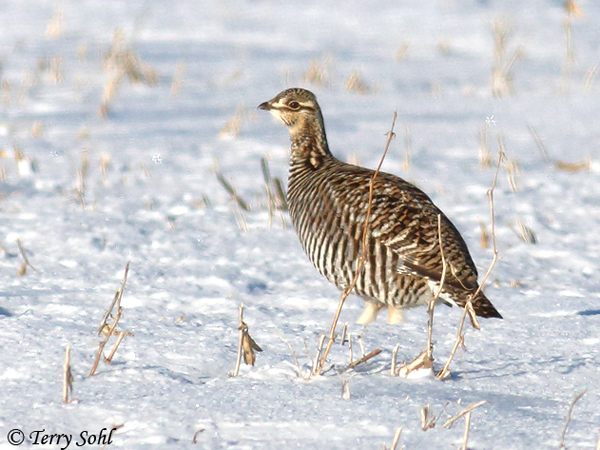
The Greater Prairie Chicken perform their spectacular booming displays every spring on traditional sites, called leks. Males have inflatable sacs on the sides of their neck which inflate during courting displays, and also have long feathers which are raised while displaying. Greater Prairie Chickens are much reduced in range and in numbers due to the loss of native tall-grass prairies. A former subspecies, the "Heath Hen" was once found along the East Coast, but the last ones were extirpated on Martha's Vineyard by the early 1930s. Another subspecies, "Atwater's Prairie Chicken" is found near coastal regions in Texas and is in serious danger of extinction. In South Dakota, however, they are relatively common in the central part of the state, so much so that hunting seasons are allowed for Greater Prairie Chickens.
Habitat
Requires relatively undisturbed prairie, originally living on natural tallgrass prairie. They can tolerate a small amount of agricultural land interspersed with prairie, but generally become less and less numerous as the percentage of agricultural land increases.
Diet
Primarily feeds on leaves, seeds, berries, and waste grain in the winter, as well as acorns where available. In the summer, these items are augmented by insects, especially when they are breeding and feeding young.
Behavior
The Greater Prairie-Chicken is a ground-dwelling grouse that spends most of its time walking through native grasslands while feeding on seeds, insects, and other vegetation. During spring, males gather on traditional display grounds called leks, where they perform elaborate courtship displays by inflating bright orange air sacs on their necks, raising elongated neck feathers, stamping their feet, and producing deep booming calls to attract females. Outside the breeding season, Greater Prairie-Chickens often form flocks and forage together across prairies and agricultural fields.
Nesting
May and June breeding in South Dakota, with lek displays occurring earlier. The nest itself is a simple depression on the ground, lined with grasses, feathers, and sometimes dead leaves or other vegetative material. The female lays between 6 and 15 eggs, and she alone incubates them. The young hatch after about 24 days.
Song
Long, low hooting from male in display. Both males and females also having clucking sounds.
- Click here to hear the display calls of a male Greater Prairie Chicken1
- Click here to hear multiple display Greater Prairie Chickens on a lek2
Migration
Generally a permanent resident, although individuals may move around within the same general area.
Interactive eBird Map
Click here to access an interactive eBird map of Greater Prairie Chicken sightings
Similar Species
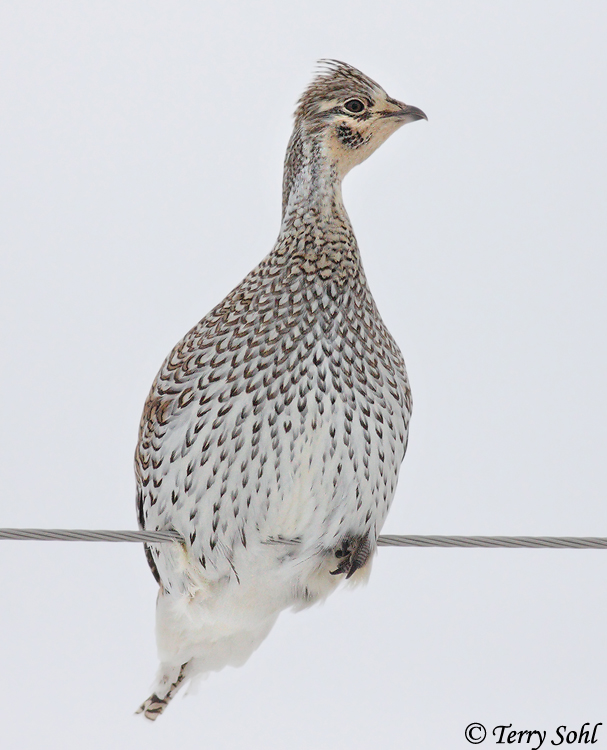
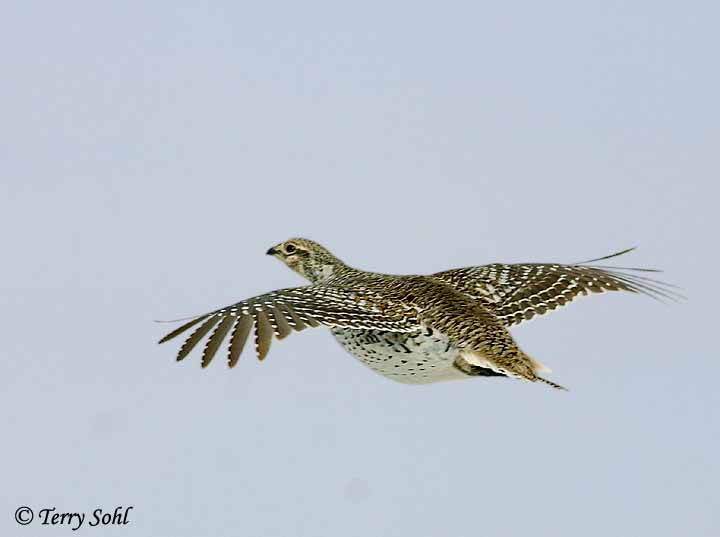
- Sharp-tailed Grouse. The most obvious difference between a Greater Prairei Chicken and a Sharp-tailed Grouse is the plumage on the underside of the body. Sharp-tailed Grouse have a series of chevron-shaped posts, while Greater Prairie Chickens have a horizontal barring. As the namesake implies, Sharp-tailed Grouse also have a very differently shaped tail, tapering to a point (very obvious if seen well in flight). In comparison, the tail of a Greater Prairie Chicken is more squared off and blunt. See the species comparison chart for additional tips on differentiating between Greater Prairie Chickens and Sharp-tailed Grouse.
- Lesser Prairie-Chicken also very similar, but the two species do not overlap in geographic range, other than a very small part of northwestern Kansas. Within that range, there are hybrids of the two species that are found.
 |
 |
 |
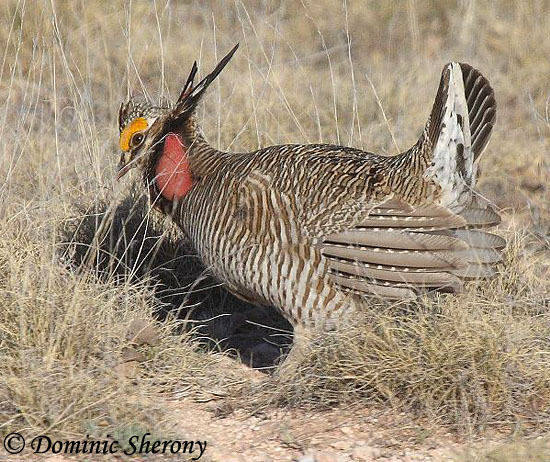 |
| Sharp-tailed Grouse | Sharp-tailed Grouse | Sharp-tailed Grouse | Lesser Prairie Chicken |
Status
The now Atlantic Coast race (the Heath Hen) is now extinct. Other races such as the Texas Coast race (Attwater's) is seriously endangered. Extirpated locally elsewhere, they are greatly reduced in number and in range from their historical numbers, with estimates that they have declined by more than 90% in the last four decades. Numbers continue to decline as grassland habitats are lost to human uses. They are still common in parts of Kansas, Nebraska, and South Dakota, but given the overall threats to the species, the IUCN classifies the Greater Prairie Chicken as a "near threatened" species.
Further Information
- eBird - Greater Prairie Chicken
- Audubon Field Guide - Greater Prairie Chicken
- Cornell Lab of Ornithology - All About Birds: Greater Prairie Chicken
Photo Information
December 27th, 2016 - Fort Pierre National Grasslands, South Dakota - Terry Sohl
Audio File Credits
- 1Ross Gallardy. Recorded in Yuma County, Colorado on April 12th, 2019. Original recording and information available from xeno-canto.
- 2Andrew Spencer. Recorded in Yuma County, Colorado on May 1st, 2011. Original recording and information available from xeno-canto.
