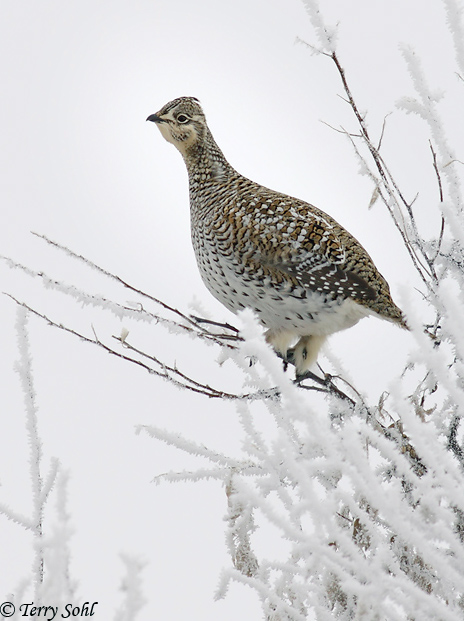
ID Keys: Body shape, chevron-shaped spots on underparts, white outer feathers on tail
in flight. Compare to Greater
Prairie Chicken .
The Sharp-tailed Grouse
has a very wide geographic range, from Alaska in the north southward through the
central Great Plains of the United States, and eastward through much of Canada
and the western Great Lakes in the U.S. They have disappeared from many
parts of their historic range, including California, New Mexico, Iowa, and
Illinoise. They are generally found in more northerly locations than its cousin, the
Greater Prairie
Chicken, but their ranges do overlap in parts of the northern Great Plains.
Males gather on leks (breeding grounds) in the spring to perform their breeding
displays, with tails up wings spread, and heads held low. Males have a
"inflatable" patch on the sides of the neck that is puffed up (and brilliantly
purple in coloration) during displays on the leks.
Habitat
Prefers grasslands and prairies
with scattered groves of trees or thickets. They generally prefer more
open habitats in the summer, and areas with more trees and bushes in the winter.
Diet
Feeds on a wide variety of plant
matter, including seeds, leaves, berries, waste grain, buds, and flowers.
They will also feed on insects in the summer, particularly when breeding and
feeding young.
Behavior
Primarily forages on the ground in the
summer months. Will feed more often in trees and shrubs during the
winter months, and can often be found roosting in trees (see photo to the
right!).
Nesting
May and June in South Dakota, with courtship
behavior on leks occurring earlier. The nest of a Sharp-tailed Grouse is a
simple depression on the ground, lined with feathers, grasses, leaves, and other
softer materials. The female lays between 6 and 16 eggs, and she alone
incubates them. The eggs hatch after about 22 days. Upon hatching, the
female looks after the young, but the young move about and find their own food.
Song
Odd hoots interspersed with soft wek
calls and chatters (chatters produced with feet stomping on the ground).
Migration
Generally a permanent resident, with small
local movements.
Has disappeared throughout parts of its
historic range due to habitat loss. They were once found in high numbers
in Iowa, Illinois, and elsewhere in the Midwest, but disappeared when grassland
habitats were converted to cropland. Similarly, habitat loss caused the
loss of breeding populations in California, New Mexico, and parts of Canada. Declines in range and population
are still occurring, again, primarily due to habitat loss. However, they
area still found over a very wide geographic area, and are quite common in many
parts of their range.
The IUCN currently lists the Sharp-tailed Grouse as a species of "least
concern".
Photo Information
December 19th, 2009 -- Fort Pierre National
Grasslands near Pierre -- Terry Sohl