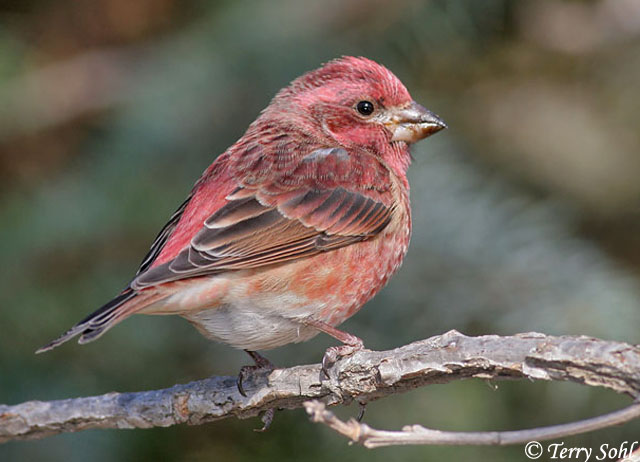
A winter visitor often seen at home feeders in South Dakota. Purple Finch populations in the East have been hard hit, first by competition with the introduced House Sparrow, and then by the introduction and spread of the House Finch in the East. The photo on the right shows the brightly-colored male, while additional photos of both males and females can be found at the bottom of the page.
Habitat
Prefers coniferous or mixed woods for breeding (outside of South Dakota). Found in a wide variety of habitats during migration and in winter, including forest edges and openings, brushy fields, and residential areas.
Diet
Primarily seeds in the winter, also some fruit and berries. Will occasionally feed on insects in the summer.
Behavior
Often gregarious outside of the breeding season, foraging in small flocks. Will forage at nearly any level, from the ground up through the forest canopy.
Breeding
Non-breeder in South Dakota. In their breeding range, the nest is a small cup built of weed stems, twigs, strips of bark, and other material, lined with softer material such as grasses or animal hair. The female lays between 2 and 7 eggs, and she alone incubates them. When the eggs hatch, both parents help to feed the young. The young leave the nest after about 2 weeks.
Song
Males sing a sometimes quite long, variable song of rich warbled phrases. Purple Finches also have a tick call and other variable vocalizations.
- Click here to hear the warbling song of a male Purple Finch, recorded in Washington County, Wisconsin1
- Click here to hear another song of a male Purple Finch, recorded in Quebec2
- Click here to hear the tick call of a Purple Finch, recorded in DuPage County, Illinois3
Migration
Summers in Canada, winters in the eastern half of the U.S. Also found in all seasons in the Northeast U.S., the Great Lakes area, and along the West Coast.
Interactive eBird Map
Click here to access an interactive eBird map of Purple Finch sightings
Similar Species
Purple Finches are similar in appearance to other small finch species that can be found in South Dakota.
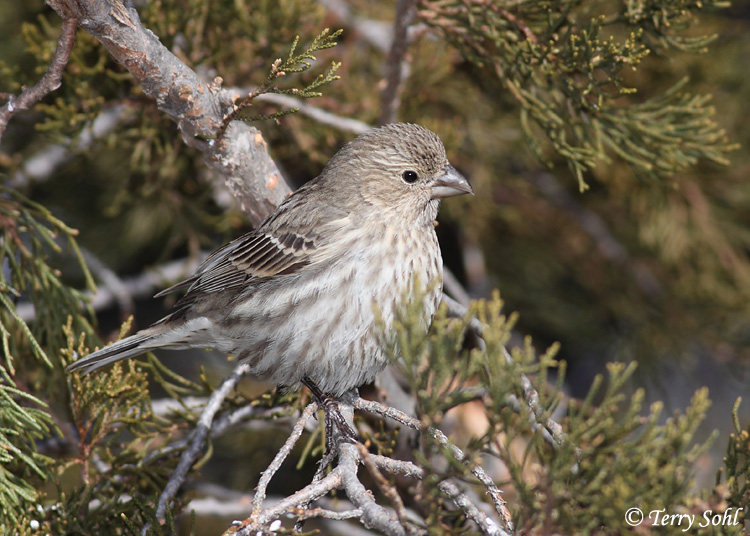
- House Finch - House Finch are the most widespread small finch on this list, found throughout the state at all seasons. Both males and females could easily be confused with their Purple Finch counterparts. Click here for a page that describes how to differentiate between the two species.
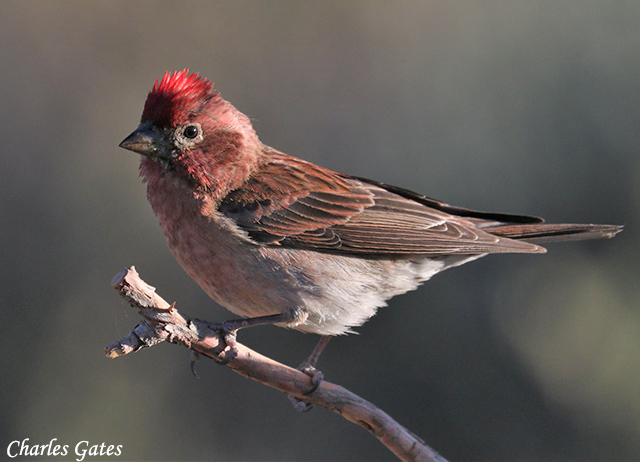
- Cassin's Finch - Cassin's Finch are only found in and around the Black Hills in South Dakota, where Purple Finch sightings are rare. In appearance, male Cassin's Finch have a pronounced, brighter-red crown. Male Cassin's Finch also are much plainer on their underparts, with less (or little) of the diffuse streaking on the flanks of a male Purple Finch. Female Cassin's Finch have finer, more distinct streaking than the diffuse streaking on a female Purple Finch. Female Cassin's Finch also lack the white "eyebrow" found on a female Purple Finch.
- Pine Siskin - A male Purple Finch is unlikely to be confused with a Purple Finch, as Pine Siskins lack any reddish tones. Females could be confused with Pine Siskins. Pine Siskins have varying amounts of yellow edging on their wing feathers and upper part of the tail, a pattern lacking on female Purple Finches. Pine Sikins also have sharper, more pointed bills than the heavier bills of a Purple Finch.
 |
 |
 |
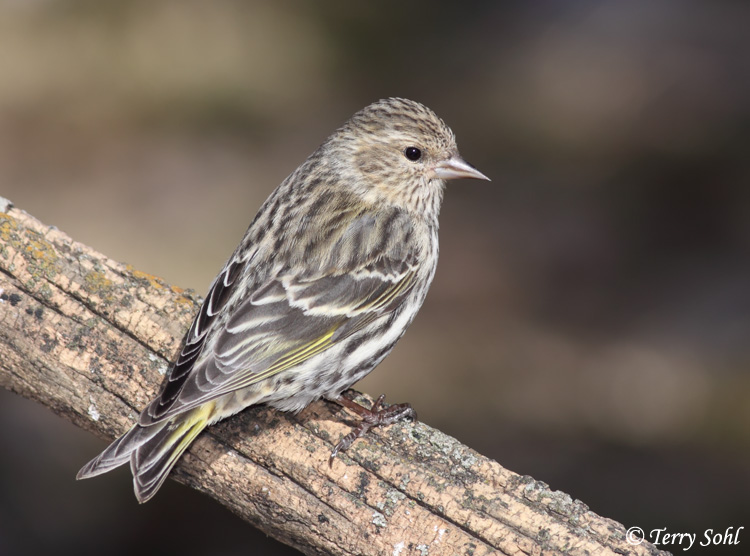 |
| House Finch (male) | House Finch (female) | Cassin's Finch | Pine Siskin |
Bird Feeders
Purple finches will readily attend feeders for sunflower seeds and millet, with sunflower seeds generally their preferred food. I've also had them at my niger seed feeder on occasion.
Conservation Status
There are undoubtedly declines in the Eastern United States due to competition with House Sparrows and House Finches. Records from Breeding Bird Survey and Christmas Bird Count both are indicative of a population decline. However, they are still relatively common and widespread, and the IUCN lists the Purple Finch as a species of "Least Concern".
South Dakota "Hotspot"
Purple Finches are very unpredictable winter visitors in South Dakota, and it's difficult to highlight a specific place where they can reliably be found. They are more commonly seen in the northeastern part of the state, and are rare in the west. The two types of places I have seen them are 1) natural areas with conifer trees, preferably, spruce, and 2) near feeder complexes.
Photo Information
November 15th, 2007 - Big Sioux Recreation Area near Brandon, South Dakota
Audio File Credits
- 1Todd Wilson, XC97357. Accessible at www.xeno-canto.org/97357
- 2Chris Parrish, XC13636. Accessible at www.xeno-canto.org/13636
- 3Matt Wistrand, XC342339. Accessible at www.xeno-canto.org/342339
