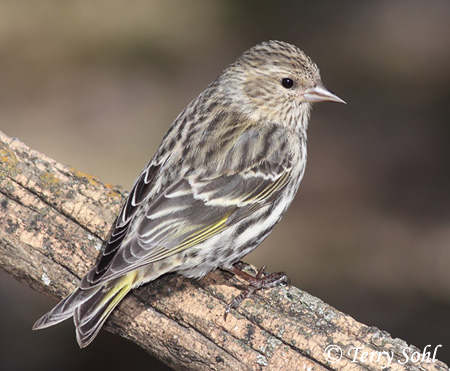
ID Keys: Brown upperparts, white underparts with heavy streaking,
yellow at edges of tail and wings
A tame gregarious winter
visitor throughout most of the state, although it may be found in all seasons in
the Black Hills. Pine Siskins behave very similarly as Goldfinches, and
are often found at home feeders with them. Pine Siskins are sometimes
attracted to sources of salt, and many may be killed on salted roads in the
winter.
Habitat
Prefers mixed or conifer forest during nesting season. Found in wide variety of habitats in winter and migration, including forest openings and edges, brushy fields, and residential areas.
Diet
Mostly seeds of trees such as birch and spruce, also other seeds, buds, flowers, nectar, and occasionally insects.
Behavior
Will forage at all levels and in all types of vegetation. They sometimes hang upside down, "chickadee style" as they forage for seeds. During migration and in winter, Pine Siskins can often be found in mixed species flocks, most often associating with American Goldfinches .
Nesting
April through July. The nest of a Pine Siskin is a cup built on a confer branch, anywhere from 8 to 50 feet above the ground. The female builds the nest of grasses, sticks, weed stems, leaves, and roots, and lines with materials such as hair, feathers, and mosses. Three to five eggs are laid, and incubation (carried out by the female) takes 12 to 14 days.
Song
Pine Siskin Song.
Migration
Winters throughout most of the U.S. Summers in Canada, the U.S. Rocky Mountains, New England, and the West Coast.
Interactive eBird Map
Click here to access an interactive eBird map of Pine Siskin sightings
Similar Species
House Finch , Purple Finch
Bird Feeders
Sunflower seed (preferably hulled), thistle seed, suet, and occasionally other seeds.
South Dakota "HotSpot"
While year-long residents of the Black Hills, the easiest way to find Pine Siskins is near feeder complexes. In most of the state, that only occurs during migration and in winter, and numbers can be quite sporadic, with some winters hosting many Pine Siskins at one location, but yet other winters where they're completely absent. In the Black Hills, I always see them at the feeders they typically have at the visitor's center at Pactola Reservoir.
Conservation Status
Widespread and very common, with numbers appearing to be stable. The IUCN considers the Pine Siskin to be a species of "Least Concern ".
Photo Information
February 16th, 2009 - Farm Island near Pierre, South Dakota -- Terry Sohl