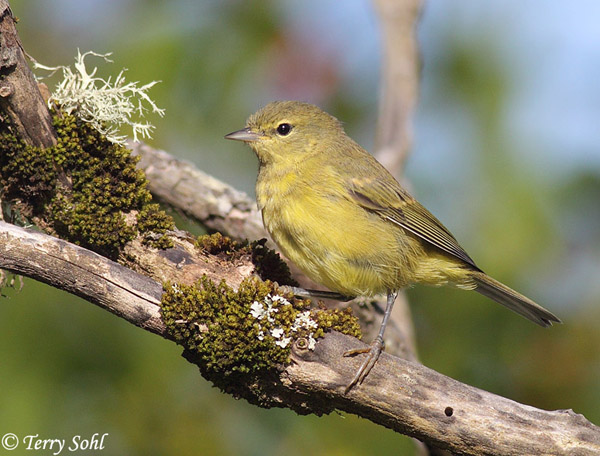
Orange-crowned Warblers are one of the plainest warblers that migrates through the state, with a name that is somewhat deceptive! A typical sighting of an Orange-crowned Warbler may leave a birder wondering if the bird is properly named, as the namesake feature is usually extremely difficult to see. Four sub-species are recognized in North America, with some sub-species relatively gray and dull, and others somewhat more colorful. They are usually more noticeable than some other warblers during migration because they often stay very low in trees and shrubs. Orange-crowned Warblers don't migrate as far south in the fall as most warblers, with many staying in the southern United States. In South Dakota, they are a migrant, and are often one of the most abundant migrating warblers in both the spring and fall.
Habitat
The Orange-crowned Warbler inhabits shrubby thickets, woodland edges, riparian areas, brushy clearings, and open forests with dense low vegetation. During migration it is commonly found in shelterbelts, parks, gardens, and weedy brushy habitats where it forages actively among shrubs and small trees.
Diet
The Orange-crowned Warbler feeds mainly on insects and spiders gathered from leaves, twigs, bark, and flower clusters in shrubs and trees. Its diet includes caterpillars, beetles, flies, aphids, and other small arthropods, while nectar and berries are occasionally eaten during migration and winter. Will also feed at sapsucker "wells" for tree sap, and eat berries, some other fruit, insects, and nectar.
Behavior
Orange-crowned Warblers often forage low in vegetation, but will forage at all heights. They clamber and flit through vegetation, gleaning insects from flowers, leaves, and tips of branches. They will also sometimes capture insects in flight.
Nesting
Non-breeder in South Dakota. The nest of an Orange-crowned Warbler is placed on the ground, or sometimes very low in a shrub. It is typically placed in a sheltered location, such as the base of a plant, a crack of a rock, or a sloped area. The female builds the nest, a cup that is constructed of leaves, grasses, and other plant fibers, lined with hair, feathers, or fine grasses. She lays 3 to 6 eggs, and she alone incubates them. Incubation lasts about 2 weeks, with young fledging from the nest in another 12-14 days.
Song
High thin trill, trailing downward in pitch at the end. They also have a sharp chip call note.
- 1Click here to hear the song of an Orange-crowned Warbler, recorded in DuPage County, Illinois
- 2Click here to hear the call of an Orange-crowned Warbler, recorded in Glacier County, Montana
Migration
Summers in Canada, Alaska, and the Rockies in the western U.S. Winters in the extreme southern U.S. and points south. In South Dakota, they are common migrants. Unlike many warblers, they will feed on berries or other fruit, and thus are typically one of the first warbler species to arrive in the spring, and one of the latest to leave in the fall, times when insects may be scarce.
Interactive eBird map
Click here to access an interactive eBird map of Orange-crowned Warbler sightings
Bird Feeders
Suet and peanut butter, sweet breads.
Similar Species
Orange-crowned Warblers are rather plain overall, with some variability. Overall, Orange-crowned Warblers generally have more yellow the further west they are found in North America. Those in the eastern part of the US often have a much grayer overall appearance, particularly the head. Overall, Orange-crowned Warblers could potentially be confused with the following species:
- Tennessee Warbler - Easily the species most likely to be confused with an Orange-crowned Warbler, Tennessee Warblers share the same overall olive coloring, without obvious or bright plumage details. Both species are migrants in South Dakota. The one definitive ID mark that differentiates the two species is that Orange-crowned Warblers have yellow undertail coverts (under the tail), while Tennessee Warblers have white undertail coverts.
- Common Yellowthroat (Female) - Male Common Yellowthroats are brightly colored with strong plumage details, and won't be confused with an Orange-crowned Warbler. Female Common Yellowthroats however can be confused with Orange-crowned Warblers, as both have yellow undertail coverts and rather plain bodies. However, Common Yellowthroat females tend to have yellow coloring only on their undertail coverts and near their throat, while Orange-crowned Warblers are more uniformly yellowish underneath. Female Common Yellowthroats also lack the thin, incomplete white eye-ring on a Orange-crowned Warbler, and are more brownish colored on their body than the olive tones on an Orange-crowned Warbler.
- Yellow Warbler - Female or immature Yellow Warblers are most likely to be confused with an Orange-crowned Warbler, as they're not as brightly colored as male Yellow Warblers. Both species may appear yellowish overall, but Orange-crowned Warblers have more of an olive tone on the upperparts, and the yellow on a female or immature Yellow Warbler is still more colorful than that of an Orange-crowned Warbler. The bill is also shorter and more stout on a Yellow Warbler
- Nashville Warbler - Female or immature Nashville Warblers may share a grayish head and yellowish underparts seen on many Orange-crowned Warblers. However, Nashville Warblers have a much more prominent and complete white eye-ring, and have more gray tones on their back as opposed to the olive or yellowish on an Orange-crowned Warbler.
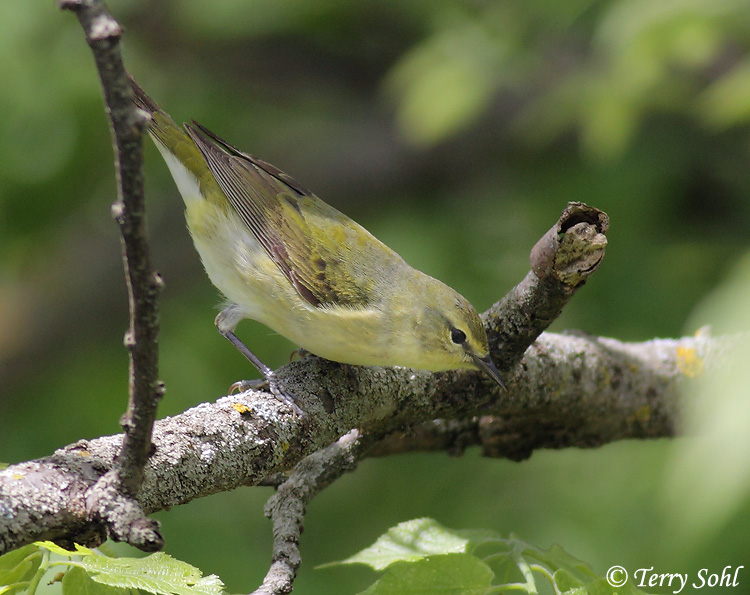 |
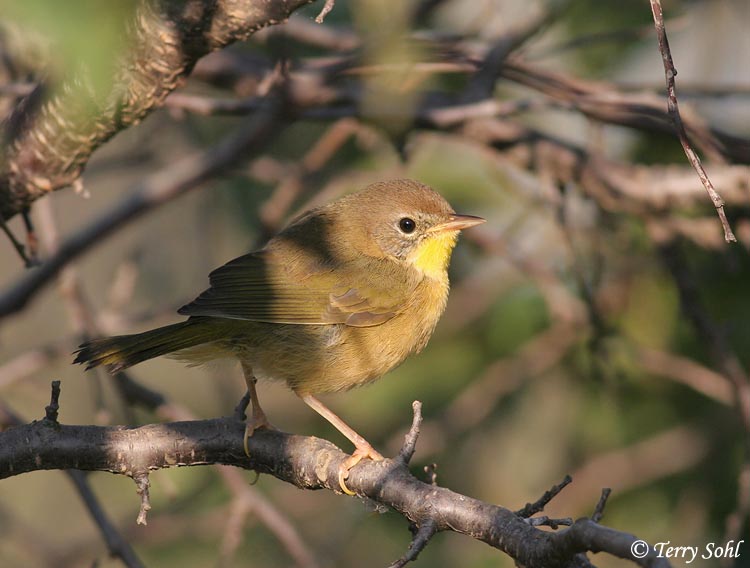 |
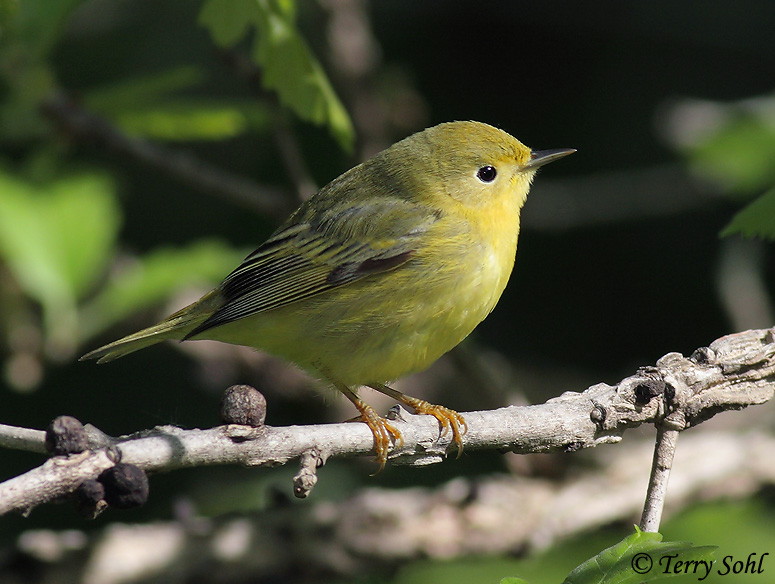 |
 |
| Tennessee Warbler | Common Yellowthroat | Yellow Warbler | Nashville Warbler |
Conservation Status
Generally stable throughout its range, with some indications that populations are increasing. They are found across a very broad geographic area, and are common in parts of their range. The IUCN considers the Orange-crowned Warbler to be a species of "least concern".
Photo Information
October 10th, 2004 -- Outdoor Campus in Sioux Falls -- Terry L. Sohl
Audio File Credits
- 1Matt Wistrand, XC366475. Accessible at www.xeno-canto.org/366475
- 2Thomas Magarian, XC388420. Accessible at www.xeno-canto.org/388420
