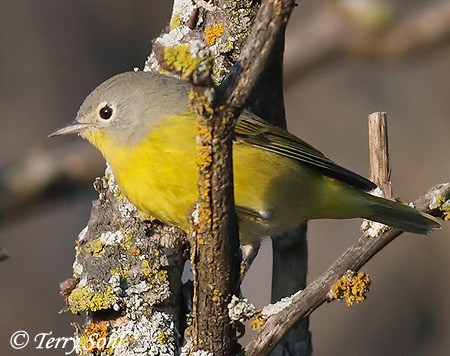
Nashville Warblers are named for the location at which the species was first documented, even though it is just a migrant through the Nashville area. They are more visible than many migrating warblers, as they generally forage rather low in brush or small trees. Two distinct breeding populations exist, one in the Pacific Northwest, and one in the upper Midwest, the Northeast, and southeastern Canada. Western populations used to be called another species, the "Calaveras Warbler".
Habitat
The Nashville Warbler inhabits open coniferous and mixed forests, shrubby woodland edges, regenerating forests, and brushy clearings during the breeding season. During migration it is commonly found in parks, shelterbelts, riparian thickets, gardens, and other leafy habitats with dense shrubs and low trees.
Diet
The Nashville Warbler feeds mainly on insects and spiders gathered from foliage and small branches in shrubs and trees. Its diet includes caterpillars, flies, beetles, aphids, and other small arthropods, with berries occasionally eaten during migration and fall.
Behavior
The Nashville Warbler is an active, restless forager that moves quickly through shrubs and low tree branches searching for insects. It often flicks its tail and may briefly hover while gleaning prey from leaves, especially during migration in mixed-species warbler flocks.
Nesting
Non-breeder in South Dakota. On their breeding grounds, Nashville Warbler females build a small cup nest on the ground, typically next to the base of a shrub or thick clump of herbaceous vegetation. The nest is constructed of twigs, moss, roots, and strips of bark, lined with finer grasses and animal hair. The female lays four or five eggs, with both parents helping to incubate them. The young hatch after about 12 days, and fledge from the nest about 10 days after hatching.
Song
The song of a Nashville Warbler begins with a series of sweet, two-note phrases, followed by a rapid trilling at a lower pitch. They have multiple short call notes.
- Click here to hear the song of a male Nashville Warbler1
- Click here to hear the short chip call of a Nashville Warbler2
Migration
Summers throughout the Great Lakes region, the northeastern U.S., parts of the northwestern U.S., and south-central and southeast Canada. Winters in Mexico and Central America.
Interactive eBird map
Click here to access interactive eBird map of Nashville Warbler sightings
Similar Species
Nashville Warblers have a somewhat similar appearance to a few other warbler species (all migrants in South Dakota)
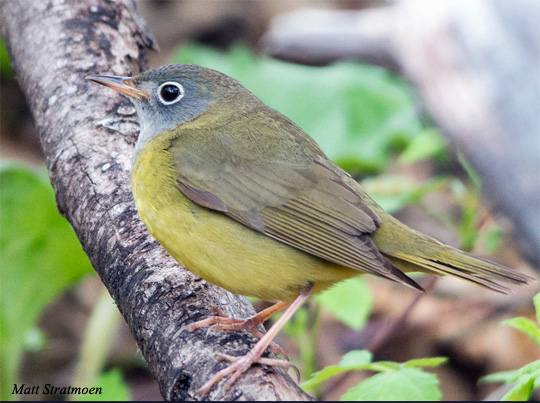
- Connecticut Warbler - Both Connecticut and Nashville Warblers have yellow underparts, gray on the head, a white eye-ring, and darker grayish or greenish upperparts. However, on a Connecticut Warbler, the gray is found on the forehead, face, and throat, while on a Nashville Warbler, the gray is found on the face, head, and back of the neck. Connecticut Warblers are a much less common migrant in South Dakota than Nashville Warblers.
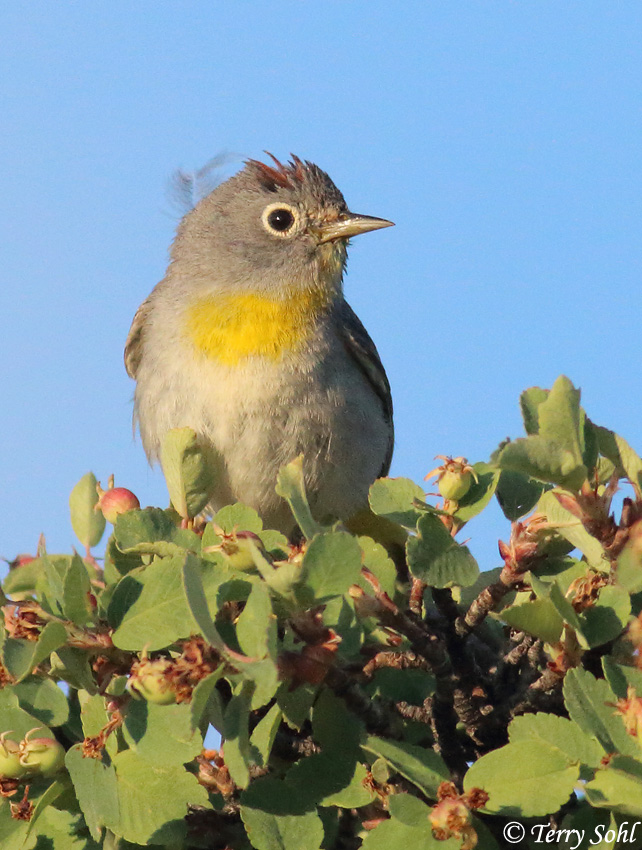
- Virginia's Warbler - Virginia's Warblers are found in South Dakota, but in the far southwestern part of the state where they breed in a few select spots. Nashville Warblers are primarily found in the eastern part of South Dakota, and only as migrants. In terms of appearance, they share the same bold white eyering, and a gray head with a chestnut crown. However, Virginia's Warblers have are primarily gray on their underparts (with a yellow chin), while Nashville Warblers are mostly yellow underneath.
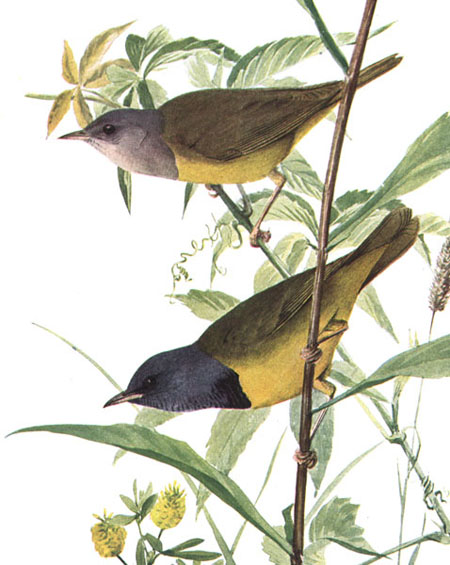
- Mourning Warbler - Another migrant in South Dakota, Mourning Warblers share some of the same plumage features as a Nashville Warbler, with yellow underparts, greenish upperparts, and gray on the head. However, male Mourning Warblers have darker gray on the head, with the dark gray stretching down across the throat as well. Male Nashville Warblers have a yellow throat. Female Mourning Warblers have a paler gray on the head that makes them more confusing compared to Nashville Warblers. However, the gray on the head extends across the throat (unlike the yellow throat on a Nashville Warbler).
 |
 |
 |
 |
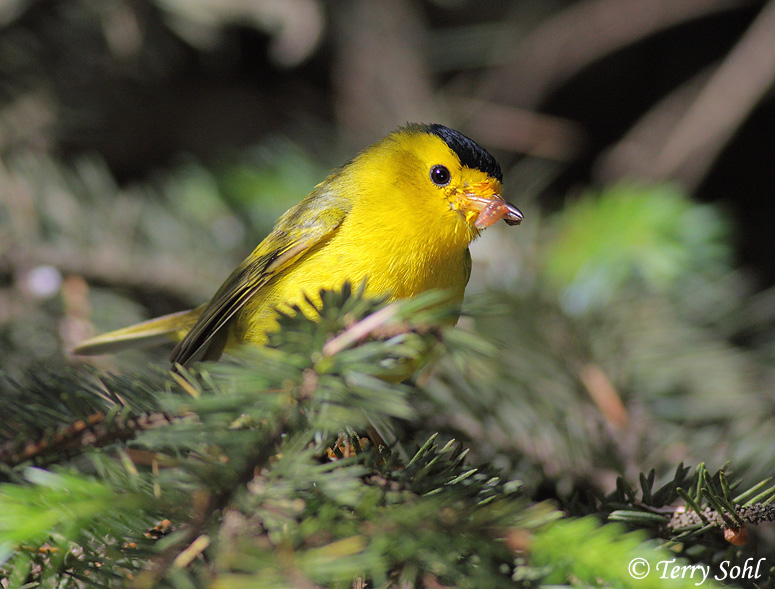
| Connecticut Warbler | Virginia's Warbler | Virginia's Warbler | Mourning Warbler |
Conservation Status
Nashville Warblers are found across a broad geographic area, and are common in parts of their range. Surveys over the last few decades show increases in overall populations. The IUCN considers the Nashville Warbler to be a species of "Least Concern".
Photo Information
September 2008 - Minnehaha County, South Dakota - Terry Sohl
Audio File Credits
- 1Ken Hall and Peter Ward. Recorded near Leavenworth, Washington on May 2nd, 1983. Original recording and information from xeno-canto.
- 2Frank Lambert. Recorded in Nayarit, Mexico on April 10th, 2015. Original recording and information from xeno-canto.
