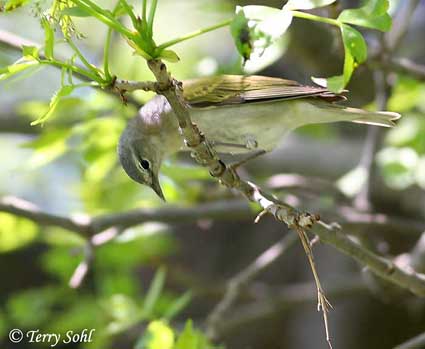
The Tennessee Warbler is a fairly plain warbler, common as a migrant through the state. Despite the name, the Tennessee Warbler is only found briefly in that state during migration. It was named by Alexander Wilson, who first found the species in the state of Tennessee in 1832. Populations of Tennessee Warblers often fluctuate wildly, following cycles of high and low spruce budworm populations.
Habitat
The Tennessee Warbler inhabits boreal coniferous and mixed forests during the breeding season, especially areas with spruce, fir, and dense understory vegetation. During migration it frequents woodlands, shelterbelts, parks, gardens, and shrubby habitats where it actively forages in trees and bushes.Diet
The Tennessee Warbler feeds mainly on insects and spiders gathered from foliage and small branches in trees and shrubs. Its diet includes caterpillars, flies, beetles, aphids, and other small arthropods, while nectar and fruit are also taken during migration and winter.Behavior
Forages on the outer canopy of forest areas, as well as in shrubby and weedy areas. Tennessee Warblers are fairly gregarious, forming loose breeding colonies in many locations, and often congregating in large groups during the winter months.Breeding
Non-breeder in South Dakota. In range, the Tennessee Warbler nests on or near the ground in boreal forests, usually concealed beneath shrubs, grasses, mosses, or fallen branches. The female builds a cup-shaped nest of grasses, bark strips, moss, and fine plant material lined with softer fibers and hair. Typical clutches contain 4–7 eggs, and the female performs most of the incubation.Song
The Tennessee Warbler sings a rapid series of high, sharp notes that often accelerate into a dry trill, somewhat resembling the song of a Chipping Sparrow. Calls include soft chips and thin tseep notes commonly heard while the bird forages actively through foliage.
Tennessee Warbler SongMigration
The Tennessee Warbler migrates between boreal breeding forests of Canada and wintering grounds in Mexico, Central America, the Caribbean, and northern South America. During migration it passes widely through eastern and central North America, frequently stopping in woodlands, parks, gardens, and shrubby habitats to feed on insects and nectar.Interactive eBird map
Click here to access an interactive eBird map of Tennessee Warbler sightingsSimilar Species
Easily confused with the Orange-crowned Warbler. The Tennessee Warbler is slimmer and grayer than the Orange-crowned Warbler, with a sharper pointed bill, cleaner whitish underparts, and a crisper pale eyebrow. Orange-crowned Warblers are more olive-yellow overall, usually show faint broken eye rings, and often have a slightly warmer yellow wash on the undertail and face.
Could also be confused with Warbling Vireo, Philadelphia Vireo. The Tennessee Warbler is much smaller and more active than both the Warbling Vireo and Philadelphia Vireo, with a thin pointed warbler bill rather than the thicker hooked bill of vireos. Warbling and Philadelphia Vireos move more deliberately through the canopy and have heavier bodies, while the Tennessee Warbler forages quickly and restlessly among leaves and twigs. Philadelphia Vireos are also brighter yellow below with darker lores creating a faint spectacled look, whereas Tennessee Warblers show a plainer face with a pale eyebrow stripe.
