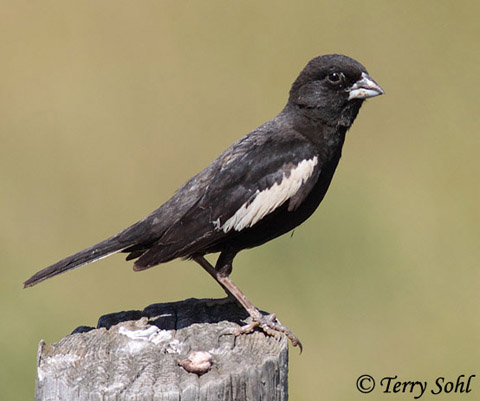
The breeding male Lark Bunting (pictured at right) is an unmistakable resident of shortgrass prairies of the Plains states, with an all-black body and bold white wing patch. They are the only sparrow species where males molt from a bold summer breeding plumage to a plainer winter plumage. They are gregarious birds, and are usually found in loose flocks and breeding colonies.
Habitat
Prefers to breed on native shortgrass prairies. Will also breed in sagebrush habitats if there is a sufficient understory of grasses. Can be found in a wide variety of open habitats during migration and in winter.
Diet
Primarily feeds on insects during the summer months. Seeds and waste grain become the primary food item during the winter months. They will also occasionally feed on small fruits.
Behavior
Primarily forages by walking or running along the ground. They will also pursue insects that are stirred up by flying after them and catching them in flight.
Nesting
June and July. The nest of a a Lark Bunting is a cup of grasses, weeds, plant down, and animal hair, placed on the ground in a protected area such as under a clump of grass or weeds. The female usually lays 4 or 5 eggs, and she does most of the incubation. When the eggs hatch, both parents help to feed the young. The young fledge after about 10 days.
Song
Repetitive low liquid whistling. The call is a clear wheet.
1Click here to here the songs of two males in close proximity
2Click here to here the calls of multiple Lark Buntings perched on a fence.
Migration
Summers throughout the Western Plains into southern Canada. In South Dakota, they are found in the western half of the state, with migrants and stragglers found much less often in the eastern half. Lark Buntings winter in the Texas, Arizona, New Mexico, and southward into Mexico.
Interactive eBird map
Click here to access an interactive eBird map of Lark Bunting sightings
Similar Species
Male Lark Buntings are rather distinctive, with the all black body and white wing patch. However, female Lark Buntings could potentially be confused with multiple sparrow species that can share the same grassland habitats:
- Vesper Sparrow - Potential confusion of Vesper Sparrows with female Lark Buntings. Both share the same general structure, streaked flanks, and white stripe below the cheek. Vesper Sparrows have a bold white eye-ring, and lack the whitish stripe over the eye of a female Lark Bunting. The bill of a Vesper Sparrow is usually pinkish, while that of a female Lark Bunting is grayish. The bill of a Lark Bunting is also more robust and thick than that of a Vesper Sparrow. Finally, Vesper Sparrows the lighter colored strip on the front edge of the folded wing of a female Lark Bunting (basically the same location as the obvious white patch on the male Lark Bunting).
- Savannah Sparrow - Again, potential confusion is with female Lark Buntings, as Savannah Sparrows are another "streaky" sparrow species that can share the same habitat as Lark Buntings. Savannah Sparrows typically have a yellowish spot above and in front of the eye, while female Lark Buntings have a whitish stripe above the eye. The bill of a Savannah Sparrow is smaller and typically pink, while a female Lark Bunting has a thicker, grayish bill. Savannah Sparrows lack the whitish leading edge of the wing found on a female Lark Bunting.
- Chestnut-collared Longspur - Male Chestnut-collared Longspurs are very unique and easily identifiable, but females and immature birds could be confused with female or immature Lark Buntings. Both are streaked and of the same general structure. Chestnut-collared Longspurs lack the white patch on the leading edge of the wing of a Lark Bunting, have a thinner, less robust bill than a Lark Bunting, and lack the white stripe below the cheek.
Bird Feeders
Will occasionally attend feeders for grains and small seeds.
South Dakota "HotSpot"
Not a difficult species to find if you're in the western half of the state. They prefer short-grass prairies, which constitute much of western South Dakota. Finding Lark Buntings simply means driving through short-grass prairie in the western part of the state and looking on fence posts and barbed wire fences for perched birds.
Conservation Status
Populations are greatly reduced from historical levels, records show very sharp declines in overall populations from the 1960s through about 2000. Habitat loss is the likely cause of the overall declines. However, those same records show a bit of an increase since 2000. Lark Buntings are still common in areas, and they are found across a broad geographic area. Thus, despite the population declines, overall populations are not currently threatened, and the IUCN lists the Lark Bunting as a species of "Least Concern".
Photo Information
July 23rd 2011 -Grand River National Grasslands, South Dakota - Terry Sohl
Audio File Credits
1Eric DeFonso. Recorded in Weld County, Colorado on June 5th, 2013. Original recording and information at xeno-canto.
2Paul Marvin. Recorded in Cochise County, Arizona on February 5th, 2012. Original recording and information at xeno-canto.
