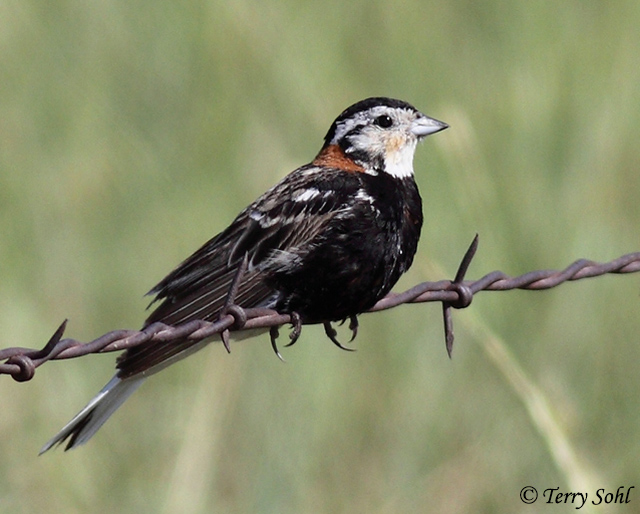
The Chestnut-collared Longspur is a denizen of of the Northern Great Plains, breeding in areas of very short grasses such as very dry grasslands, grazed lands, recently disturbed lands, or in and around prairie dog towns. Summer males (see photo to the right) are strongly marked, and are made even more identifiable in flight by the white underside of the tail with a bold black triangle. They are migrants throughout South Dakota and breed in the northern part of the state.
Populations of Chestnut-collared Longspurs have plummeted in recent decades. Research shows they strongly prefer large grassland patches of at least 100 acres, with breeding attempts and breeding success greatly reduced in smaller grassland patches. The mass conversion of grassland habitats to agriculture have negatively impacted the species, both on their summer breeding grounds in the US and Canada, and on their wintering grounds in the southern US and Mexico. Indications from the Breeding Bird Survey are that they have declined by almost 90% since 1966, with declines continuing.
Habitat
Chestnut-collared Longspurs breed in and around short-grassed prairies, typically in areas with short grasses, including areas that have been grazed or disturbed. The shorter grasses in and around prairie dog towns are often attractive to them, including outside of the breeding season. They may also be found in agricultural land when foraging, in migration, and in winter.
Diet
Seeds make up the overall majority of the diet throughout the year, and are the almost exclusive winter diet item. Insects may make up to half of the summer diet. Grasshoppers are often a favorite prey species.
Behavior
Walks and runs along the ground in search of insects, occasionally fluttering up a short distance to capture one in flight. Also feeds on the ground for seeds.
Nesting
May through July. Breeding begins with males arriving on the breeding grounds and attempting to attract females through courtship rituals. A courtship flight begins with a male flying up into the air, hovering and flying in circles, and then spreading his wings and tail and descending while singing. The nest is a depression on the ground, placed next to a clump of grass or other vegetation, and lined with grasses and feathers. The female lays 4-5 eggs and she alone incubates them. The young hatch after about 12-14 days, and fledge from the nest in another 12-14 days.
Song / Calls
The song of a Chestnut-collared Longspur is a high clear warbling that descends at becomes more harsh at the end. A tzzzzip contact call is given that almost sounds like a very rapid trill. They also have a bubbling flight call.
- Click here to hear the song of a Chestnut-collared Longspur1
- Click here to hear the buzzy contact calls of a Chestnut-collared Longspur2
- Click here to hear the bubbling flight calls of Chestnut-collared Longspur3
Migration
Chestnut-collared Longspurs summer through the northern Great Plains, although their range is greatly reduced from historical times due to habitat loss. They winter in the southwestern U.S., southern Great Plains, and Mexico.
Similar Species
- McCown's Longspur - McCown's Longspur are a very uncommon migrant in western South Dakota, and an even rarer breeding bird on the far western edge of the state. Males in breeding plumage are relatively easy to differentiate from Chestnut-collared Longspurs, as they lack the namesake chestnut collar of the latter species, and the black is much less extensive on their body, with just a small black bib on their upper chest (compare to photo of male Chestnut-collared Longspur above). Females are more difficult to differentiate. Both have streaking on the back and plainer underparts, with a much plainer appearance overall than the male. Female McCown's Longspurs have a pinkish bill, and a clean appearance on their underside, while female Chestnut-collared Longspurs have a gray bill, and some faint, diffuse streaking on their flanks.If seen in flight, McCown's Longspurs have a "T"-shaped black pattern on a white tail, while that same pattern on a Chestnut-collared Longspur is more of a triangular shape.
- Lapland Longspur - Lapland Longspurs are winter visitors in the state, while Chestnut-collared Longspurs are summer breeding birds and migrants. Seasonality is thus the major clue, but plumage patterns are also quite different. Breeding male Lapland Longspurs have a black face and throat and a white belly, almost the opposite pattern of a male breeding plumaged Chestnut-collared Longspur. Winter-plumaged Lapland Longspurs have a rusty patch on their wing and a generally stronger facial pattern than winter-plumaged Chestnut-collared Longspurs.
- Smith's Longspur - Smith's Longspurs are very rare migrants in the state. Males in breeding plumage are easy to differentiate, as male Smith's Longspurs are a rich buffy color on their belly, chest, and throat, with a triangular black patch on their cheek. Male Chestnut-collared Longspurs have a black belly, white throat, and a simpler facial pattern. Females again are more similar, but female Smith's Longspurs have a richer, buffier color on their underparts, with vertical streaking on the upper chest. Male non-breeding Chestnut-collared Longspurs have more of a diffuse horizontal barring on the breast and lack the rich buffy color.
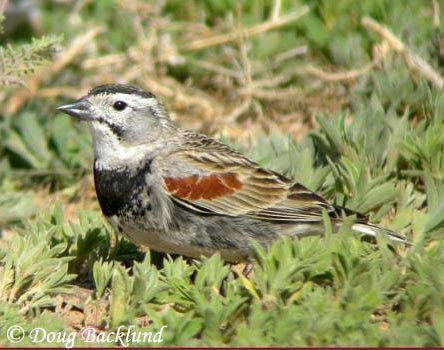 | 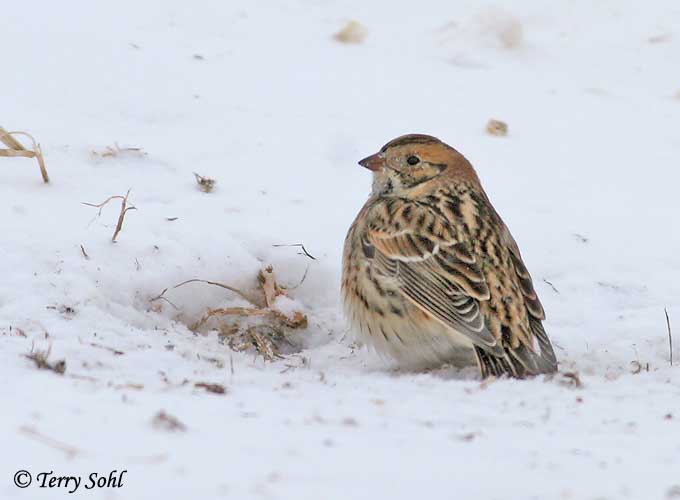 | 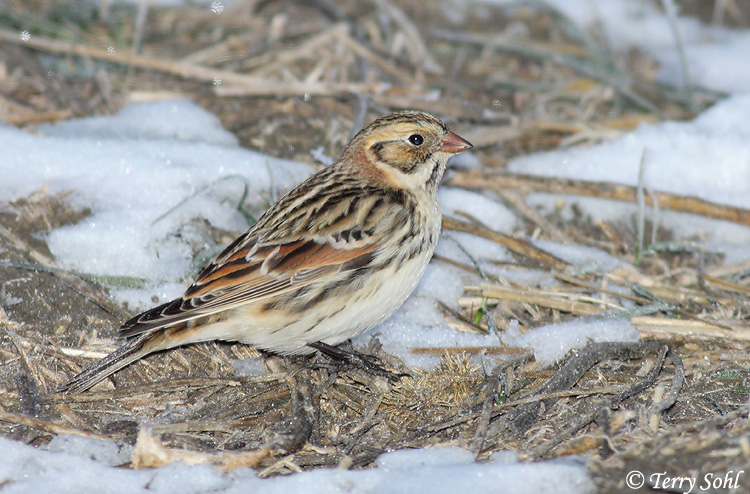 | 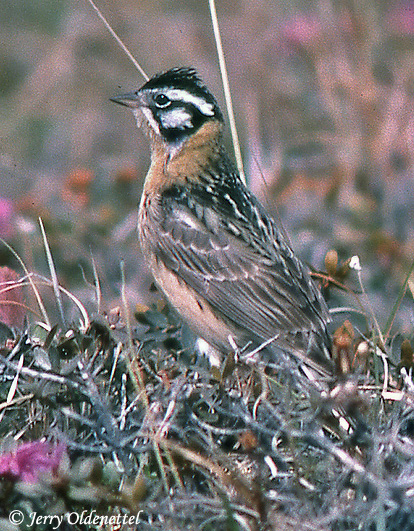 |
| McCown's Longspur | Lapland Longspur | Lapland Longspur | Smith's Longspur |
Conservation Status
The IUCN currently lists the Chestnut-collared Longspur as a "Vulnerable" species, which they downgraded from "Near Threatened" in 2017. Systematic surveys in the past few decades show severe declines in overall populations, with the Breeding Bird Survey showing almost a 90% decline since 1966. Populations declines are even more severe in the Canadian portion of their range, with an estimated loss of 95% of the total population in the last 50 years.
Habitat loss is the overwhelming reason for the decline. Huge areas of native grassland in the Great Plains have been converted to agricultural land uses, and lesser amounts to urban lands. Chestnut-collared Longspurs used to be relatively common breeding birds in parts of Nebraska, Kansas, and Minnesota, and now they're largely absent as breeding birds in those states. Habitat conversion continues to the present day, both in the US and Canadian portions of their breeding range, and also in their wintering range in Mexico. South Dakota itself has lost huge amounts of grassland/prairie in the last 20 years, as demand for biofuel and resulted in massive expansion of corn and soybean acreage. In western North Dakota, the Baaken oil formation and the massive levels of extraction activity have heavily fragmented the landscape, resulting in fewer suitable large blocks of grassland for the species to breed. Total population trends continue to decline, and the long-term outlook is potentially dire.
Photo Information
July 22nd, 2011 -- Harding County, South Dakota - Terry Sohl
Audio File Credits
- 1Matt Wistrand. Recorded in Valley County, Montana on May 30th, 2017. Original recording and information available from xeno-canto.
- 2Richard E. Webster. Recorded in Phillips County, Montana on June 6th, 2014. Original recording and information available from xeno-canto.
- 3Paul Marvin. Recorded in Wilcox, Arizona on March 15th, 2013. Original recording and information available from xeno-canto.
Interactive eBird Map
Click to access the eBird species page for Chestnut-collared Longspur
