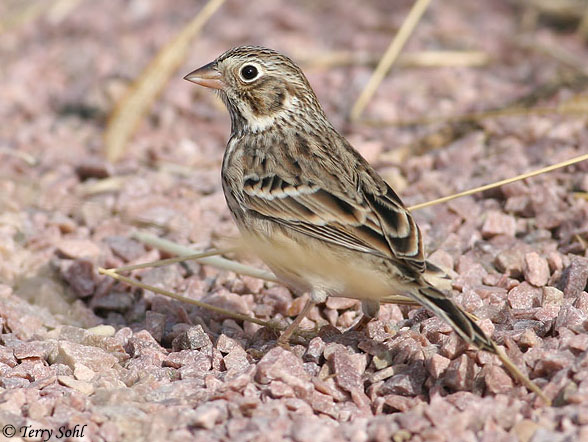
The Vesper Sparrow is generally less shy than many of the grassland sparrows, and can often be seen singing from the highest perch in its territory. They are named after their believed tendency to sing most gloriously during the vesper (evening) hours, although they will sing at any hour of the day. Strongly preferring life on the ground, they are typically seen foraging on the ground, running or hopping between stops as they scratch at the ground for seeds. Their preference for life on the ground extends to grooming and courtship activities, as they are very fond of dust baths, and male courtship displays to the females are also primarily from the ground.
Vesper Sparrows are one of multiple "streaked" sparrow species in South Dakota, with obvious streaking on the flanks and breast. They can be easily differentiated from other sparrow species by their bold white eye-ring, and white outer tail feathers that are most obvious when a bird takes flight..
Habitat
Vesper Sparrows can be found in many open dry habitats, including roadside ditches, short-grass prairies, grassy or weedy fields, and stubble fields.
Diet
Insects and seeds. Vesper Sparrows primarily feed on insects during the summer, along with spiders and other small invertebrates. Seeds make up most of the diet during migration and in the winter months.
Behavior
Vesper Sparrows seemingly prefer life on the ground more than in the air, as they not only forage on the ground, but their courtship behavior is mostly on the ground. Foraging is done on the ground, running or walking along and periodically stopping for food items. As with some other species, they can sometimes be seen scratching on the ground with their feet to uncover food items. During the summer breeding season when they also feed on insects, they are typically obtained by gleaning them from vegetation or directly off the ground, again, while the bird forages at ground level. Courtship displays are also mostly ground based, with males chasing females with wings spread, and then popping up into the air with a quick hop and brief hover to try and attract a mate.
Nesting
May through July. The nest of a Vesper Sparrow is built in a shallow depression scraped out on the ground next to a clump of grasses or other similarly protected area. The nest itself is a cup constructed of grasses, weed stems, moss, toots, and other vegetative material, and lined with hair and fine grasses. The female lays two to six whitish or slightly greenish eggs with brown markings, with both parents helping to incubate them. The young hatch after about 12 days, and fledge from the nest 10 to 14 days after hatching.
Song
The call of a Vesper Sparrow is a crisp chert. The song is a series of rapid notes, typically starting with a series of sweet whistled phrases and then ending with a trill.
- Click here to hear the song of a Vesper Sparrow1
- Click here to hear another song version of a Vesper Sparrow2
- Click here to hear the call of a Vesper Sparrow3
Migration
Summers throughout much of the United States and southern Canada. Winters in the southern U.S. and points south.
Interactive eBird Map
Click here to access an interactive eBird map of Vesper Sparrow sightings
Similar Species
Vesper Sparrows are most likely to be confused with the following "streaked" sparrow species in South Dakota, some of which are present as breeding birds during the summer months, and one of which is just a migrant through the state.
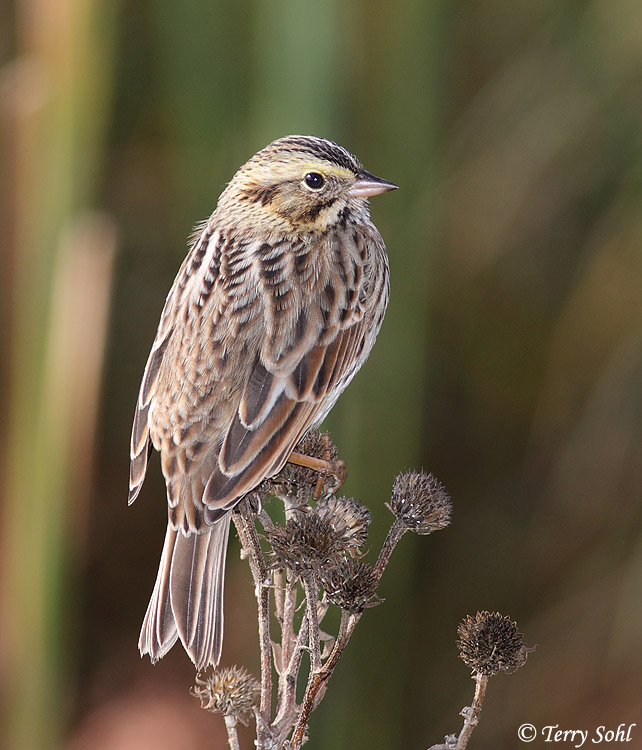
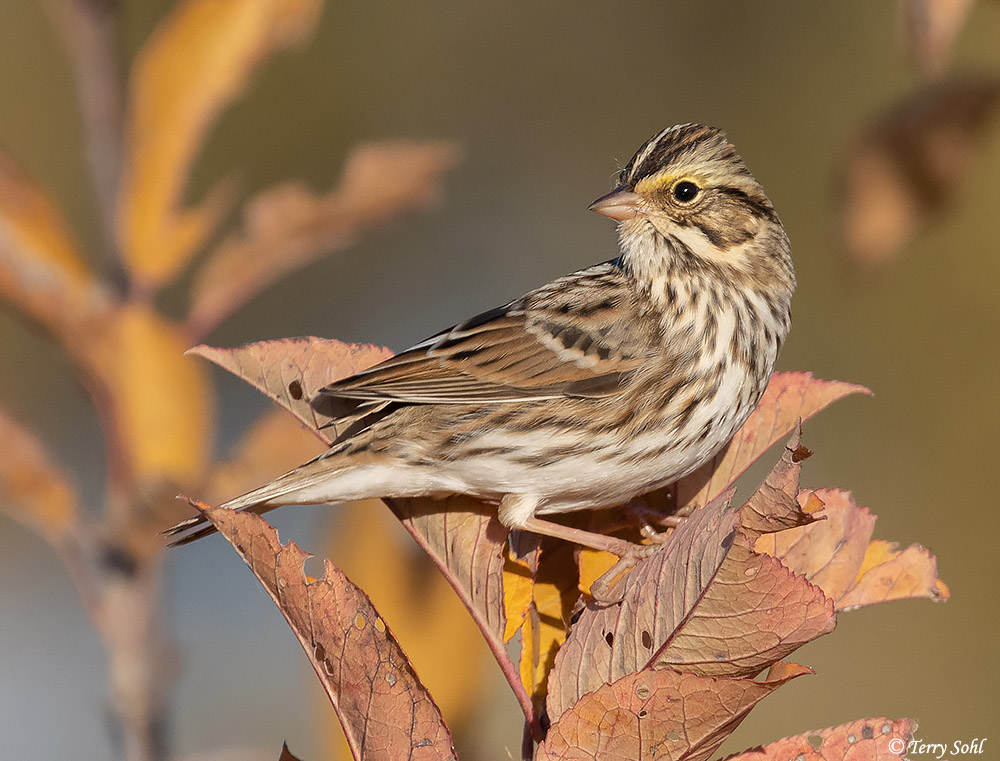
- Savannah Sparrow - Like the Vesper Sparrow, Savannah Sparrows are a summer breeding resident in South Dakota as well as a migrant, and they can often be found in similar habitats. They share the same general body plumage and streaked sides. However, Savannah Sparrows typically have a yellowish spot in front of the eye, and they lack the characteristic white eyering and white outer tail feathers (best seen in flight) of a Vesper Sparrow.
- Song Sparrow - Song Sparrows are another common summer breeding bird in South Dakota that may be found in the same habitats as a Vesper Sparrow. Song Sparrows have stronger streaking on their underparts than a Vesper Sparrow, and also have a central chest spot. Song Sparrows lack the white eye ring and white outer tail feathers of a Vesper Sparrow. Song Sparrows have stronger facial striping than a Vesper Sparrow, with bold dark lines behind the eye, and as a trailing "mustache" below the bill.
- Lincoln's Sparrow - Lincoln's Sparrows don't breed in South Dakota, however, they can be very common in migration and can be found in similar habitats as Vesper Sparrows during that time. Lincoln's Sparrows are another of the "streaked" sparrows, and that streaking pattern can look similar to a Vesper Sparrow. Both species also tend to have a buffy wash on the flanks, but it's typically brighter and more obvious on a Lincoln's Sparrow, and generally pale and diffuse on a Vesper Sparrow. Lincoln's Sparrows lack the white eye-ring and outer tail feathers of a Vesper sparrow. Facial patterns are also different, with bolder, straighter lines radiating backwards from the bill and eye of a Lincoln's Sparrow, and a more obvious contrasting crown on a Lincoln's Sparrow as well.
 |
 |
 |
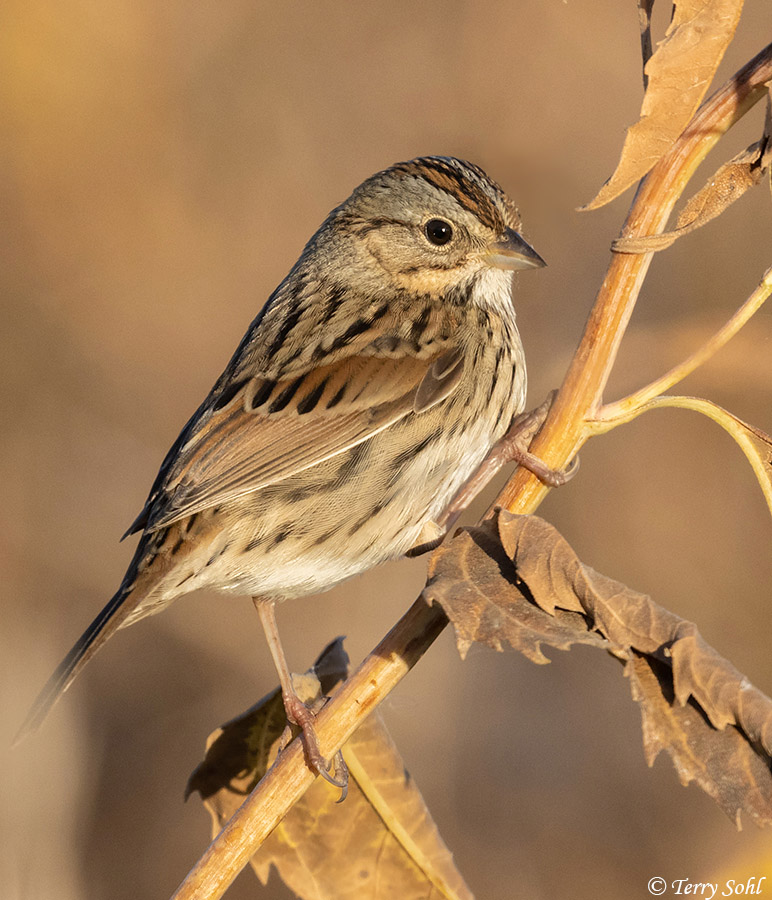 |
| Savannah Sparrow | Savannah Sparrow | Song Sparrow | Lincoln's Sparrow |
Conservation Status
Vesper Sparrows declined precipitously in the eastern United States during the 20th century, but that is most likely due to the reforestation of forest lands that were cut or used for agricultural near the start of the 20th century. Their numbers were likely artificially high in the East during the years with low forest cover, but are declining as forest lands return. They are still widespread and common in the West. Overall, numbers may be showing some decline, but there's no substantial threat to their overall population. The IUCN considers the Vesper Sparrow to be a species of "Least Concern".
Photo Information
September 30th, 2006 - Lincoln County, South Dakota - Terry Sohl
Audio File Credits
- 1Jeff Dyck. Recorded in Fraser-Fort George, British Columbia on May 22nd, 2019. Original recording and information available from xeno-canto.
- 2Caio Brito. Recorded in Pisgah National Forest, North Carolina on April 23rd, 2019. Original recording and information available from xeno-canto.
- 3Jeremy Nance. Recorded in Fairfield County, Connecticut on April 4th, 2020 . Original recording and information available from xeno-canto.
