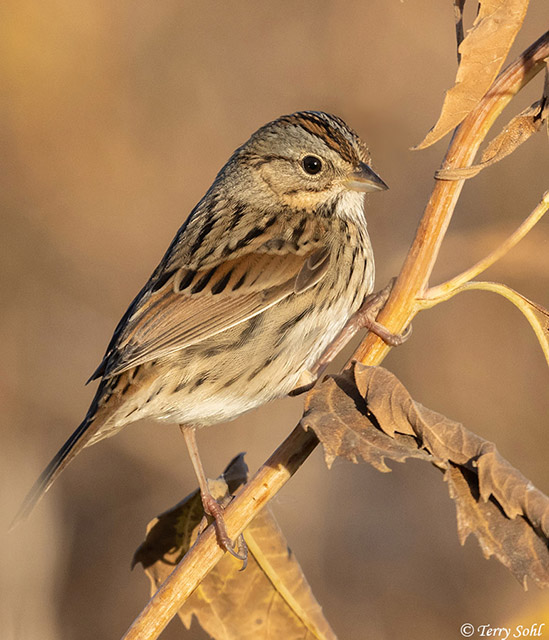
Lincoln's Sparrows are an elegant looking sparrow with fine streaking and a distinctive buffy wash across their upper chest and lower face. They are a migrant in South Dakota, generally being found in greater numbers in the eastern part of the state than in the west. They can be sometimes be found at feeders during migration through South Dakota. Their summer breeding grounds are higher-elevation areas of the western US, up into Canada and Alaska. Most common in the fall, they will often be found foraging in groups of mixed sparrow species. While they are often quite common in migration, they tend to be found as individual birds or in very small groups (particularly when part of a mixed-species flock).
Habitat
Lincoln's Sparrows can be found in a wide variety of habitats as they move through the state, but the common element that generally must be present is some form of cover. This can be a riparian thicket, shrubby wetlands, fencerows and shelterbelts, and other areas with low shrubs and cover. During the summer breeding season they are often found in riparian areas, boggy areas with scattered shrubs, or patchy woodlands with cover interspersed with more open areas.
Diet
Seeds make up a large portion of the diet, particularly in migration and during the winter months. They will also feed on insects and spiders, particularly during the summer breeding season when young need animal protein.
Behavior
Lincoln's Sparrows usually forage on the ground or low in vegetation. They can often be seen scratching on the ground, looking for both insects or other food items. They typically prefer staying near cover, foraging on the ground but scurrying back to cover if they sense a threat.
Nesting
Non-breeder in South Dakota. On their breeding grounds, the nest is a cup built of grasses, strips of bark, and roots, lined with finer material such as grasses, downy plant material, and mosses. The nest is usually placed on the ground or very close to the ground, in a protected area such as in a shrub, the base of a shrub, next to a tussock of grass, or other similar area. The female lays 3-6 eggs, and she alone incubates the eggs. The eggs hatch after about 12 days, with the young fledging from the nest about 10-14 days after hatching.
Song
The song of a Lincoln's Sparrow is a complex bubbling series of notes, generally ending with softer and slower notes as the song "loses steam" at the end. They also have short and sharp cheet calls.
- Click here to hear the song of a Lincoln's Sparrow1
- Click here to hear the calls of a Lincoln's Sparrow2
Migration
Summers throughout much of Canada and Alaska, as well as part of the mountain west. Winters in the southern U.S. and points south.
Interactive eBird Map
Click here to access an interactive eBird map of Lincoln's Sparrow sightings
Similar Species
There are a number of "streaked" sparrows that either are summer breeding residents in South Dakota, or migrate through in the spring and fall. Here are the species most likely to be confused with a Lincoln's Sparrow:
- Song Sparrow - Two of the most common sparrows in the fall in South Dakota are Song Sparrows and Lincoln's Sparrows. While both are heavily streaked and may be found in the same habitats, the streaking on a Lincoln's Sparrow is always more fine. Lincoln's Sparrows also have a buffy wash across their chest and lower face that is lacking on the Song Sparrow.
- Vesper Sparrow - Perhaps the most similar species visually to the Lincoln's Sparrow, Vesper Sparrows also show fine streaking that is reminiscent of a Lincoln's Sparrow. However, Vesper Sparrows have a broader, more obvious eye ring, lack the buffy wash across the lower face and breast of a Lincoln's Sparrow, and have obvious white outer tail feathers lacking on a Lincoln's Sparrow.
- Savannah Sparrow - Another heavily streaked sparrow, Savannah Sparrows lack the Lincoln's Sparrow's buffy wash across the breast and lower face, lack the thin white eye-ring of a Lincoln's Sparrow, and have a yellowish spot on the lore above the eye that's lacking on the Lincoln's Sparrow.
Conservation Status
Lincoln's Sparrows are found a very broad geographic area and are quite common in parts of their range. Their overall population is currently considered stable. The IUCN considers the Lincoln's Sparrow to be a species of "Least Concern".
Bird Feeders
Will sometimes attend feeders for a variety of seeds during migration through the state. At feeder stations they are generally seen scratching on the ground below feeders for seeds.
Photo Information
October 12th, 2020 - Minnehaha County, South Dakota - Terry Sohl
Audio File Credits
- 1Peter Boesman. Audio recorded in Alaska on June 1st, 2016. Original recording and information from xeno-canto.
- 2Paul Marvin. Audio recorded in San Diego California, November 10th, 2018. Original recording and information from xeno-canto.
