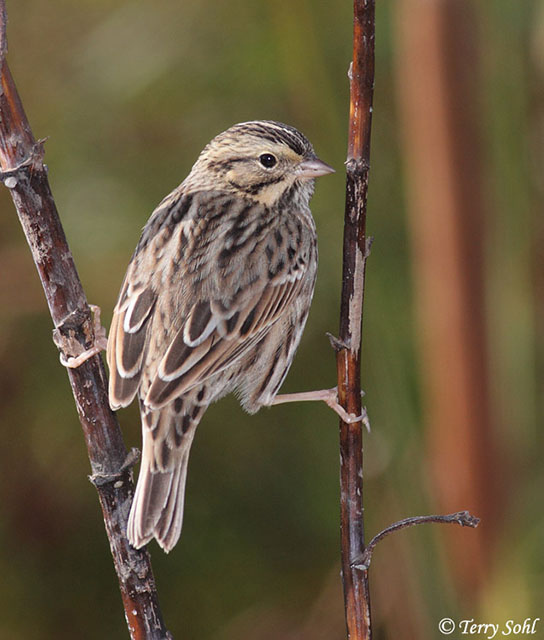
The Savannah Sparrow is a ground-dwelling sparrow found in a wide variety of open grassy/marshy habitats. They are a common bird in South Dakota, particularly during migration in the fall. They breed throughout the state, with higher numbers in the north and fewer in the south. Sometimes confusing for birders, several different races exist with a variety of colorations. Many birds however have a distinctive yellowish spot on the lore in front of and on top of their eye.
Given Savannah Sparrows are often found in grassland and prairie in South Dakota, the natural assumption is that they were named for their preferred habitat. However, their namesake comes from the location where they were first identified and described, near Savannah, Georgia.
Habitat
Open habitat including prairies, meadows, rangeland, pastures, salt marshes, other wetland edges, dunes, shores. In South Dakota they are primarily found in grassland areas and pastures with few trees or shrubs. They also may be found in crops such as clover or alfalfa.
Diet
Primarily feeds on insects in the summer. Also feeds on seeds and berries, especially in the winter. Populations along the coast will also feed on small crustaceans and mollusks.
Behavior
Savannah Sparrows forage on the ground, or low in grasses and bushes. They can be very sociable in migration, forming large flocks.
Nesting
May through July in South Dakota. The female builds the nest, constructed primarily of grasses (occasionally with fine sticks or roots), lined with finer grasses (and sometimes hair, moss, or other softer material). The nest is placed in a protected vegetative area on or very near the ground, such as at the base of a thick tussock of grass, or low in a small shrub. The female lays 2 to 6 eggs, with both parents helping to incubate them. The young hatch after about 12 days, and fledge from the nest another 10-14 days after hatching.
Song
The song of a Savannah Sparrow consists of various numbers of "chip" notes interspersed by a buzzy trilling.
- Click here to hear the song of a Savannah Sparrow1
- Click here to hear the call of a Savannah Sparrow2
- Click here to hear the excited alarm calls of a Savannah Sparrow3
Migration
Summers through all of Canada and Alaska, and most of the northern half of the U.S. Winters in the southern half of the U.S., Mexico, and Central America. In South Dakota they can be found in migration and during the summer months, with lower numbers in the southern part of the state in summer.
Interactive eBird map
Click here to access an interactive eBird map of Savannah Sparrow sightings
Similar Species
Savannah Sparrows are similar in some overall plumage characteristics to other "streaked" sparrow species. The following are the species most likely to be confused with a Savannah Sparrow in South Dakota:
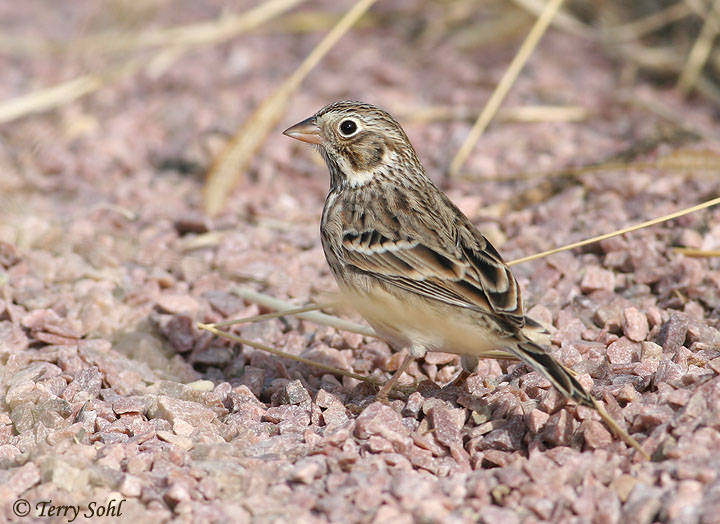
- Vesper Sparrow - Both share similar plumage patterns on the body, with streaking on the sides and breast. The Vesper Sparrow has an obvious white eye ring that is lacking on a Savannah Sparrow. Vesper Sparrows lack the yellow lore (spot above and in front of the eye) that is found on Savannah Sparrows. And Savannah Sparrows have white outer tail feathers (most obvious when taking flight) that are lacking on the Savannah Sparrow.
- Song Sparrow - Song Sparrows and Savannah Sparrows can both be very common in South Dakota, particularly during the fall migration. Both share streaked plumage patterns and striping on the face. The Song Sparrow lacks the yellow eye spot/lore of a Savannah Sparrow. The streaking on the sides and breast of a Song Sparrow appears more coarse than that on a Savannah Sparrow. Song Sparrows also have a central breast spot that is lacking on Savannah Sparrows.
- Lincoln's Sparrow - Another sparrow that can be found in migration in South Dakota, it too shares the streaked plumage of a Savannah Sparrow. Lincoln's Sparrows have the finest streaking of these species, with a more delicate looking plumage pattern as a result. Lincoln's Sparrows also have a buffy tone on their breast and upper flanks that is lacking on a Savannah Sparrow.
 |
 |
 |
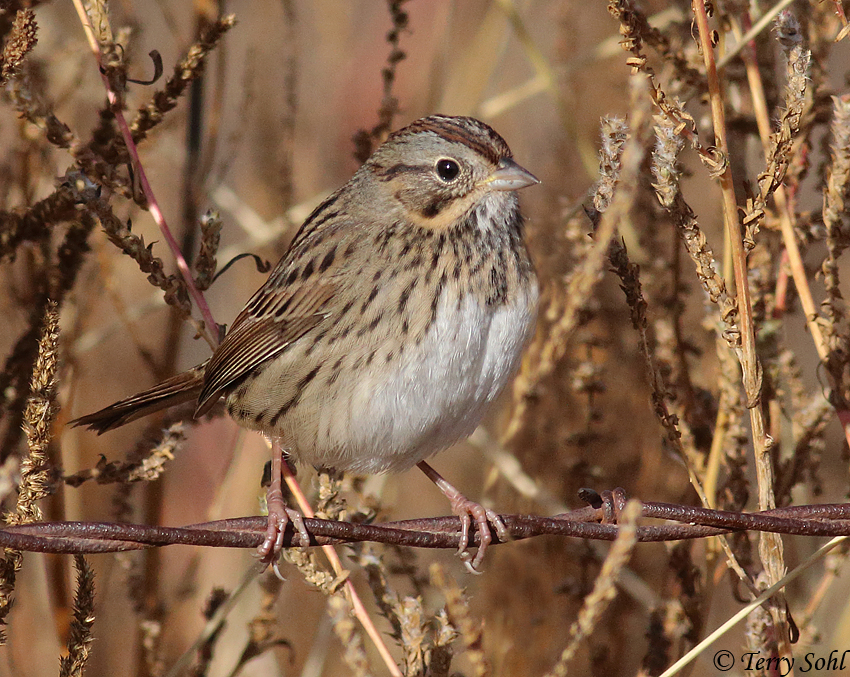 |
| Vesper Sparrow | Vesper Sparrow | Song Sparrow | Lincoln's Sparrow |
Conservation Status
Savannah Sparrows have an extremely large geographic range, are common to abundant in parts of that range, and the overall population trend is stable. The IUCN considers the Savannah Sparrow to be a species of "Least Concern".
South Dakota "Hotspot"
Savannah Sparrows are a common, sometimes abundant species in South Dakota, and they're typically not difficult to find in the right season and habitat. During the summer breeding season, they are common in the northeastern part of the state, in grassland areas and pastures that haven't been over-grazed, or in herbaceous vegetation habitats near wetlands. During the fall migration they can be downright abundant in eastern South Dakota. Grassy and brushy habitats are the best places to look, where they may join with roving flocks of other sparrow species.
Photo Information
October 4th, 2009 -- Minnehaha County -- Terry Sohl
Audio File Credits
- 1Jacob Saucier. Recorded in Valley County, Montana on June 23rd, 2015. Original file and information from xeno-canto.
- 2Martin St-Michel. Recorded in Quebec, Canada on July 1st, 2017. Original file and information from xeno-canto.
- 3Martin St-Michel. Recorded in Quebec, Canada on July 19th, 2014. Original file and information form xeno-canto.
