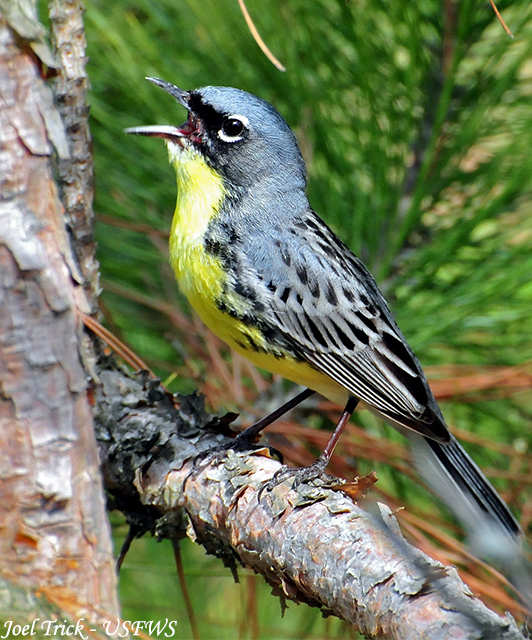
ID Keys: Grayish upperparts, yellow underparts, white broken
eye-ring, black streaks on sides, white undertail coverts
The
Kirtland's Warbler is an endangered species with a very small North American
Range. They only breed in a small part of Michigan, and rarely, in
Wisconsin. Probably never common, Kirtland's Warblers use young jack
pine forests for breeding, a type of habitat that was likely once more
common before European settlement, when natural forest fires would
periodically destroy patches of mature forest and allow young jack pines to
grow in their place. Upon settlement, active fire suppression greatly
reduced habitat. Nearly extinct in the 20th century, conservation
efforts have focused on 2 fronts. The first is ensuring adequate
breeding habitat, which is accomplished through active forest management,
periodically cutting large swaths of pine to allow young jack pines to grow.
The second measure is control of cowbird parasitism. Kirtland's
Warblers are extremely susceptible to Cowbird parasitism, with esimates that
in some areas, up to 90% of nests contain a cowbird egg. Cowbirds are
actively trapped and removed from the small Kirtland Warbler range in an
effort to improve breeding success. Despite all efforts to restore
Kirtland Warbler populations, numbers today still number a few thousand at
most.
Habitat
Breeds almost exclusively in areas of
young jack pine in Michigan or Wisconsin. In the winter, they can be
found in the understory of pines in the Bahamas.
Diet
Mostly feeds on insects and spiders, but
will also feed on berries, as well as pine sap during the summer breeding
season.
Behavior
Is more observable than many warblers,
as they tend to forage fairly close to the ground, or even on the ground.
They are loosely colonial in summer, with pairs typically returning to the
same breeding grounds each year. In the winter, they are solitary.
Nesting
The nest is build on the ground in sandy
soil, typically under or next to a pine. The female alone builds the
nest, using grasses, leaves, and pine needles, with mosses and hair as a
lining. The female alone incubates the eggs, although the male feeds
her during incubation. Both parents help to raise the young.
Song
Song is a series of low strong notes, with
an increase in strength and rise in pitch as the song progresses.
Migration
Summers in a very small range in
northern Michigan, and now sparsely in northern Wisconsin. Winters in
the Bahamas.
Listed as endangered in the
U.S., with the IUCN listing it as "near threatened". After becoming
nearly extinct in the 20th century, conservation efforts have led to a
recovery, but there has never been more than 5,000 of the species since
conservation efforts began.
Image Information
June 8th, 2008 - Adams County,
Wisconsin - Photo by Joel Trick from the US Fish and Wildlife Service
(Public Domain)