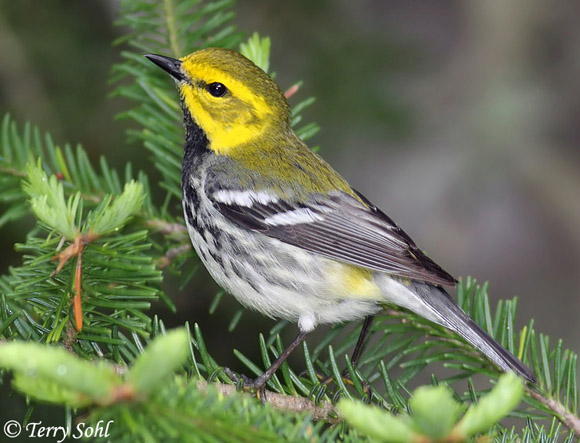
The Black-throated Green Warbler is a small, active songbird of coniferous and mixed forests in eastern North America. Adult males are strikingly patterned with olive-green upperparts, a bright yellow face, and a bold black throat and chest, while females and immature birds appear duller with reduced black markings. The species breeds in northern forests and mountainous woodlands before migrating to the southeastern United States, the Caribbean, Mexico, and Central America for winter. It feeds mainly on insects and spiders gleaned from foliage and branches high in trees. Its song is one of the most recognizable woodland sounds in eastern forests, often described as zee-zee-zee-zoo-zee.
Habitat:
The Black-throated Green Warbler prefers mature coniferous and mixed forests, especially spruce, fir, hemlock, and pine woodlands with dense canopy cover. During migration it also occurs in deciduous forests, wooded parks, riparian corridors, and shrubby woodland edges where it forages actively among tree foliage.
Diet:
The Black-throated Green Warbler feeds mainly on insects and spiders, including caterpillars, flies, beetles, moths, and other small arthropods gleaned from leaves and branches. During migration and winter it also eats small berries and other fruits.
Behavior:
An active forager, moving briskly from location to location along branches and in the foliage of trees, gleaning insects from the vegetation surface, or occasionally flitting out to snag insects in mid-air.
Interactive eBird Map:
Click to access an interactive eBird map of Black-throated Green Warbler sightings
Song:
The voice of a Black-throated Green Warbler is a high-pitched, slightly nasal song often described aszee-zee-zee-zoh-eee. Males have two distinct, repetitive song types used for territorial defense and attracting mates, typically heard in high forest canopy. They will also often use a crisp chip call.
Click here to hear a Black-throated Green Warbler Song
Click here to hear the chip calls of a Black-throated Green Warbler
Migration:
Summers in New England, the Appalachians, the Great Lakes region, and much of southern and eastern Canada. Winters in Mexico and points south.
Similar Species:
Townsend's Warbler , Hermit Warbler. These three warblers are best differentiated by their facial patterns and underpart coloration. The Townsend's Warbler is the darkest, featuring a black cap and olive back. The Hermit Warbler has a clean yellow head and white breast, while the Black-throated Green Warbler has a yellowish face, green crown, and white sides with black streaks
Conservation Status:
The Black-throated Green Warbler is classified as Least Concern by the IUCN , with a stable population and large population. While common and widespread in northern coniferous forests, they face localized threats from habitat fragmentation, logging, and other habitat disruptions. Breeding numbers in the Great Lakes region have been in decline.
Photo Information:
Photo taken on May 24th, 2012 near Acadia National Park, Maine - Terry Sohl
