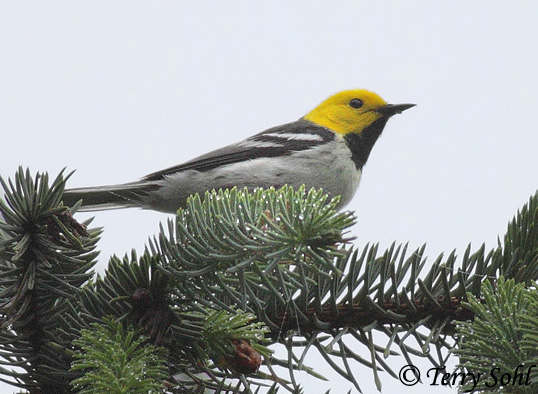
The Hermit Warbler is a western warbler of wet conifer forests, where it is typically more easily heard than seen. They typically forage high in the canopy, and while nests are somewhat closer to the ground, they typically stay at mid- or higher-levels of the canopy at most times. They are closely related to the Townsend's Warbler, and the two species do interbreed and produce hybird offspring in some locations where their summer range overlaps.
Habitat
During the summer breeding season, found in wet, dense conifer forests, typically either near the coast or in cooler, wet forests at higher elevations. Preferred habitats include forests of Douglas fir, western recedar, and hemlock. During winter, found in a greater variety of forested habitats, including mixed oak and conifer forests.
Diet
The Hermit Warbler feeds mainly on insects and spiders gleaned from conifer needles, branches, and foliage high in forest canopies. Its diet includes caterpillars, beetles, flies, aphids, and other small arthropods, with small berries occasionally eaten outside the breeding season.
Behavior
Often forages similarly to a Brown Creeper , but "horizontally". Where a Brown Creeper will fly to the base of a tree and move up the trunk in search of food, Hermit Warblers often forage by flying to the trunk of a tree, and then moving horizontally outward along the branch, searching for insects on the branches and foliage. When they get towards the end, they fly back to the trunk and begin on another branch. They will also fly out from a perch to capture flying insects in mid-air.
Nesting
The nest of a Hermit Warbler is a deep cup built of moss, stems of herbaceous vegetation, lichen, conifer needles, and twigs, and lined with softer material such as feathers or plant down. It is placed anywhere from 20 to 120 feet from the ground. The female builds the nest. Both parents likely incubate the eggs and held to raise the young, but given the height of Hermit Warbler nests and the dense forests they inhabit, breeding and nesting details are currently poorly understood.
Song
The Hermit Warbler sings a clear, musical series of whistled notes often described as sweet and flowing, somewhat similar to the song of the Townsend's Warbler but less buzzy and harsh. Calls include soft chips and thin tseet notes given while foraging in conifer forests.
Migration
Summers in the Pacific Northwest from San Francisco Bay to the Canadian border, as well as the mountains of southern California. Winters in Mexico and Central America.
Interactive eBird Map
Click here to access an interactive eBird map of Hermit Warbler sightings
Similar Species
Townsend's Warbler , Black-throated Green Warbler. The Hermit Warbler is distinguished by its clean yellow head and face combined with a plain white underbody lacking strong streaking. Townsend's Warbler shows bold black streaking on the sides and a darker cheek patch that creates a more strongly patterned face, while Black-throated Green Warbler has olive-green upperparts, a greenish back, and a less completely yellow head with more contrasting black throat markings.
Conservation Status
The Hermit Warbler is generally considered a species of low conservation concern, with populations remaining fairly stable across much of its western coniferous forest range. However, habitat loss from logging, severe wildfires, and changes to mature conifer forests may affect some regional populations.. Still common within its normal range, and the IUCN lists it as a species of "Least Concern" .
Further Information
- eBird - Hermit Warbler
- Audubon Field Guide - Hermit Warbler
- Cornell Lab of Ornithology - All About Birds: Hermit Warbler
Photo Information
Photo taken on June 29th, 2011 - Ecola State Park, Oregon - Terry Sohl
