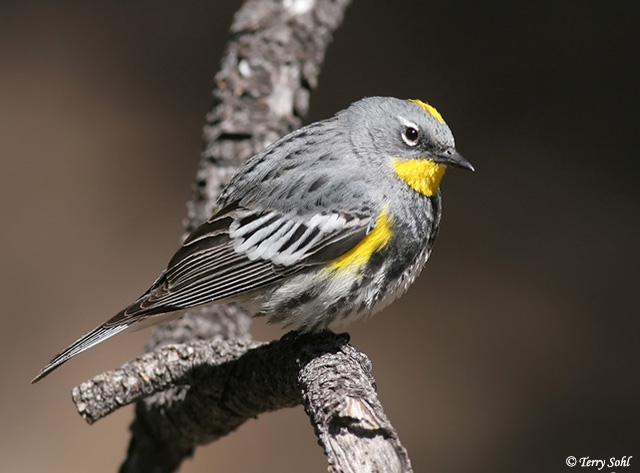
There are two forms of the Yellow-rumped Warbler, the Myrtle and the Audubon's. The Audubon's (shown in the picture to the right) is generally found in the western half of the continent, while the Myrtle is generally found in the eastern half. Note the differing throat color and facial pattern for the two forms, as seen in photos of both (bottom of the page). Both forms can be found in South Dakota.
Yellow-rumped Warblers are able to digest some berries and fruits that most other warblers can't. This allows them to arrive earlier in the spring and stay later in the fall than many other warblers, including during migration through South Dakota. Their fruit-eating habits also allows them to winter in the southern U.S.
Habitat
The Yellow-rumped Warbler inhabits coniferous and mixed forests, woodland edges, riparian corridors, and shrubby habitats across much of North America. During migration and winter it is especially common in parks, shelterbelts, brushy fields, gardens, and open woodlands where it can forage for insects and berries.
Diet
The Yellow-rumped Warbler feeds on insects, spiders, and other small arthropods during the breeding season, capturing prey from foliage, bark, and occasionally in flight. Unlike many warblers, it also eats large amounts of berries and waxy fruits, which allows it to winter farther north than most warbler species.
Behavior
Uses a wide variety of methods when foraging for food, including flycatching and snatching insects in mid-air, hovering and grabbing prey from the foliage, clambering through foliage and along branches and tree trunks, or feeding on the ground. Males stick very tightly to females during courtship, exhibiting courtship displays at every turn.
Nesting
Late May through mid-July. Yellow-rumped Warblers most often nest in conifer trees, less often in deciduous trees. The nest is placed in the crook of a forking branch, and is built by the female. The nest is a cup of grasses, twigs, and roots, lined with finer grasses, hair, and feathers. The female lays between 2 and 5 eggs, and she alone incubates them. Incubation lasts about 12 days, with the young fledging from the nest after about another 12 days.
Song
The primary song of a Yellow-rumped Warbler is a series of sweet whistled notes that accelerate towards the end. They have multiple calls, including a crisp check call, and more of a whistled psee.
- 1Click here to hear the short pseet call of a Myrtle form of Yellow-rumped Warbler
- 2Click here to hear the short song of a Myrtle form of Yellow-rumped Warbler
- 3Click here to hear a check call of a Myrtle form of Yellow-rumped Warbler
- 4Click here to hear another song of a Myrtle form of Yellow-rumped Warbler
- 5Click here to hear the call of an Audubon form of Yellow-rumped Warbler
- 6Click here to hear another call of an Audubon form of Yellow-rumped Warbler
- 7Click here to hear the song of an Audubon form of Yellow-rumped Warbler
Migration
Neotropical migrant. Yellow-rumped Warbler summer through much of the western US, Canada, up through Alaska, and in the Great Lakes and New England areas of the US. They over-winter in the southern U.S. and points south. In South Dakota, they are migrants in most of the state, where they may be among the most numerous spring and fall migrant warblers. They also breed in the Black Hills and locally in other areas of far western South Dakota.
Interactive eBird map
Click here to access an interactive eBird map of Yellow-rumped Warbler sightings
Similar Species
There are a number of warbler species that migrate through South Dakota that have yellow patches interspersed with more basic gray, black, and white colors. The following are the species most likely to be confused with Yellow-rumped Warblers:
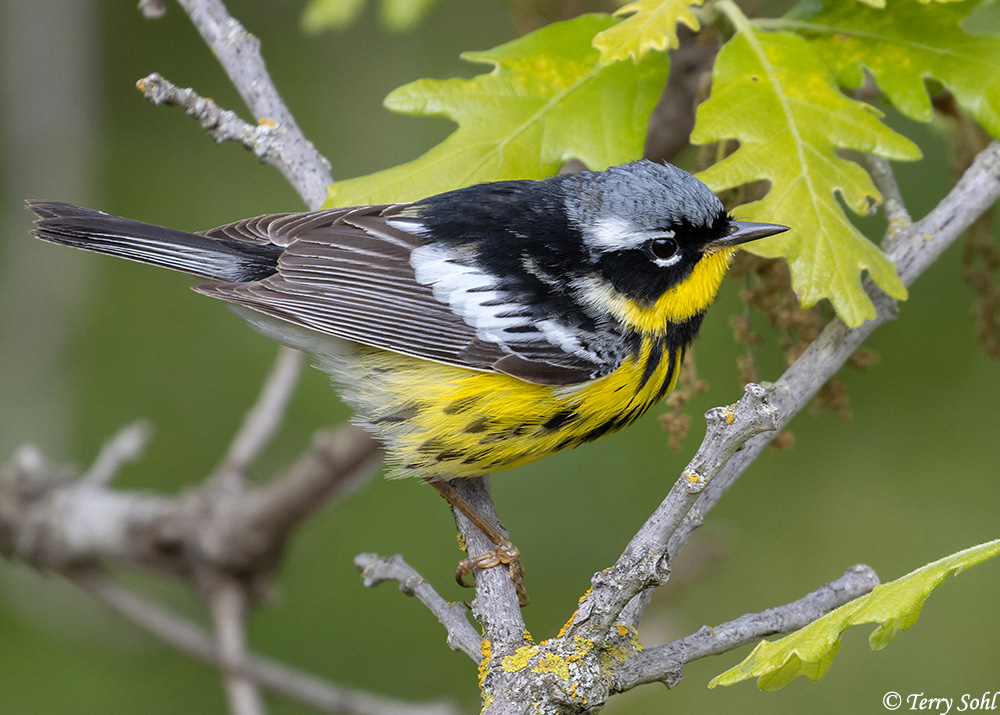
- Magnolia Warbler - Like the Yellow-rumped Warbler, Magnolia Warbler plumage is a combination of yellow, black streaks, gray, and white patches. Magnolia Warblers have yellow underparts with black streaks, while Magnolia Warblers (both Audubon's and Myrtle) have light underparts with black streaks.
- Yellow-throated Warbler - Yellow-throated Warblers are a species of the southeastern US and are but very rare migrants in South Dakota. They have more extensive yellow on the throat than a (Audubon's) Yellow-throated Warbler, with yellow from the chin down to the upper breast.
 |
 |
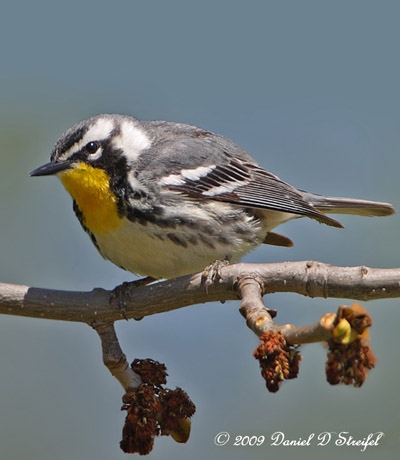 |
| Magnolia Warbler | Magnolia Warbler | Yellow-throated Warbler |
Conservation Status
Yellow-rumped Warblers have an extremely large geographic range, and are common in parts of that range. Systematic surveys show no worrying trends in overall populations. The IUCN considers the Yellow-rumped Warbler to be a species of "Least Concern".
Photo Information
May 2008 - Bryce Canyon, Utah - Terry Sohl
Audio File Credits
- 1Manuel Grosselet. Recorded in Ciudad de Mexico, Mexico on January 27th, 2021. Original recording and information available from xeno-canto.
- 2Christopher McPherson. Recorded in Hillsborough County, New Hampshire on July 2nd, 2020. Original recording and information available from xeno-canto.
- 3Alfonso Auerbach. Recorded in the Honduras on November 27th, 2017. Original recording and information available from xeno-canto.
- 4Martin St-Michel. Recorded in the Quebec on July 5th, 2015. Original recording and information available from xeno-canto.
- 5Manuel Grosselet. Recorded in the Oaxaca, Mexico on December 15th, 2020. Original recording and information available from xeno-canto.
- 6Paul Marvin. Recorded in Santa Cruz County, Arizona on December 26th, 2017. Original recording and information available from xeno-canto.
- 7Chris Parrish. Recorded in Yosemite National Park, California on July 2nd, 2007. Original recording and information available from xeno-canto.
