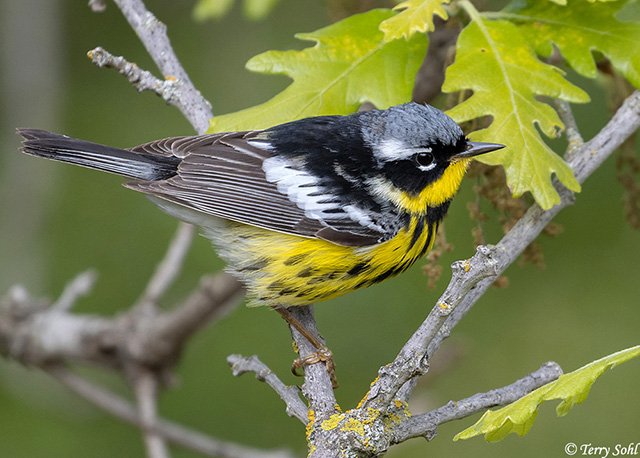
Magnolia Warblers are a migrant in South Dakota, primarily seen in the eastern part of the state (in both spring and fall). They are often easier to see than many warblers due to their preference for small trees and shrubs. This preference for smaller trees has helped it to avoid population losses due to habitat loss, as it can quickly adapt to second-growth forest.
Habitat
On their breeding grounds, they prefer areas of young conifer trees, usually dense stands that offer considerable cover for nesting. In migration through South Dakota they can be found in a variety of forest and shrubland habitats, usually being found along woodland edges, forest understories, or shrubby areas with scattered trees.
Diet
Mostly insects and spiders, with caterpillars the strongly preferred food item during the summer breeding season. Magnolia Warblers will also occasionally feed on fruit and berries in migration or on their wintering grounds.
Behavior
Forages by moving through foliage and gleaning insects, often at very low heights. They will also sometimes act like flycatchers and take insects in mid-air.
Breeding
Non-breeder in South Dakota. On its breeding grounds, the Magnolia Warblers nest in areas of young, dense conifer trees, with the nest placed close to the trunk. The nest is a loose structure of twigs, covered with rootlets, grasses, and weed stems. The female lays between 3 and 5 eggs, and she alone incubates them. The young hatch after about 12 days.
Song
The song of a Magnolia Warbler is a short series of whistled notes, weeta-weeta weet-e-o. The call is a short tseep.
- Click here to hear the song of a Magnolia Warbler1
- Click here to hear the call of a Magnolia Warbler on its wintering grounds in Mexico2
Migration
Neotropical migrant, wintering in Mexico and Central America. Breeds throughout much of Canada, the northeastern United States, and the extreme northern part of the U.S. Midwest.
Interactive eBird Map
Click here to access an interactive eBird map of Magnolia Warbler sightings
Similar Species
A number of warbler species that migrate through South Dakota have plumage patterns that include the black, yellow and/or white of a Magnolia Warbler. Here are the species most likely to be confused with a Magnolia Warbler in South Dakota, and keys to differentiating between the species:
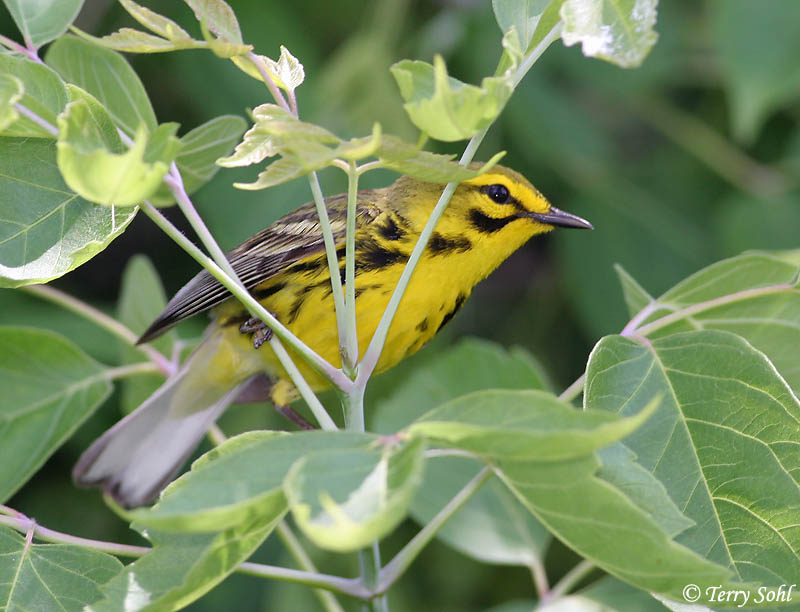
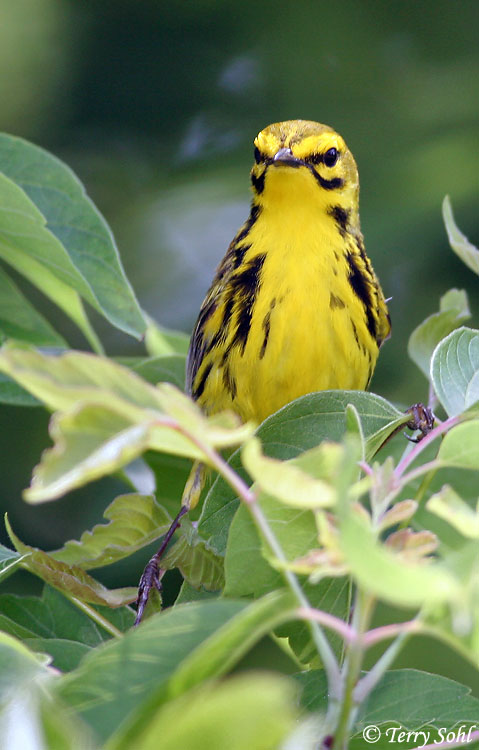
- Prairie Warbler - Males of both Prairie and Magnolia Warblers have yellow underparts with black streaking. Head and back patterns are substantially different, however. Prairie Warblers have a primarily yellow head, with black lines through the eye and below the cheek. Magnolia Warblers have a gray cap, black face and cheek with a white eyebrow and mark below the eye, and a yellow chin. Back colors are also different, with a black back on a male Magnolia Warbler, and yellowish olive neck/nape on a Prairie Warbler
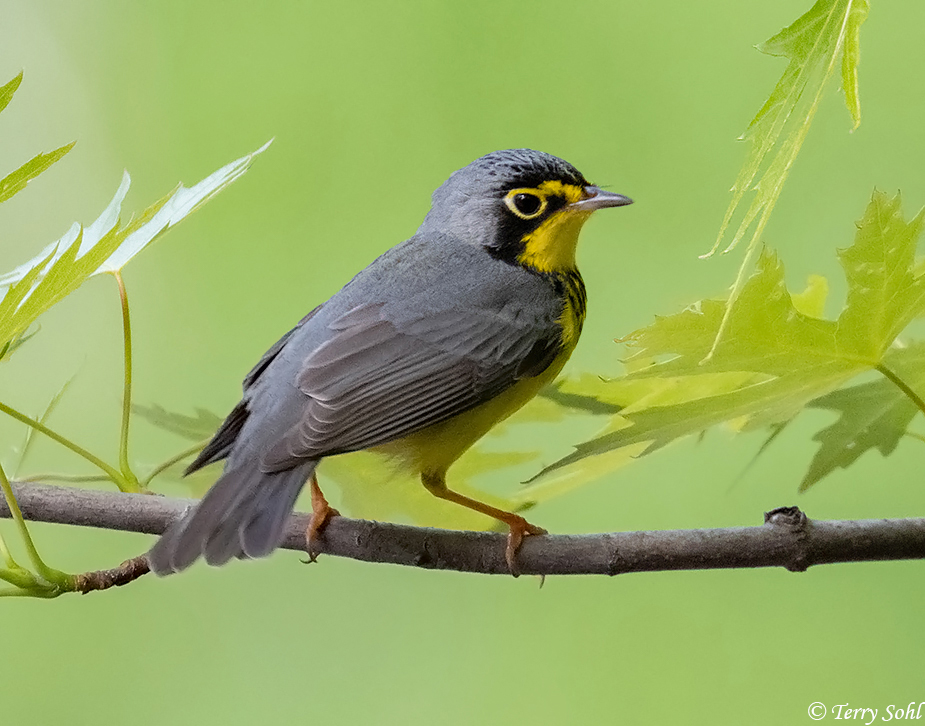
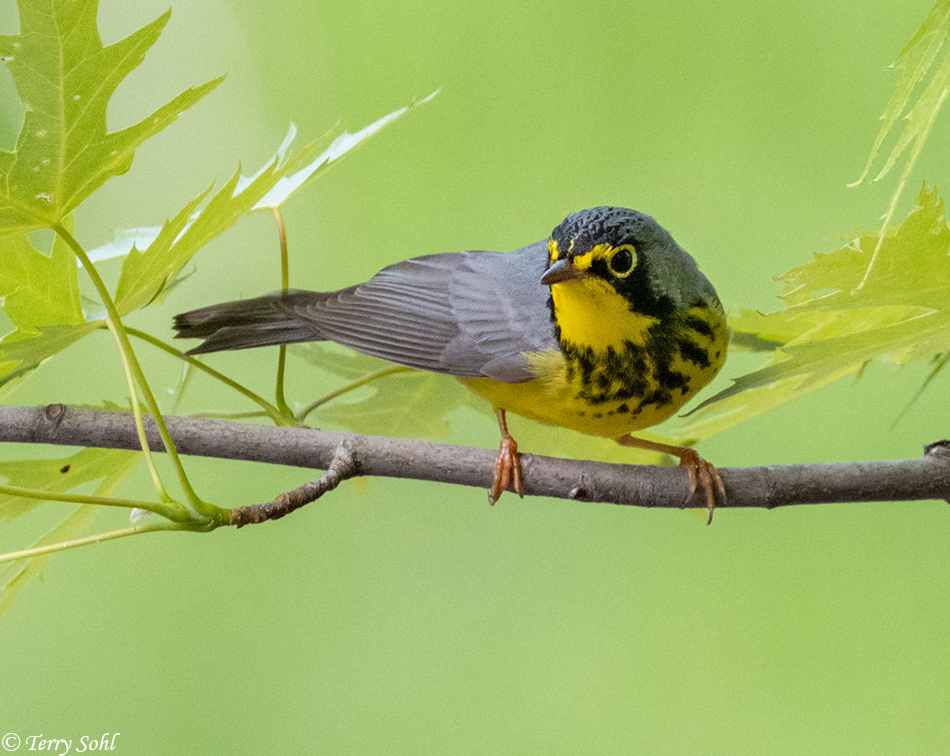
- Canada Warbler - Males of both species have yellow underparts with black streaking. However, the black streaking is found from the neck and down the flanks of a Magnolia Warbler, while on a Canada Warbler, black is restricted to a black "necklace". Facial patterns are also different. Both have yellow chins, but a Magnolia Warbler has a black face and white eyebrow, while a Canada Warbler has a primarily gray face with yellow lores, and much less black. Magnolia Warblers also have prominent white wingbars that are lacking from Canada Warblers.
 |
 |
 |
 |
| Prairie Warbler | Prairie Warbler | Canada Warbler | Canada Warbler |
Conservation Status
Systematic surveys indicate populations of Magnolia Warbler have been increasing in recent decades. They are found across a broad geographic area, and are common in parts of their range. The IUCN considers the Magnolia Warbler to be a species of "Least Concern".
South Dakota "Hotspot"
Magnolia Warblers could be possibly be found in any forested patch in eastern South Dakota in migration. The Big Sioux Recreation Area, Beaver Creek Nature Area, the Outdoor Campus in Sioux Falls, Dakota Nature Park in Brookings, and Newton Hills State Park are all excellent places to look not only for Magnolia Warblers in migration, but other warbler and songbird species as well.
Photo Information
May 17th, 2020 - Union Grove State Park, South Dakota -- Terry Sohl
Audio File Credits
- 1Martin St-Michel. Recorded in Quebec on June 2nd, 2018. Original recording and information from xeno-canto.
- 2Richard E. Webster. Recorded in Chiapas, Mexico on Quebec on March 21st, 2018. Original recording and information from xeno-canto.
