
While not a particularly shy bird, the Canada Warbler can be difficult to spot given its preference for dense undergrowth and brushy thickets. They are often seen in pairs (possibly breeding pairs) during migration through the state. Known for their black "necklace" which stands out from a yellow throat and underside, they are sometimes known colloquially as the "necklace warbler".
Habitat
Prefers thick undergrowth of mature forests, especially near water or wetlands, on its breeding grounds. Found in forests and thickets during migration through the state.
Diet
The Canada Warbler feeds mainly on insects and spiders, including mosquitoes, flies, beetles, caterpillars, and other small arthropods captured in dense understory vegetation. During migration and on wintering grounds it also occasionally eats small berries and other fruits.
Behavior
Moves actively through foliage, gleaning insects from foliage and branches, and also flitting out to capture insects in mid-air as they are flushed by the warbler's movements. They will also forage on the ground.
Breeding
Non-breeder in South Dakota. On their breeding grounds, the nest of a Canada Warbler is a cup, built of grasses, weed stems, roots, strips of bark, and leaves, lined with finer material such as grasses, hair, and moss. It is placed on the ground in a protected area, usually at the base of a shrub or other clump of vegetation. The female selects the nest site, builds the nest, and lays between 3 and 6 eggs. She alone incubates them, with the eggs hatching after about 12 days. The young fledge from the nest about 10 days after hatching.
Song
The song of a Canada Warbler is a fast jumble of musical notes, with songs often varying among individual birds. The call note is a simple chek.
Migration
Summers in central and eastern Canada, the Great Lakes region, the Northeastern U.S., and at higher elevations in the Appalachians. Winters in South America. Canada Warblers may be seen either in spring or fall migration in South Dakota.
Similar Species
Possibly confused with other warbler species with grayish upperparts and yellow underparts:
- Magnolia Warbler - The species most likely to be confused with a Canada Warbler, Magnolia Warblers share the characteristics of gray upperparts, yellow underparts, and a black "necklace" with streaks on the upper chest. Note the more extensive streaking on the breast and flanks of a Magnolia Warbler, and a much more pronounced black mask behind, through and in front of the eye on the Magnolia Warbler. Magnolia Warblers also have black on their upper backs and a white "eyebrow" above and behind the eye. Females are more difficult to distinguish, as most plumage characteristics are quite similar. However, female Magnolia Warblers usually have some faint darker barring on the flanks, and white wing bars that are lacking on a Canada Warbler.
- Kirtland's Warbler - Not an identification problem in South Dakota, as Kirtland's Warblers are a rare warbler species that breeds in the Great Lakes region. However, in range, they could potentially be confused with a Canada Warbler, as both have grey upperparts, yellow underparts, and some white around the eye. However, Kirtland's Warblers have black streaks on the flanks, compared to the black necklace and breast streaks of a Canada Warbler. Kirtland's Warblers also have black in front of the eye, compared to yellow on a Canada Warbler.
- Yellow-throated Warbler - Yellow-throated Warblers are a very rare visitor to South Dakota, but could potentially be confused with a Canada Warbler. Yellow-throated Warblers do indeed have a yellow throat, but it lacks the black necklace pattern on a Canada Warbler. Yellow-throated Warblers also have a white bellow compared to the yellow belly of a Canada Warbler. The head pattern also differs, with Yellow-throated Warblers having a more pronounced black mask, and a white eyebrow stripe above and behind the eye.
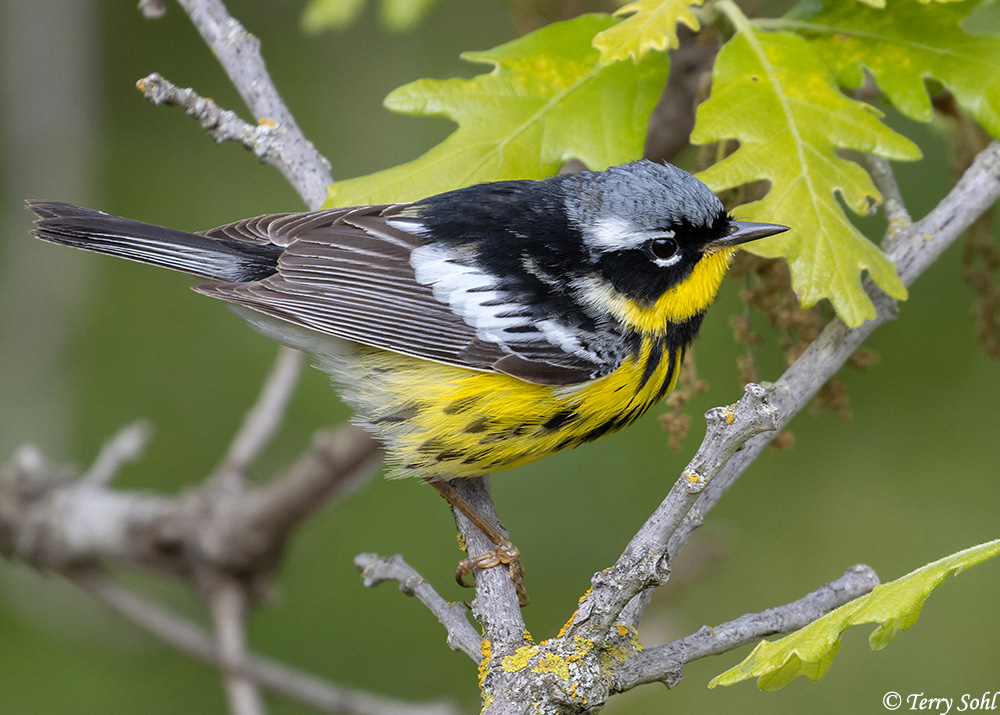 | 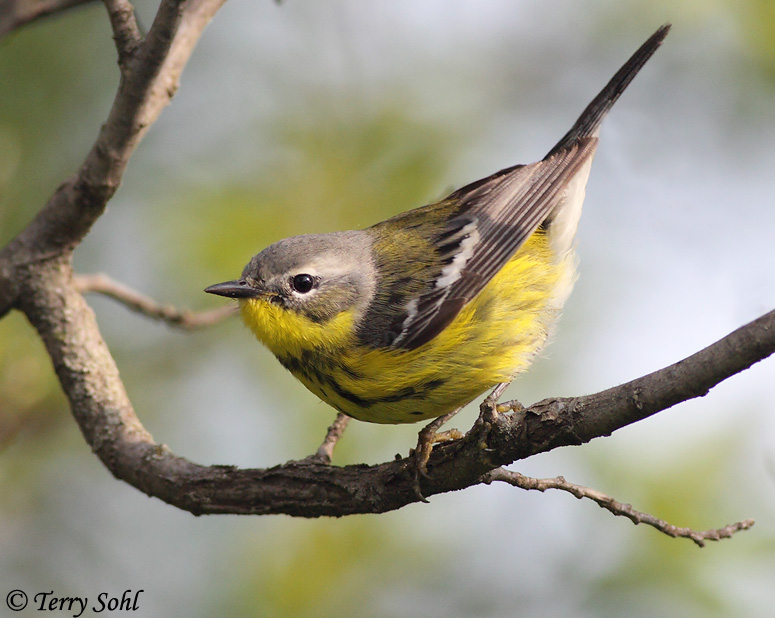 | 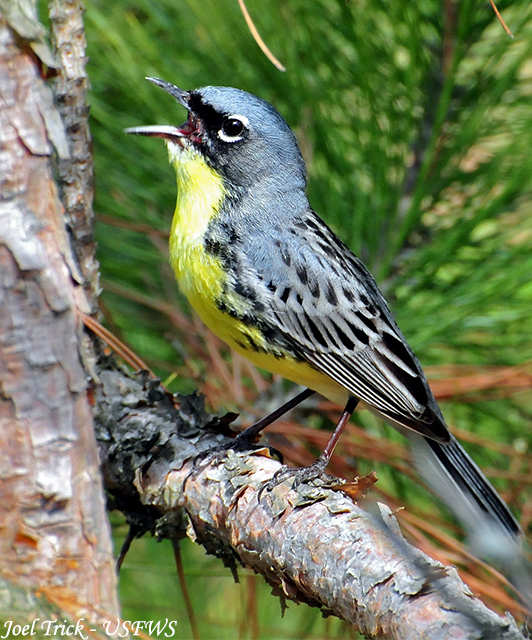 | 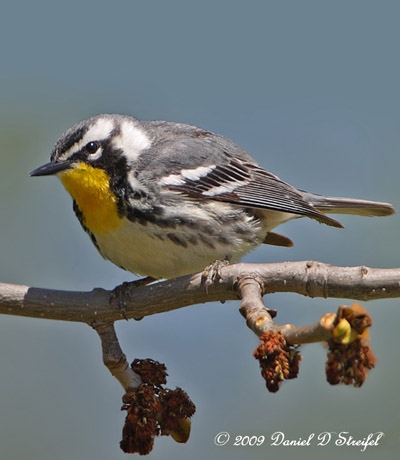 |
| Magnolia Warbler | Magnolia Warbler | Kirtland's Warbler | Yellow-throated Warbler |
Conservation Status
Survey records such as the Breeding Bird Survey show a decline in recent years, likely due to habitat loss, especially on South American wintering grounds. Canada Warblers are also a somewhat common host toBrown-headed Cowbirdparasitism. However, they are still found over a relatively broad geographic area and are relatively common in parts of that range. The IUCN considers the Canada Warbler to be a species of "Least Concern".
Photo Information
May 21st, 2020 - Outdoor Campus in Sioux Falls, South Dakota - by Terry Sohl
Audio File Credits
- 1Peter Boesman. Recorded in San Martin, Peru on January 4th, 2008. Original recording and information from xeno-canto.
- 2Mike Nelson. Recorded in Roan Mountain State Park of North Carolina on May 27th, 2013. Original recording and information from xeno-canto.
Interactive eBird Map
Click to access the eBird species page for Canada Warbler
