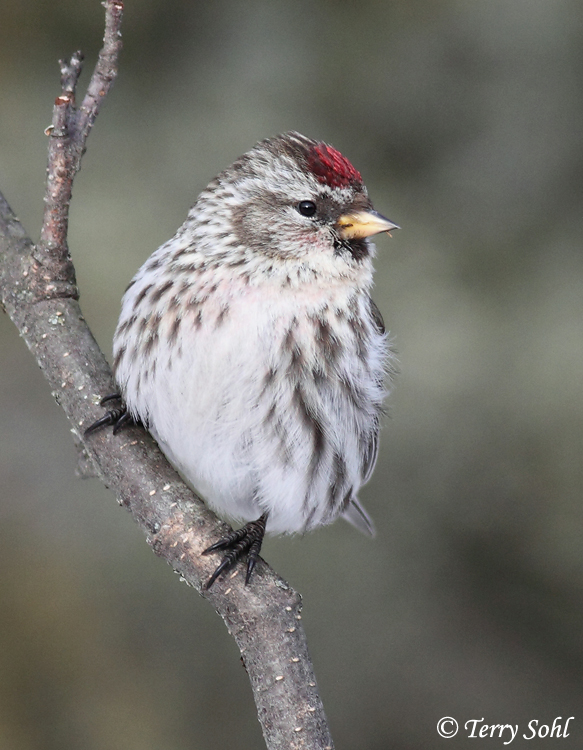
The Common Redpoll breeds in the Arctic, but is an irregular winter migrant to southern Canada and the northern United States. They are well adapted to cold climates, even having a small pouch in their throat where they can store food, allowing them to dart out into the cold and collect a large amount of food, and then return to a protected perch to slowly ingest it. They will often visit bird feeders, where they are often extremely tame.
There is some question as to the species status of Common Redpolls and their close cousins the Hoary Redpoll. Hoary Redpolls do have distinct differences from Common Redpolls, with a tiny, stubby bill, much paler coloring overall, and far less streaking. But there are intergrades between species, and recent genetic analysis has found only very small differences, indicating they may be better treated as one species.
Habitat
The Common Redpoll inhabits boreal forests, tundra, willow thickets, birch woodlands, and shrubby northern landscapes across Canada, Alaska, Greenland, and northern Eurasia. During winter, it often moves south into open woodlands, weedy fields, shelterbelts, forest edges, suburban areas, and backyard feeding stations. In South Dakota, it is an irregular winter visitor, appearing in some years during southward irruptions when food supplies are scarce farther north.
Diet
Primarily feeds on seeds. Also will take buds, catkins, and insects. In our yard in winter, when they do visit, they are attracted more to the catkins on our paper birch than they are to even the feeder complex with niger and sunflower seed.
Behavior
The Common Redpoll is a highly social finch that often travels in active flocks, especially during winter. It spends much of its time feeding on seeds from birches, alders, willows, weeds, and grasses, frequently hanging upside down or clinging to slender branches while foraging. During irruption years, large flocks may visit feeders and move widely in search of food. Redpolls are remarkably adapted to cold climates and can remain active in some of the harshest winter conditions in North America.
Breeding
Non-breeder in South Dakota. The nest of a Common Redpoll is a cup of grasses, small twigs, mosses, and feathers. The female usually lays 4 or 5 eggs, and she does all of the incubating. When the eggs hatch, the female does most of the feeding of the young. The young fledge after about 2 weeks.
Common Redpoll Song / Calls
A trilling followed by a bubbly twittering that may go on for some time. The calls of a Common Redpoll include a trilling, a repetitive series of sweet chee-chee-chee notes, or a nasal call rising in pitch.
- Click here to hear the nasal call of a Common Redpoll1
- Click here to hear the repetitive chee-chee-chee-chee call of a Common Redpoll2
- Click here to hear the mixed calls of a group of Common Redpolls at a feeder complex3
- Click here to hear the complex song of a Common Redpoll4
Migration
The Common Redpoll breeds across the Arctic and subarctic regions of North America and Eurasia, including tundra, boreal forest, and shrubby northern habitats. Its winter movements are highly variable and are often driven by food availability rather than a fixed migration pattern. In some winters, large numbers move well south of their normal range in dramatic irruptions, reaching states such as South Dakota, while in other years few or none are seen. These unpredictable movements are closely tied to the availability of birch, alder, and other seed crops in the far north.
Similar Species
Common Redpolls are one of several small finch species with streaking on their underparts that are found in South Dakota (some just during the winter months). Here are species most likely to be confused with a Common Redpoll:
- Hoary Redpoll - The first question...is Hoary Redpoll even a distinct species (see notes above). Hoary Redpolls are typically few and far between in the lower 48 states, even during heavy winter irruptions. In terms of appearance, they are much paler overall, and have a very small bill that is noticeably shorter than Common Redpolls. They also tend to have far less striping on their flanks than do Common Redpolls.
- House Finch - House Finch are typically the most common of these species at feeders in South Dakota. They are larger than Common Redpolls (although size can be difficult to judge if the two species aren't seen side-by-side). They also have a heavier, dark bill, compared to the small, yellowish-orange bill of a Common Redpoll. The red on a male House Finch is much more extensive than that of a Common Redpoll, found on the head and breast. Female House Finch lack any red and have heavier streaking, more consistent streaking across their underparts than do Common Redpolls.
- Purple Finch - Purple Finch can be differentiated from Common Redpolls by most of the same characteristics noted for House Finch above. Note the reddish color on a Purple Finch male is even more extensive than that of a male House Finch.
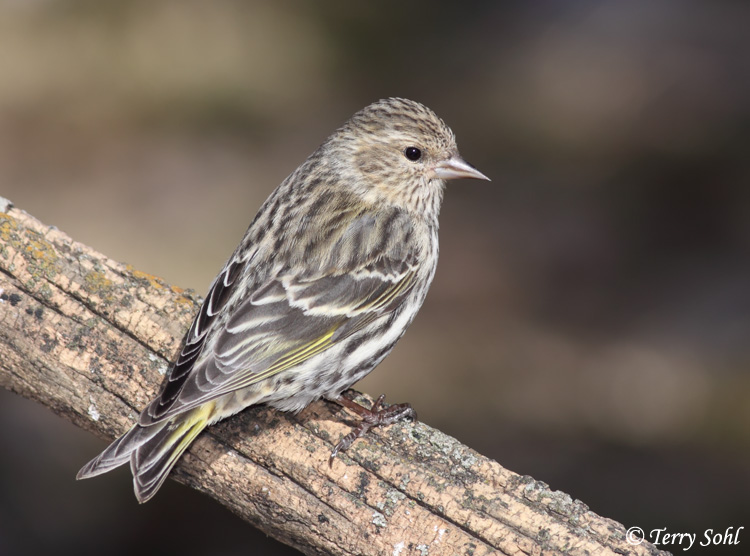
- Pine Siskin - Pine Siskins can sometimes be surprisingly difficult to differentiate from Common Redpolls at times, particularly for birds at some distance. Both are quite small with streaking, and at distance, it can be difficult to see the red crown patch on Common Redpoll. Pine Siskins also have yellow edging on their wings, but given plumage variations and the position of a bird, that yellow sometimes isn't obvious in the field.
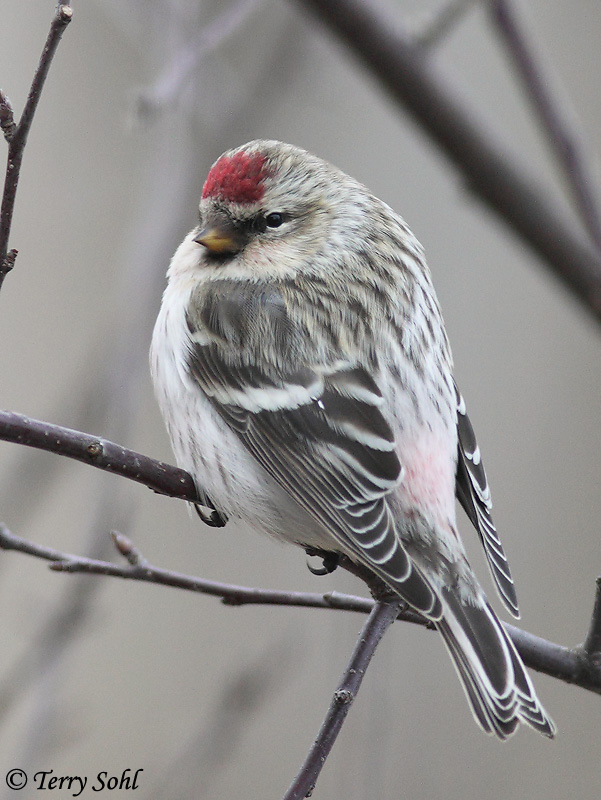 | 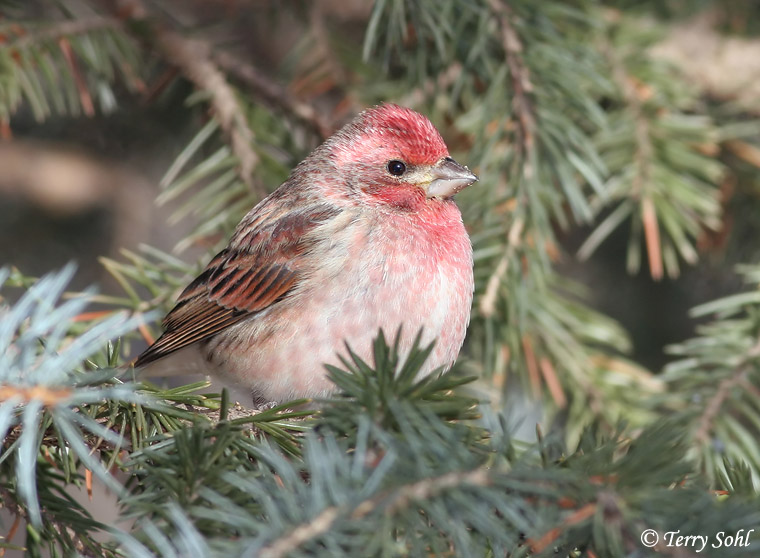 | 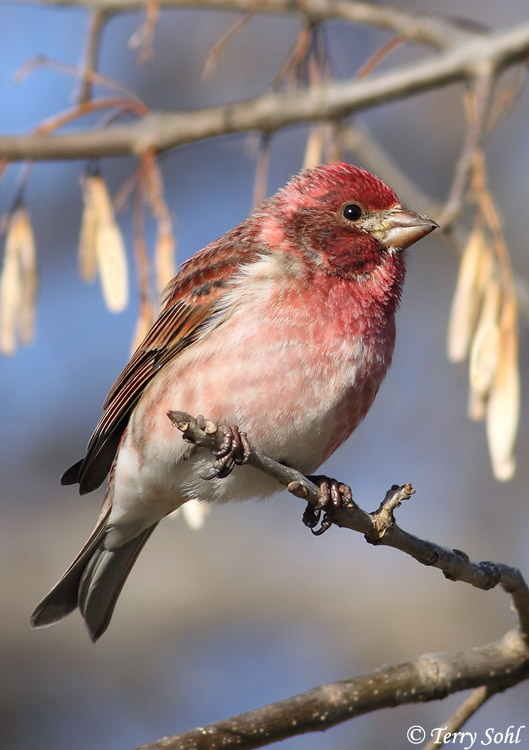 |  |
| Hoary Redpoll | House Finch | Purple Finch | Pine Siskin |
Conservation Status
Systematic surveys in North America have shown rather substantial declines in Common Redpoll populations over the last few decades. Population trends are more mixed in the European part of their range, where numbers appear to be more or less stable. Reasons for the North American decline aren't clear, but are likely a combination of habitat loss and climate change. Overall, however, Common Redpolls are found across a very broad geographic range and are common in parts of that range. The IUCN lists the Common Redpoll as a species of "Least Concern".
Bird Feeders
Will come to feeders for sunflower seeds, millet, and niger ("thistle") seed (with the latter typically being their favorite for their visits in my yard). Note the biggest attractant of Common Redpolls in my yard hasn't been the bird feeders, but the catkins on a large Paper Birch in our landscaping. The catkins also attract other finches all winter long (House Finches, American Goldfinches, Pine Siskins).
Photo Information
December 2004 - Sax-Zim Bog in northern Minnesota - Terry Sohl
Audio File Credits
- 1Paul Marvin. Recorded in Lake County, Minnesota on November 2nd, 2014. Original recording and information available from xeno-canto.
- 2Steve Hampton. Recorded in Matanuska-Susitna, Alaska on May 26th, 2017. Original recording and information available from xeno-canto.
- 3Lance A.M. Benner. Recorded in the Yukon Territory of Canada on March 17th, 2018. Original recording and information available from xeno-canto.
- 4LAndrew Spencer. Recorded in the Nome Census Area of Alaska on June 5th, 2013. Original recording and information available from xeno-canto.
Interactive eBird Map
Click to access the interactive eBird species sightings page for Common Redpoll
