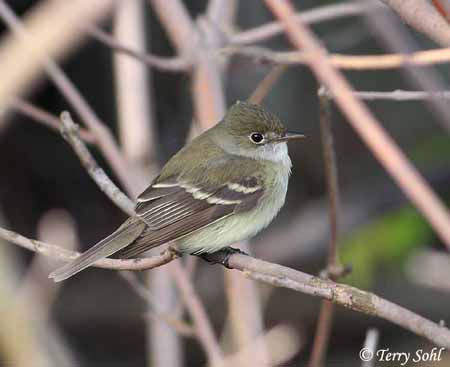
The Alder Flycatcher and the Willow Flycatcher were considered one species, the "Traill's Flycatcher", until the 1970s. Virtually identical in looks, they are only safely distinguished from each other by their different voices. Their ranges are quite different in summer, however, with the Alder Flycatcher found primarily in Canada and Alaska, while most Willow Flycatchers are found in the lower 48 states.
Interestingly, while many bird species must learn their songs from their own species, Alder Flycatchers are born instinctively knowing their song.
Habitat
During the summer breeding season, they strongly prefer forest or thickets near water, especially in groves of willows or alders. During winter, they prefer woodland and woodland edges in the tropics, also near water.
Diet
Primarily feeds on insects, as well as spiders, fruits and berries, and occasionally small seeds.
Behavior
Forages like other flycatchers, by flying out from a perch and catching insect in mid-air. Will also hover while gleaning insects from vegetation.
Interactive eBird Map
Click to access an interactive eBird map of Alder Flycatcher sightings.
Song
The song is a buzzy free-beee-yeer, with an emphasis on the 2nd syllable. The call is a bold peep. Click to listen to the Alder Flycatcher's song, also the Alder Flycatcher's call.
Migration
Summers throughout much of Canada and Alaska, as well as the Great Lakes region and New England. Winters in South America.
Similar Species
Acadian Flycatcher, Least Flycatcher, Willow Flycatcher
Conservation Status
Numbers are probably stable.
Further Information
- eBird - Alder Flycatcher
- Audubon Field Guide - Alder Flycatcher
- Cornell All About Birds - Alder Flycatcher
Photo Information
May 30th, 2005 -- Lake Thompson, Kingsbury County -- Terry L. Sohl
