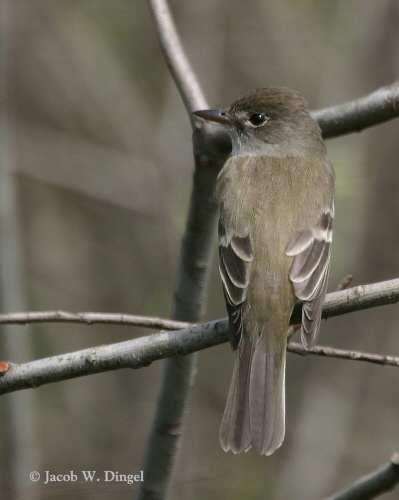
The Acadian Flycatcher is primarily a bird of the forests of the Southeastern United States. It is only known in South Dakota by historical records, and hasn't been officially identified in the state since 1922 (see SDOU's Birds of South Dakota). It is expanding its range to the north in recent decades, however, so it's possible it may again make an appearance in the state.
Of all the very similar Empidonax flycatchers, the Acadian is the only one that regularly nests in the far southern part of the United States, a useful summer ID key in that part of the country.
Habitat
Generally breeds in moist deciduous forests, such as riparian areas and swamps, but can also be found in the understory of dryland forest. Winters in and around tropical forests.
Diet
Primarily feeds on insects. Will also eat spiders, millipedes and centipedes, and fruits and berries.
Behavior
Forages in typical flycatcher fashion, observing from a perch and flying out to catch insects in mid-air. Courtship is often frenetic, with the male chasing the female in rapid aerial pursuit.
Interactive eBird Map
Click to access interactive eBird map for the Acadian Flycatcher
Song
A bold peet-shaaaa song, and a soft peet call. Click to listen to the Acadian Flycatcher's song, also the Acadian Flycatcher's call.
Migration
Summers throughout most of the eastern half of the United States, south of New York. Winters in South America.
Similar Species
Least Flycatcher, Willow Flycatcher, Alder Flycatcher
Conservation Status
Numbers are generally stable, and it may be expanding its range in the northeastern United States.
Further Information
- eBird - Acadian Flycatcher
- Audubon Field Guide - Acadian Flycatcher
- Cornell All About Birds - Acadian Flycatcher
Photo Information
May 31st, 2005 - Butler County, Pennsylvania - Jake Dingel
