
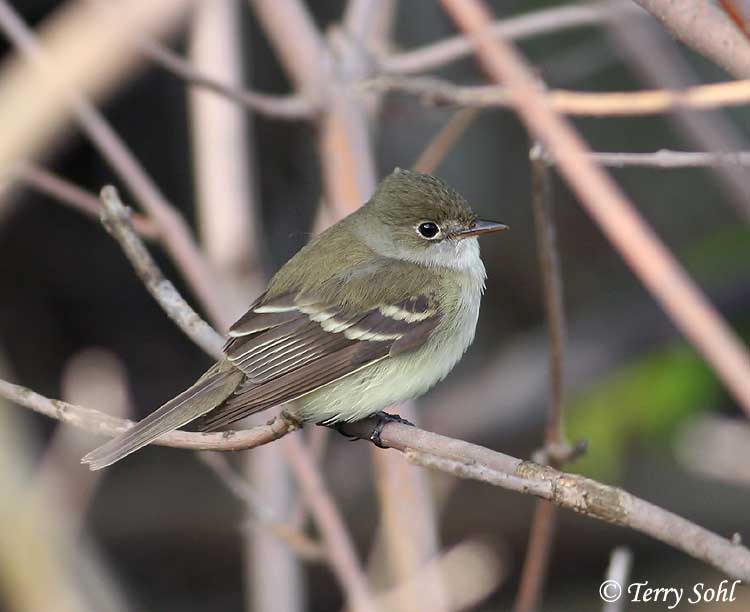
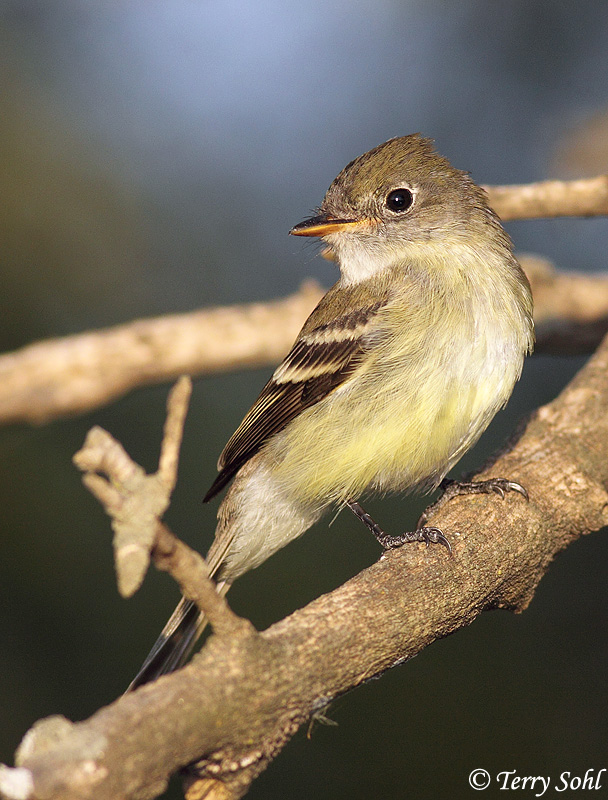
Least Flycatchers are one of the most common small flycatchers that can be found in the state. It is often seen in the open, singing its repetitive song. The Least Flycatcher belongs to a group of 11 "Empidonax" flycatchers, all of which are very similar and difficult to separate. Voice, behavior, and location are often the best clues in differentiating the species. In South Dakota, time of year and habitat offer some clues. Least Flycatchers breed in South Dakota while some species are only migrants. Least Flycatchers are also primarily found in deciduous forest habitats, while another similar species that breeds in here in the summer months (Willow Flycatcher) is primarily found in shrubby areas near water.
Habitat
Mixed habitat with trees and open areas, including woodland edges and clearings, residential areas, parks, and orchards.
Diet
Mostly insects, occasionally berries, other fruit, and seeds.
Behavior
Observes from a perch and flies out to capture passing insects in mid-air. They will also hover and glean insects from foliage and branches.
Nesting
June and July. The nest of a Least Flycatcher is built by the female, in the fork of a tree or shrub, anywhere from 3 to 40 feet from the ground. The nest is constructed of grasses, strips of bark, weedstems, and spider webs, lined with finer grass, moss, lichen, and/or animal hair. The female lays between 3 and 6 eggs, and both parents help to incubate them. The young hatch after about 14 days.
Song
The song of a Least Flycatcher is a short, distinct chee-bek. The call is a soft wheet.
- Click here to hear the song of a Least Flycatcher1
- Click here to hear the call of a Least Flycatcher2
Migration
Summers in much of Canada, the northern third of the U.S., and the Appalachians in the U.S. east. Much rarer in the western part of the continent however. Neotropical migrant, but a few can occasionally be found overwintering in Florida.
Interactive eBird Map
Click here to access an interactive eBird map of Least Flycatcher sightings
Similar Species
Very similar to the other Empidonax flycatchers. The species are all best separated by voice and range, as wells as very minor plumage or structural differences. In eastern South Dakota, the two most likely to be confused with Least Flycatchers are the following:
- Alder Flycatcher - In terms of appearance, they're not safely separated by sight most of the time, although Alder Flycatchers do have a narrower white eye-ring than do Least Flycatchers. Alder Flycatchers are migrants in South Dakota, and thus they are eliminated from consideration during the summer breeding season.
- Willow Flycatcher - As with the Alder Flycatcher, the primary visual difference with a Least Flycatcher is that Willow Flycatchers have a narrower white eye-ring. Both Least and Willow Flycatchers breed in South Dakota, and a clue for identification is habitat. Willow Flycatchers are primarily found in brushy areas near water, while Least Flycatchers are found in upland deciduous forest.
 |
 |
 |
| Alder Flycatcher | Willow Flycatcher | Willow Flycatcher |
Conservation Status
Surveys show declines in recent decades, primarily in the southern part of their breeding range. However, Least Flycatchers are still found across a very broad geographic area, and are common in parts of their range. The IUCN considers the Least Flycatcher to be a species of Least Concern.
Photo Information
May 16th, 2020 -- Beaver Creek Nature Area, South Dakota -- Terry Sohl
Audio File Credits
- 1Jacob Saucier - Recorded in Valley County, Montana on June 21st, 2015 - Original recording and information from xeno-canto.
- 2Martin St-Michel - Recorded near Quebec City, Canada on June 6th, 2016 - Original recording and information from xeno-canto.
