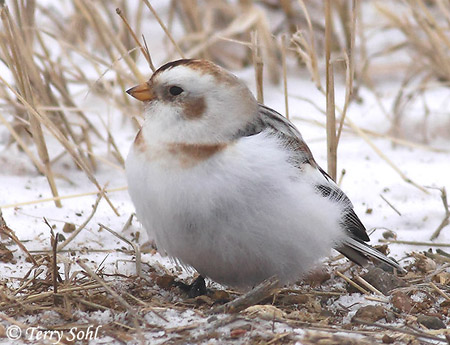
ID Keys: Pale brown and white in winter (in South Dakota), with bold
white wing patch
The Snow Bunting is a
winter visitor to South Dakota. They are most easily observed after a
fresh snowfall, where they can often be found foraging along the edges of roads,
often in mixed flocks with Horned Larks and
Lapland Longspurs. Starkly white with black patches in the
summer (males), they become duller with pale brown and white coloring during
their winter visits to the state. Strongly preferring their summer Arctic
habitat, they are generally very late to arrive in the winter, and very early to
leave in the spring. Males usually leave a month before the females in the
spring to establish breeding territories, arriving on the breeding grounds when
it's often still extremely cold.
Habitat
Summer habitat is the northern Arctic tundra,
preferably in areas with rocky outcrops. In winter, they can be
found in a wide variety of open habitats, including farmland, shortgrass
prairie, and shorelines.
Diet
Primarily seeds and insects, with
seeds making up a large portion of the diet in all seasons. Will also
occasionally feed on leaves and buds, and on small crustaceans and mollusks in
coastal areas.
Behavior
The Snow Bunting is highly social during winter, often forming large, restless flocks that sweep across open fields and snow-covered prairies in tight synchronized flight. It spends much of its time feeding on seeds and waste grain on the ground, frequently moving long distances in response to weather and snow cover.
Breeding
Non-breeder in South Dakota. The Snow Bunting breeds in the high Arctic, nesting among rocky tundra slopes, boulder fields, and crevices that provide shelter from harsh weather. The female builds a well-insulated cup nest of grasses, mosses, and feathers, usually hidden deep within rock cavities. Typical clutches contain 4–6 eggs, and both parents help feed the young after hatching.
Song
The Snow Bunting gives soft, rolling chirps and rattling “tew” or “chew” calls that are commonly heard from flocks in flight. Males produce a pleasant, musical warbling song on the Arctic breeding grounds, often delivered from rocks or during display flights.
Migration
Summers in Arctic. Winters in
much of Canada and the northern half of the U.S.
Breeding range is generally beyond most
human influence. They are found across a broad geographic area, and are
common in parts of their range. Their numbers are in decline, but not at a level
that would threaten overall populations.
The IUCN considers the
Snow Bunting to be a species of "Least Concern".
Photo Information
January 19th, 2009 - Minnehaha
County, South Dakota - Terry Sohl