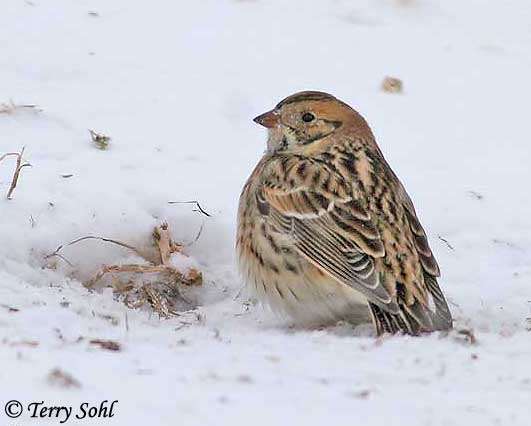
The Lapland Longspur is a hardy Arctic-breeding songbird that becomes a familiar winter visitor across open fields, prairies, and stubble lands of the central and northern United States. Often traveling in restless flocks with snow buntings or Horned Larks, Lapland Longspurs feed on seeds and waste grain in winter and shift to insects during their brief tundra nesting season.s.
Habitat
Prefers open country in winter, including farm fields, pastures, grasslands, and beaches. It summers on the Arctic tundra.Diet
Winter diet in South Dakota is primarily seeds and waste grain. Summer diet includes seeds but also many insects and spiders.Behavior
Very gregarious except while nesting, Lapland Longspurs often forage in flocks numbering in the thousands. They primarily forage by walking along the ground.Breeding
Non-breeder in South Dakota. In their breeding range, The Lapland Longspur nests on the Arctic tundra, usually placing its grass-lined cup in a shallow depression hidden beneath dwarf shrubs, moss, or tussocks. The female lays 4 to 6 eggs, and both parents help feed the nestlings on insects during the short northern summer. Careful placement among low vegetation helps shield the nest from cold winds and predators.Song
The Lapland Longspur gives dry rattling or rolling kew and prrt calls, especially from flocks moving over open fields in winter. The breeding male sings a sweet, tinkling, musical warble delivered in fluttering song flights above the Arctic tundra.Migration
Winters throughout much of the continental United States. Summers in extreme northern Canada and Alaska.Interactive eBird Map
Click here to access an interactive eBird map of Lapland Longspur sightingsSimilar Species
In South Dakota, the Lapland Longspur is most often confused with winter flocks of Horned Lark.While summer and winter ranges are different, in migration they could be confused with Chestnut-collared Longspur, McCown's Longspur, or Smith's Longspur. Lapland Longspurs are generally browner and more heavily streaked than Horned Larks, lacking the lark’s obvious black facial pattern and tiny horn tufts, while also showing a thicker seed-eating bill and a noticeable long hind claw. Compared with Chestnut-collared and McCown’s Longspurs, Laplands in winter look darker-backed, more crisply streaked below, and less pale in the face, without the cleaner buffy tones or bold white wing-and-tail flashes often shown by those prairie breeders. Smith’s Longspur is buffier and warmer overall with less distinct streaking and a softer-faced expression, whereas Lapland usually appears sharper-marked and colder brown.
