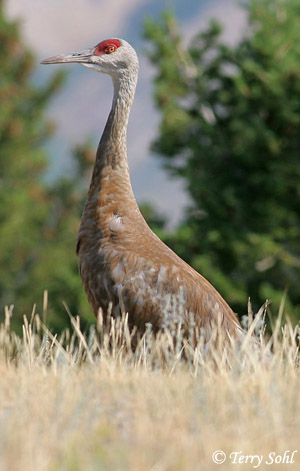
The most common crane in the world, Sandhill Cranes are best known in this area for their yearly stopover during migration at the Platte River in south-central Nebraska, where 90% of the world's population can be found in the early spring. Different races of Sandhill Cranes may exhibit a fairly large variation in size. The most common of the migrating races are generally stable or increasing in population, but non-migratory populations in Mississippi and Cuba are endangered.
Habitat
Prefers to breed in or around a variety of marshy areas. During winter and migration, they can spend much of their time feeding on waste grain in agricultural fields.Diet
Omnivorous, feeding on a wide variety of items including waste grain, seeds, roots and other plant material, frogs, various mollusks and crustaceans, small rodents, snakes, lizards, and large insects. The diet can vary tremendously between locations and at different seasons.Behavior
The Sandhill Crane is highly social and is often seen in pairs, family groups, or large flocks during migration and winter. It forages in fields, wetlands, and grasslands for grains, seeds, insects, and small animals, and is famous for its elaborate dancing displays involving bowing, jumping, wing spreading, and tossing vegetation into the air.Nesting
Non-breeder in South Dakota. In range, the Sandhill Crane nests in marshes, wet meadows, bogs, and other shallow wetland habitats with dense emergent vegetation. The pair builds a mound-like nest of grasses, sedges, reeds, and other marsh plants, usually surrounded by shallow water for protection. Most clutches contain two eggs, and both adults share incubation duties and care of the young.Song
The Sandhill Crane is famous for its loud rolling bugling calls that can carry for miles across wetlands and migration stopovers. Pairs often perform synchronized unison calls, while flocks in flight give constant rattling and trumpeting contact notes.
Click here to hear Sandhill Crane vocalization