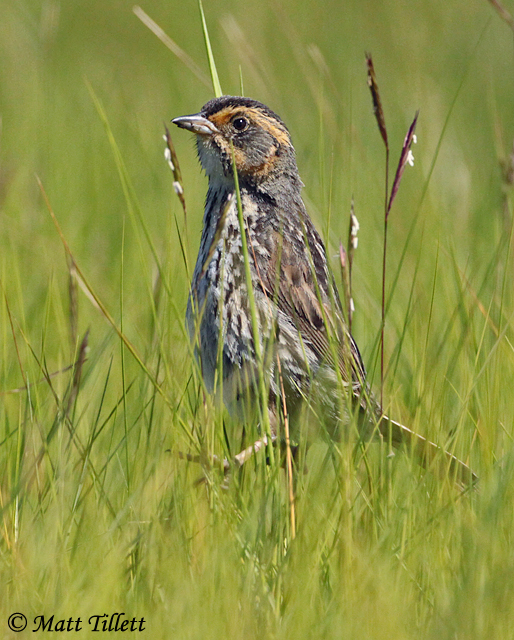
ID Keys: Bright buffy face with grayish-brown cheek, dark crown with
gray central stripe, strong streaking on flanks, white belly, pale
buff on sides
Despite
their very different geographic ranges and preferred habitats, the Saltmarsh
Sparrow and the Nelson's Sparrow were
only recently split into two species, having once been known under the
single species name of "Sharp-tailed Sparrow". The Saltmarsh Sparrow
is well named, found in coastal saltwater wetlands along the Atlantic Coast
of the United States. There are small areas where the two species may
overlap in range, but they can be differentiated by the different songs sung
by the males, by the longer bill of the Saltmarsh Sparrow, and by the more
well-defined border between belly and chest on the Nelson's Sparrow.
Habitat
Found in coastal salt marshes along the
Atlantic Coast of the United States. They can also sometimes be found
in brackish or freshwater marshes that are very near the coast.
Diet
Feeds on insects and other small
invertebrates, including small marine creatures such as snails, marine
worms, and tiny crabs. They will also sometimes eat seeds,
particularly in the winter months when invertebrates may be less abundant.
Behavior
Forages by walking along the ground, or
by clambering through the marsh vegetation. They will also sometimes
probe in the mud or sand in search of small marine invertebrates.
Nesting
The nest of a Saltmarsh Sparrow is a cup
of grasses, placed in marsh grasses just above the level of high tide.
The female usually lays between 3 and 5 eggs, and she alone incubates them.
When the eggs hatch, the female alone feeds and tends them. The young
fledge after about 10 days, but typically stay in the care of the female for
another 2 weeks. Saltmarsh Sparrows will often raise more than one
brood in a summer season.
Song
Song of a Saltmarsh Sparrow is a soft, rapid
series of fading gurgles and hisses.
Migration
Considered a permanent resident in
parts of their normal range. However, some migration along the
Atlantic Coast does occur, with birds at the northern end of the range
moving southward, and birds found in winter range where birds are not found
during the summer months.
The IUCN currently lists the
Saltmarsh Sparrow as a "Vulnerable" species. Loss of coastal wetland
habitat has greatly reduced suitable breeding areas for the species, with
populations now much more fragmented than they were historically.