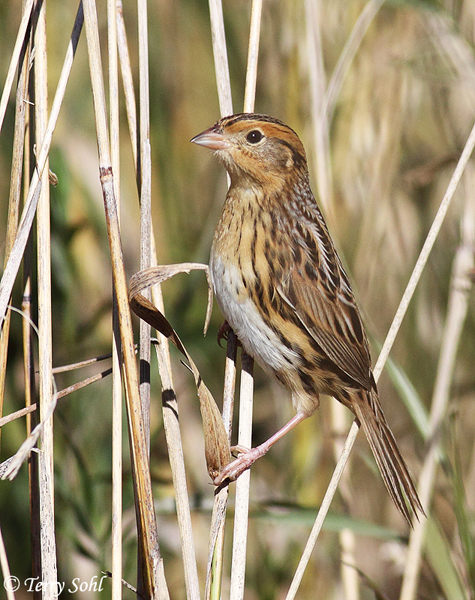
The LeConte's Sparrow can sometimes be a difficult bird to observe, as they are normally found in the dense vegetation around the edges of marshes or in damp fields. It also normally forages near the ground below the vegetation, and when disturbed, is more likely to run away or fly low through the vegetation for a short distance. Given their habits they were long considered one of the more mysterious sparrow species in North America. They were first identified in the late 1700s, but it took over 100 years before the first nest was recorded. They are one of the smallest sparrows found in South Dakota, yet one of the most beautifully colored and intricately marked.
Habitat
They are found on the fringes of wetlands and marshes or in damp fields during the summer breeding season, wherever very shallow water is found in conjunction with a dense cover of herbaceous vegetation. They winter in similar wet habitats during the winter. During migration in South Dakota, they are often found in the same damp grassy areas, or upland grassland habitats as well.
Diet
Primarily feeds on insects during the summer, and seeds during the winter.
Behavior
Most of its foraging is done on or near the ground, often under cover of dense vegetation. Males may sing night or day from a perch within tall grass during the summer breeding season.
Nesting
June and July. The nest of a LeConte's Sparrow is a small cup, built of grasses, weed stems, and other vegetative material, and lined with finer grasses and hair. It is placed on the ground in a protected area, such as the base of a clump of vegetation. The female lays 3 to 5 eggs, and she alone incubates them. The eggs hatch after 12-14 days.
Song
The song of a LeConte's Sparrow is a weak insect-like buzzing. They also have a quiet but crisp chip call.
1Click here to hear audio of a singing LeConte's Sparrow
2Click here to hear audio of the call of a LeConte's Sparrow
Migration
Summers in the extreme northern Great Plains and western Great Lakes region, and throughout much of south-central Canada. Winters in the southeastern United States, from Texas eastward through North Carolina.
Interactive eBird Map
Click here to access an interactive eBird map of Leconte's Sparrow sightings
Similar Species
Nelson's Sparrow, Grasshopper Sparrow. Of these two species, Nelson's Sparrow is the most similar, sharing most general plumage characteristics. The easiest way to differentiate between a Nelson's Sparrow and a Grasshopper Sparrow is to 1) look nape (back of the neck). A LeConte's Sparrow has obvious brown streaking on a gray nape, while a Nelson's Sparrow has a clean gray nape, and 2) Crown stripe. LeConte's Sparrow have a distinct crown stripe that Nelson's Sparrows lack.
Conservation Status
Still common in much of its range where habitat remains, but has experienced some declines due to habitat loss. They are still found over a broad geographic area, and are relatively common in parts of their range. The IUCN considers the LeConte's Sparrow to be a species of "Least Concern".
South Dakota "Hotspot"
I've had great luck finding them in many weedy overgrown fields in the Sioux Falls Area in the Fall (especially the last week of September and first week of October), especially those near wetlands. "Atkins Slough", a wetland area just west of the high school outside of Tea, in Lincoln County, nearly always has a number of LeConte's Sparrows during the fall, as well as other migrating sparrow species. They can also be found in dry shrubby and grassy areas, far from wetlands or water, as they migrate through in the Fall.
Photo Information
October 9th, 2013 -- Lake County, South Dakota -- Terry Sohl
Audio File Credits
1Andrew Spencer. Recorded in Stutsman County, North Dakota on June 14th, 2007. Original recording and information from xeno-canto.
2Patrick Turgeon. Recorded in Saskatchewan on August 15th, 2016. Original recording and information from xeno-canto.
