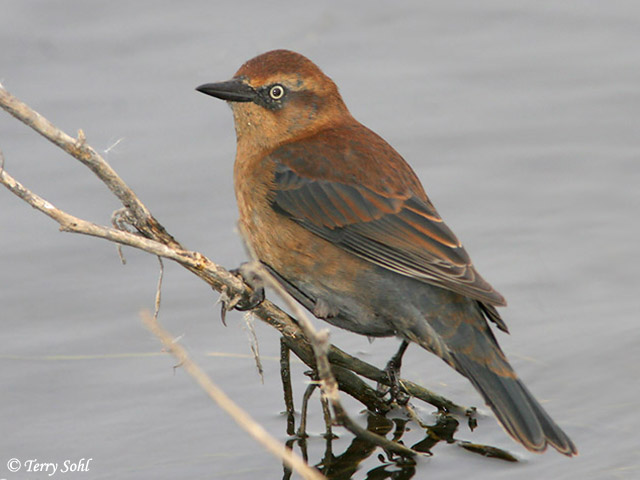
The Rusty Blackbird is only a migrant in the state, as it summers throughout Canada and winters primarily in the Southeastern United States. The species strongly prefers locations near water, both in migration and winter, and on its summer breeding grounds. Even at peak in migration, they are generally an uncommon bird compared to some of the other blackbirds in the state. Summer birds are dull black overall with much less gloss than some other blackbirds, such as Common Grackles. Their name comes from the rusty-brown plumage they acquire for the winter, as in the photo to the right.
Rusty Blackbirds are a species of concern in North America, as systematic surveys such as the Breeding Bird Survey have shown very severe declines since the mid 20th century. Habitat loss is thought to play a key role in their decline.
Habitat
Strongly prefers habitats near water. Summer breeding grounds are muskeg swamps in Canada. During migration and winter, is also generally found near wooded swamps and tree-lined rivers.
Diet
The primary food item is insects, including many aquatic insects. Will also eat small mollusks and crustaceans, small fish, and seeds and waste grain.
Behavior
Primarily forages on the ground near water, or by foraging in shallow water. Often gregarious, forming mixed flocks with other blackbird species, especially in migration and in winter.
Breeding
Non-breeder in South Dakota. On their breeding grounds, Rusty Blackbirds most frequently nest in woody wetland habitats, placing the nest low in a dense shrub or small tree within 1 to 10 feet of the water's surface. The nest is built of a foundation of twigs, grasses, and other vegetative material, and lined with a unique mix of rotting vegetation and mud which dries to a hard inner layer. The female lays between 3 and 6 eggs, and she alone incubates them. The young hatch after about two weeks.
Song
Song consists of low, squeaky gurgling followed by a higher note at the end. They also have a sharp kek call note, and individual squeaky whistled notes.
- Click here to hear the song of a Rusty Blackbird1
- Click here to hear the calls of a male Rusty Blackbird2
Migration
Rusty Blackbirds summer throughout much of Canada and Alaska, as well as parts of the far northern Great Lakes and Northeastern US. They winter in the eastern half of the United States. In South Dakota, Rusty Blackbirds are migrants, more commonly found in the eastern part of the state and rare in the west.
Interactive eBird Map
Click here to access an interactive eBird map of Rusty Blackbird sightings
Similar Species
Rusty Blackbirds are potentially confused with multiple other blackbird species in South Dakota, particularly when birds are in a more basic black plumage and the rusty coloring is reduced.
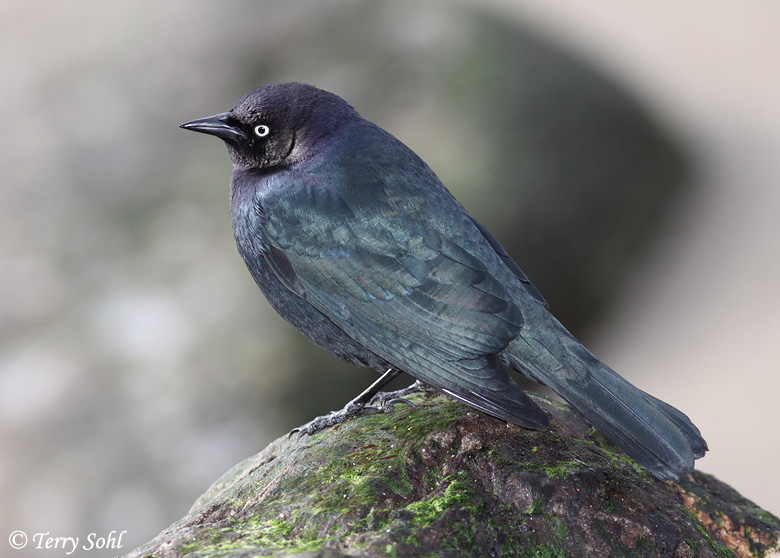
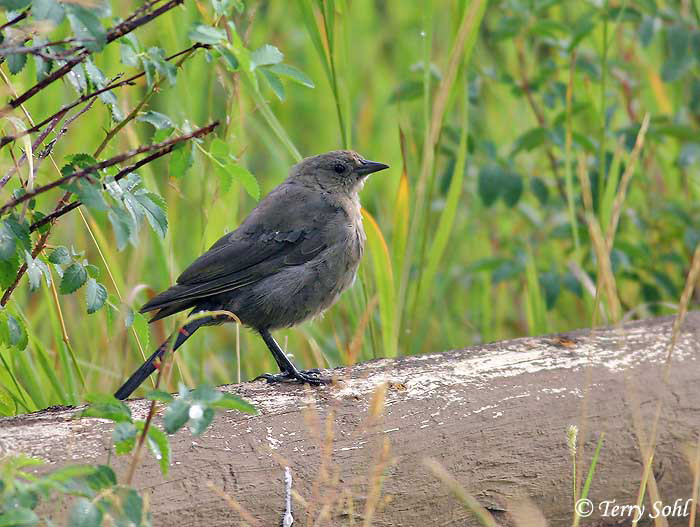
- Brewer's Blackbird - Non-breeding males are unlikely to be confused with a Brewer's Blackbird, as the rusty-coloring in that plumage is diagnostic. In breeding plumage, differentiating the males of the two species is much more difficult. The bills of the two species are slightly different, with a touch of a curve to a Rusty Blackbird bill and a straighter bill for a Brewer's Blackbird, but that's generally difficult to identify in the field. Male Brewer's Blackbirds tend to show a glossy purplish cast around the head and shoulders, while male Rusty Blackbirds lack the purplish cast. Females of the two species are easier to differentiate as female Brewer's Blackbirds are a dull brownish-gray color, and female Rusty Blackbirds have the trademark rusty plumage.
- Common Grackle - Common Grackles are indeed common in South Dakota, and can often be seen in conjunction with migrating Rusty Blackbirds. They are a larger bird, with a longer tail and a more robust bill. Male Common Grackles share the overall dark plumage of a male Rusty Blackbird in breeding plumage, but show a glossy, bluish head that has a clear demarcation with the more dark, slightly bronzed tone body feathering. Female Common Grackles share the same structural differences as the males with Rusty Blackbirds. Female Common Grackles are a dark brown overall and lack the rusty coloring of a female Rusty Blackbird.
- Brown-headed Cowbird - Male Brown-headed Cowbirds could be confused with a breeding plumaged male Rusty Blackbird, with a dark overall coloring. However, male Cowbirds have a signature brown head that contrasts with the darker body. Brown-headed Cowbirds also have a more stout and shorter bill than a Rusty Blackbird.
 |
 |
 |
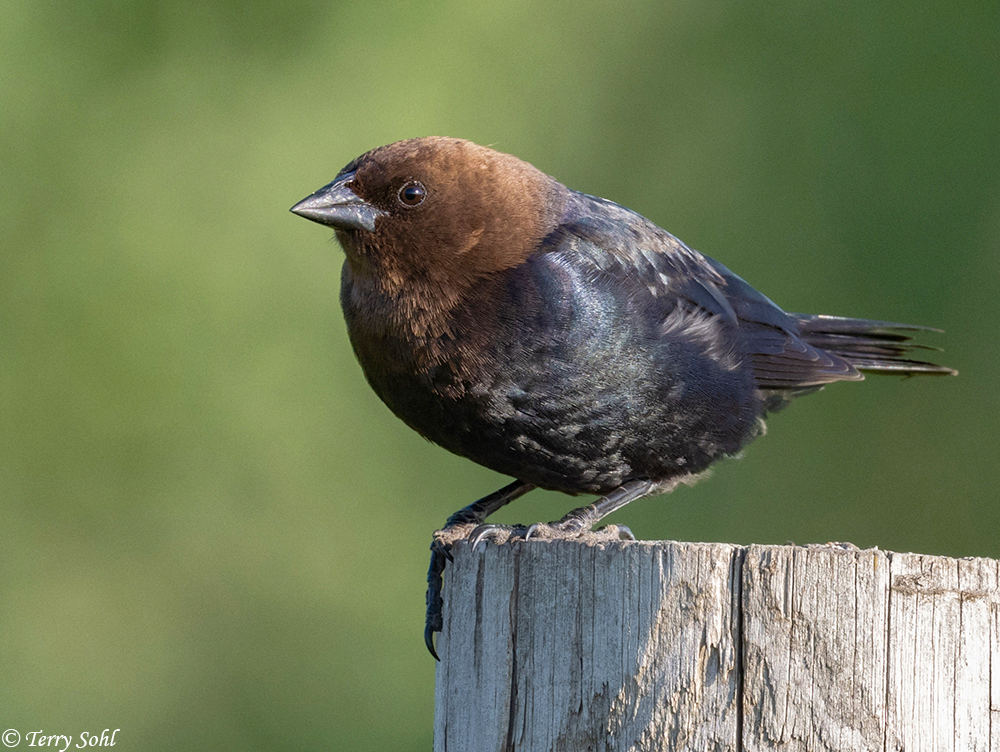 |
| Brewer's Blackbird (male) | Brewer's Blackbird (female) | Common Grackle (male) | Brown-headed Cowbird (male) |
Conservation Status
Numbers have declined significantly since the 1960s, with Breeding Bird Survey (BBS) numbers showing a decline of 89% between the 1960s and the mid 2010s. Christmas Bird Count (CBC) surveys have also recorded declining trends for the species. As a result the IUCN considers the Rusty Blackbird to be a "Vulnerable" species. There are a number of likely reasons behind the decline, including loss of boreal wetland habitats in Canada (much of it the result of mining activity), climate change impacts on northern habitats, and introduced chemicals in the environment.
Photo Information
October 9th, 2006 - Lake County - Terry Sohl
Audio File Credits
- 1Todd Wilson. Recorded in Dodge County, Wisconsin on October 10th, 2010. Original recording and information available from xeno-canto.
- 2Andrew Spencer. Recorded in Coos County, New Hampshire on June 9th, 2010. Original recording and information available from xeno-canto.
