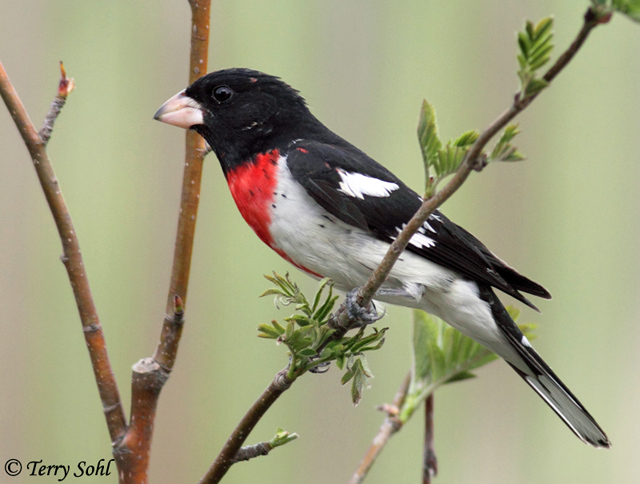
Found in deciduous forests and groves in the eastern part of the state, the Rose-breasted Grosbeak is fairly common in appropriate habitat. The males sing almost continuously during courtship, even when fighting other males or when in flight. While associated with forested areas, they rarely are found in dense, unbroken forest, instead preferring woodland edges and suburban parks. They are closely related to the Black-headed Grosbeak of the western U.S., and will occasionally interbreed with them where their ranges overlap. The photo to the right depicts the brightly colored male. Additional photos, including those of a female, can be found at the bottom of the page.
Habitat
Deciduous or mixed forest, residential areas, groves. Prefers woodland edges or openings, less likely to be found in unbroken forest.
Diet
Insects, seeds, buds, flowers, fruits and berries.
Behavior
Forages by moving through foliage of trees and shrubs, looking for food items. Will also fly out from perches to snatch insects in mid-air, or hover while taking insects from the surface of a leaf or branch.
Nesting
June and July. The nest is constructed by both the male and female, and consists of a loose, thin collection of twigs, grasses, weeds, and other vegetative material, generally lined with fine twigs, hair, or small roots. It is placed in the fork of a tree, often a small tree, and typically in a semi-open forested area or along the woodland edge. The female lays between 2 and 5 eggs, with both parents helping to incubate them. Incubation lasts about two weeks. The young fledge from the nest 10-14 days after hatching.
Song
A vocal species, with the sweet warbling song of a male often heard during spring and early summer. They also have a rather sharp chink call, and other vocalizations when alarmed or near the nest.
- 1Click here to hear the sweet warbling song of a male, recorded in Middlesex County, Massachusetts.
- 2Click here to hear the sharp calls of a male Rose-breasted Grosbeak, recorded near Montreal, Quebec
- 3Click here to hear the distress calls of a male that's in hand, being banded, recorded in Columbia
Migration
Neotropical migrant, wintering in Mexico, Central America, and South America. Summer breeding range covers much of the eastern half of the U.S. except the deep South, as well as parts of southern and central Canada.
Interactive eBird Map
Click here to access an interactive eBird map of Rose-breasted Grosbeak sightings
Bird Feeders
Will attend feeders for sunflower seeds, safflower, and fruit. They will also sometimes feed on suet.
South Dakota "Hotspot"
Rose-breasted Grosbeaks are quite common in forested areas of the eastern part of the state. Newton Hills State Park, riparian areas along the major eastern rivers of the state, and suburban parks and woodlands all may hold the species. The Big Sioux Recreation Area (across the street from our home) always holds good numbers of Rose-breasted Grosbeaks in the summer months, with birds visiting our feeders from early May through August.
Similar Species
Black-headed Grosbeak is closely related, although the striking pattern of a male Rose-breasted Grosbeak is unlikely to be confused with another species. Females of the two species are similar however.
Conservation Status
Numbers appear to be decreasing in parts of its range, likely due to local habitat loss. However, overall numbers are relatively stable, they are very common in parts of their range, and they are found over a wide geographic area. The IUCN considers the Rose-breasted Grosbeak to be a species of "Least Concern".
Photo Information
May 17th, 2013 - Newton Hills State Park in South Dakota - Terry L. Sohl
Audio File Credits
- 1Molly Jacobson, XC414557. Accessible at www.xeno-canto.org/414557
- 2Martin St-Michel, XC295794. Accessible at www.xeno-canto.org/295794
- 3Oscar Humberto Marin-Gomez, XC131800. Accessible at www.xeno-canto.org/131800
