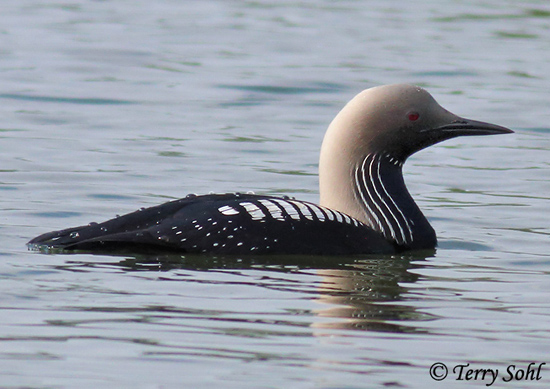
The Pacific Loon is almost exclusively found along the North American Pacific coast in the winter time, but in summer, can be found in northern Canada as far east as Hudson Bay and Baffin Island. They are rarely found inland during migration, and are thus only very rare visitors to South Dakota. They are very similar in overall appearance to the Arctic Loon, but the Arctic Loon is even more rare in the interior of the US, and has never been sighted in South Dakota.
Habitat
The Pacific Loon breeds on Arctic tundra lakes, ponds, and wetlands, often in open treeless landscapes near the coast. During migration and winter it inhabits large lakes, reservoirs, bays, estuaries, and coastal marine waters, where it forages in open water for fish and other aquatic prey.
Diet
Primarily feeds on small fish if available, but will also consume crustaceans, mollusks, aquatic insects and their larvae, and occasionally plant material.
Behavior
Forages by diving below the water's surface and propelling itself with its feet in search of prey. They will often partially submerge their head below the surface in search of food items before initiating a dive. Breeding pairs are thought to breed for life.
Nesting
Non-breeder in South Dakota. On their breeding grounds in northern Canada and Alaska, Pacific Loons build a nest nest to a shoreline of a tundra or open boreal forest lake. The nest is a platform of varying thickness, from a simple shallow scrape with a sparse lining of vegetation, to a more robust nest platform constructed of wetland vegetation, roots, and mud. The female lays between 1-3 eggs, and both parents help to incubate them. The young hatch after about 24 days, and leave the nest after only a day or two. Pacific Loons can be extremely aggressive in defending the nest site and their young, and will even attack creatures much larger than themselves.
Song
Generally silent during migration through the state. On their breeding grounds Pacific Loons have a low croaking sound, and a wailing song.
1Click here to hear the wails of a Pacific Loon on its breeding grounds, recorded near Nome, Alaska.
2Click here to hear the low croaking of a Pacific Loon, recorded on the North Slope of Alaska.
Migration
Summers in northern Canada and Alaska. Winters along the Pacific coast from Alaska down through Mexico. Given their preference for nesting along the coast, migrants through the interior of the US are thus rare.
Interactive eBird Map
Click here to access an interactive eBird map of Pacific Loon sightings
Similar Species
Pacific Loons are extremely rare visitors to South Dakota, with a handful of records. Nearly all of these records have been in the mid- to late-fall time period, and were birds in non-breeding plumage. Here are the other loon species that could potentially be confused with Pacific Loon:
- Arctic Loon - Arctic Loons and Pacific Loons are extremely similar in overall appearance, in both breeding and non-breeding plumage. The primary feature to differentiate the two is a watch patch near the rear flank on an Arctic Loon (in both plumages). In winter plumage, Pacific Loons also have a dark "beard" (small darker smudging) on the lower face, while an Arctic Loon has a cleaner white lower face and neck. In South Dakota differentiating between the two likely isn't going to be a problem, as 1) The Pacific Loon themselves are extremely rare in the state, and 2) Arctic Loons are eve more rare in the Lower 48 states, and they have never been seen in South Dakota.
- Common Loon - Common Loons share a "checkerboard" pattern on the back in breeding plumage, but that pattern is more extensive on a Common Loon and extends down the flanks more. The head and neck are completely different between the two species in breeding plumage, with the Common Loon having a dark head, and dark "collar", and smaller areas of vertical striping above and below the collar. The Pacific Loon has a gray head and neck, with a dark throat bordered by longer vertical striping than is found on a Common Loon. In non-breeding plumage, bill size is one key, as a Common Loon as a larger, thicker bill. Both are generally white below and darker above, but on a Common Loon, the line between dark and light on the neck is rather jagged and irregular, while it's more of a straight line on a Pacific Loon.
- Red-throated Loon - A Red-throated Loon in breeding plumage has (shockingly!) a red throat that is lacking on a Pacific Loon. They also have vertical striping on the back of the neck (gray back of neck on the Pacific Loon), and have a solid dark back (checkerboard on a Pacific Loon). In non-breeding plumage, Red-throated Loons have more of a mottled pattern while Pacific Loons are more consistently dark. Red-throated Loons also tend to have more white on the face and neck than a Pacific Loon.
Status
Generally stable throughout its normal range, with some indications of increases in recent decades. They are found over a wide geographic area and are common in parts of their range. The IUCN considers the Pacific Loon to be a species of "Least Concern".
Photo Information
May 22nd, 2014 - Near Eagle River, Alaska - Terry Sohl
Audio File Credits
1Patrik Aberg, XC406246. Accessible at www.xeno-canto.org/406246
2Andrew Spencer, XC141729. Accessible at www.xeno-canto.org/141729
