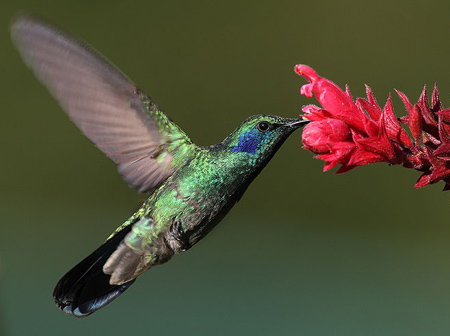
The Mexican Violetear (formerly known as Green Violetear) is typically found in central Mexico, Central America, and northern South America. While mostly a permanent resident throughout its normal range, individuals seem to wander widely. Mexican Violetears are found in Texas seemingly every year, and individual birds have strayed as far north as Wisconsin, Michigan, and even Canada.
Habitat
In their normal range in Mexico, Central America, and South America, Mexican Violetears are typically found in montane forest clearings and forest edges. They can be found at elevations as high as 10,000 feet on the eastern slope of the Andes in South America. Those that have been wandered to the U.S. have typically been found in urban and suburban habitats when they frequent bird feeders.
Diet
The Mexican Violetear feeds primarily on nectar from a wide variety of flowering trees, shrubs, and herbaceous plants. It also consumes small insects and spiders, catching them in flight or picking them from foliage to obtain essential protein. The species forages by hovering at flowers and often defends especially productive nectar sources from other hummingbirds.
Behavior
Mexican Violetears will defend a feeding territory like other hummingbirds, but in their normal range, they are often dominated by other hummingbird species. They are typically solitary, but can be found in loose concentrations where adequate food supplies are present.
Nesting
The nest of the Mexican Violetear is usually built fairly low to the ground on the horizontal branch of a shrub or tree, from 3 to 12 feet high. The nest is built of plant fibers, tiny twigs, moss, and "decorated" with lichens. The female alone builds the nest, incubates the eggs, and raises the young.
Song
The Mexican Violetear is a highly vocal hummingbird known for its loud, repetitive series of sharp metallic chips and buzzy notes. Males often sing persistently from exposed perches, especially during the breeding season, producing rapid, high-pitched phrases that carry surprisingly long distances. The species also gives shorter chattering calls while defending feeding territories and interacting with other hummingbirds.
Migration
The Mexican Violetear is primarily a resident species throughout much of its range in the mountains of Mexico and Central America. Many populations make seasonal elevational movements, descending to lower elevations after the breeding season or when flowering plants become less abundant at higher elevations. It is not considered a long-distance migrant, although individuals occasionally wander well outside their normal range, resulting in rare records in the United States and Canada.
Interactive eBird Map
Click here to access an interactive eBird map of Mexican Violetear sightings
Feeders
Will attend hummingbird feeders
Similar Species
Somewhat similar overall coloring to Broad-billed Hummingbird. The Mexican Violetear is noticeably larger than the Broad-billed Hummingbird and is mostly shimmering green with a distinctive violet patch behind each eye and a straight, dark bill. Broad-billed Hummingbirds have a bright red bill with a black tip, deep blue throat, and lack the prominent violet ear patch. Additionally, Mexican Violetears often perch conspicuously while singing, whereas Broad-billed Hummingbirds are more frequently seen actively feeding among flowers.
Conservation Status
The Mexican Violetear is classified as Least Concern by the International Union for Conservation of Nature because of its broad distribution across Mexico and Central America and its large, stable population. It remains common in montane forests, woodland edges, and gardens, where it readily uses flowering plants as nectar sources. Although localized habitat loss may affect some populations, the species is not currently considered globally threatened.
Further Information
Photo Information
Taken in Boquete, Panama - Licensed under Creative Commons Attribution-ShareAlike 3.0 Unported license .
