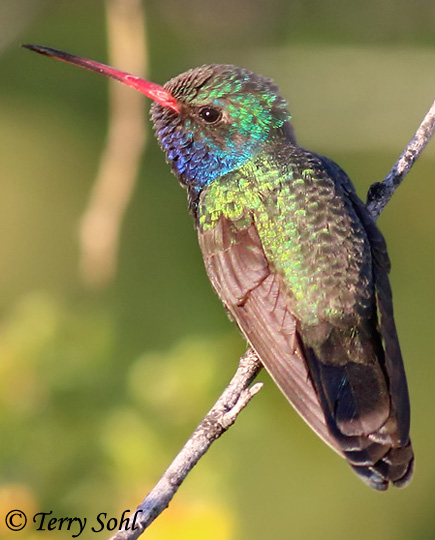
The Broad-billed Hummingbird is a very common bird of lower to medium elevations in southern Arizona during the summer breeding season, despite that being the far northern reaches of its normal range. The primary range for the species also includes a large swath of western Mexico. The brilliantly colored males are recognizable from their (relatively) broad, orangish-red bill, a dark blue gorget, and a brilliant bluish-green body. Males can often be seen courting females,by first approaching, hovering directly in front of the female, and then performing u-shaped courtship flights as the female observes. Males can also be quite territorial, resting on a high perch over a "claimed" territory and chasing away any intruders.
Habitat
Broad-billed Hummingbirds can be found in a variety of semi-open habitats, usually at lower to moderate elevations in their Arizona range. This may include riparian areas, thickets of mesquite and other brush with adjacent open areas, or open woodlands.
Diet
Feeds as do other hummingbirds, favoring tubular flowers that are red or orange in color. They will also consume many tiny insects.
Nesting
Nest is a small cup built of bits of dried vegetation and spider webs, and is typically built between 4 and 10 feet from the ground.
Song / Call
Males have a series of short, rattling chip notes given when courting. One call of a Broad-billed Hummingbird is a very fast, rattling che-dit, generally given multiple times.
- Click here to hear the short che-dit calls of a foraging female Broad-billed Hummingbird1
- Click here to hear the rattling calls of a male Broad-billed Hummingbird2
Migration
Birds in Arizona and New Mexico are most often found in the summer breeding season. Fewer are around in the fall and winter months, but some will stay all winter.
Interactive eBird Map
Click to access an interactive eBird map of Broad-billed Hummingbird sightings
Similar Species
There are many hummingbird species that could potentially be found within the range of the Broad-billed Hummingbird. Here are a couple of species that are perhaps most likely to intersect in range with Broad-billed Hummingbirds, and potentially cause identification issues.
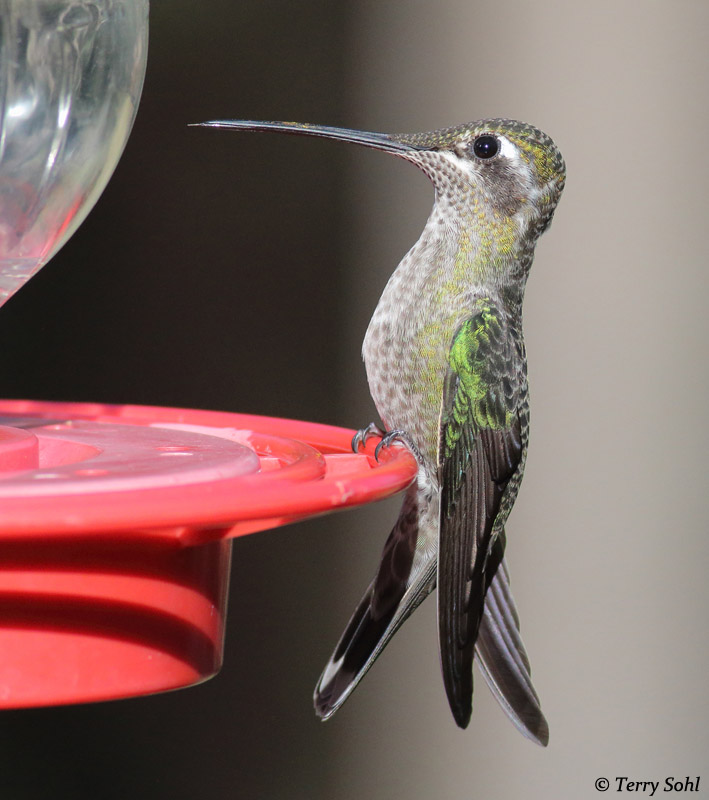
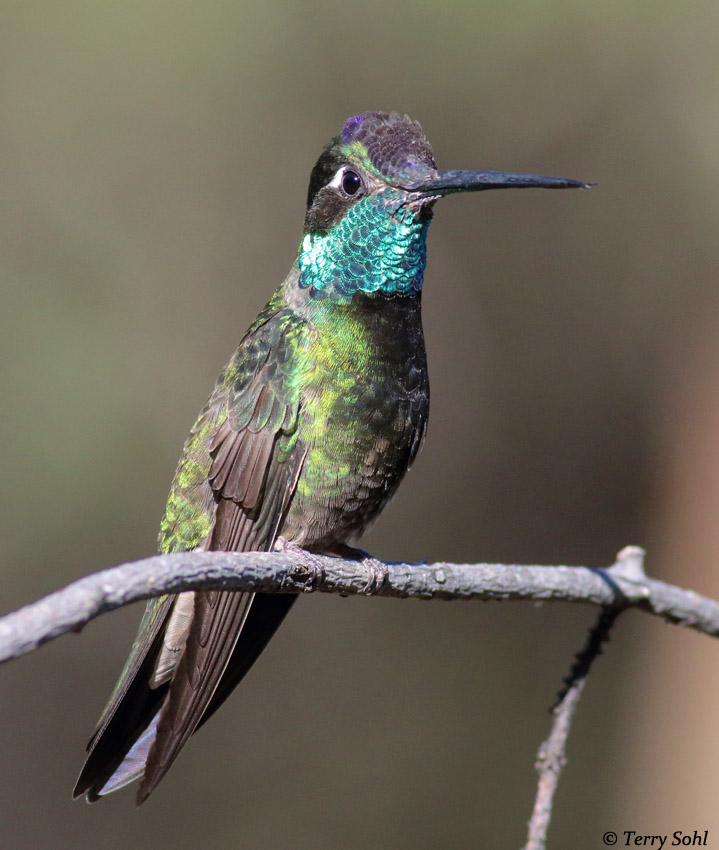
- Rivoli's Hummingbird - Rivoli's Hummingbird (previously known as Magnificent Hummingbird) do have a similar range in southern Arizona and New Mexico. They're large hummingbirds, substantially larger than a Broad-billed Hummingbird, but size alone can be difficult to judge. Male Rivoli's Humminbirds are less likely to be confused with a Broad-billed Hummingbird than females, as Male Rivoli's lack the orange bill of a male Broad-billed Hummingbird. Color patterns are different as well, with the head pattern almost flipped, as male Rivoli's have a purplish-bluish top of the head and a green throat, and the colors are flipped on a male Broad-billed Hummingbird. Female hummingbird species in general are much harder to differentiate. Female Rivoli's Hummingbirds are larger, with a white streak behind the eye. Female Broad-billed Hummingbirds have a white arc above the eye that also curls downward behind the eye.
- White-eared Hummingbird - The bills can be deceiving for both male White-eared and Broad-billed Hummingbirds, as both have the reddish bill with a black tip. Male White-eared Hummingbirds have the obvious bold white "ear" line that's lacking from the male Broad-billed Hummingbird. Female White-eared Hummingbirds also have a bold white ear line that could potentially be confused with the white arc on the face of a female Broad-billed, but on a Broad-billed the white is thinner and extends up and over the eye, from the front of the bill to behind the eye. Female White-eared Hummingbirds also have a dark face patch, and tend to have pale greenish patches on their breast (both of which are lacking on a female Broad-billed Hummingbird).
 |
 |
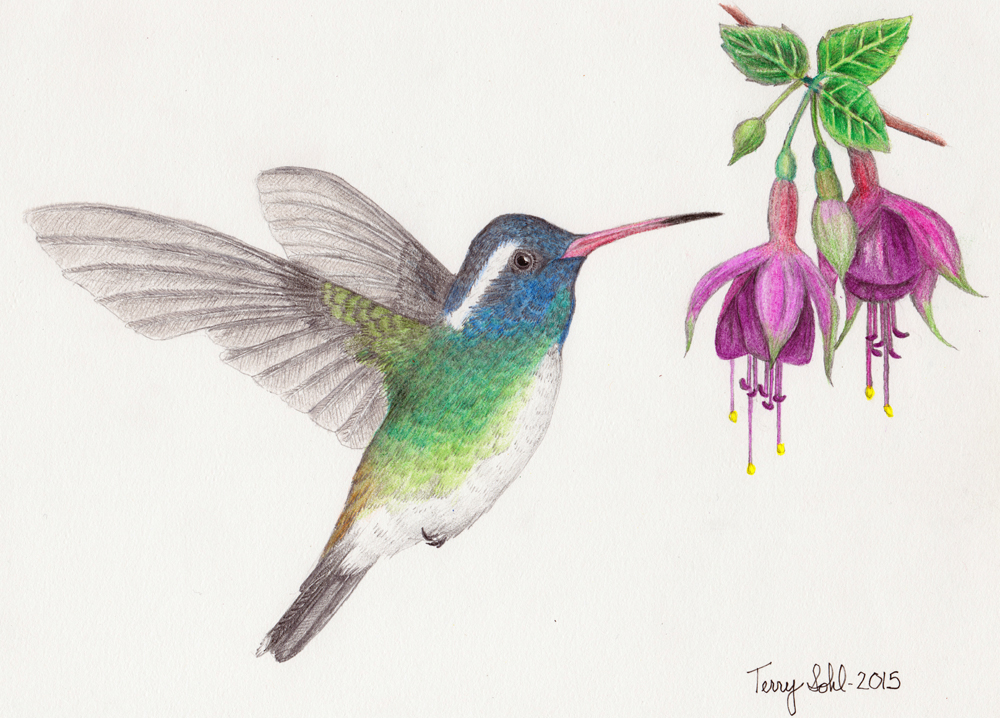 |
| Rivoli's Hummingbird (female) | Rivoli's Hummingbird | White-eared Hummingbird |
Feeders
Will attend hummingbird feeders for nectar.
Conservation Status
Systematic surveys show stable or modestly increasing populations in recent decades. They are found across a very broad geographic area, are common in parts of that range, and overall populations are strong. The IUCN considers the Broad-billed Hummingbird to be a species of "Least Concern".
