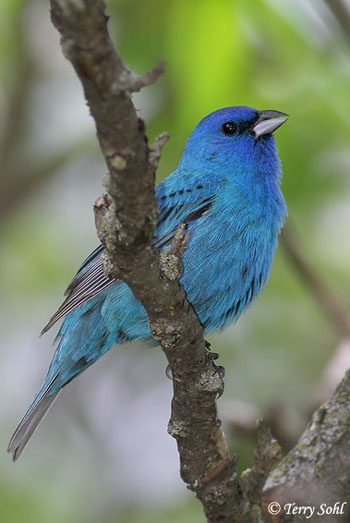
The Indigo Bunting is one of the most abundant songbirds in parts of the eastern United States. They avoid unbroken forest, strongly preferring forest edges and brushy thickets. They are thus likely much more numerous today than in historical times due to man's disturbance of the landscape. The brilliantly colored male (pictured to the right) is an unmistakable sight, while the female (last photo below) is a much more subtly plumaged bird.
Habitat
The Indigo Bunting inhabits brushy fields, woodland edges, second-growth forests, overgrown pastures, hedgerows, roadsides, riparian thickets, and forest clearings. It prefers semi-open habitats with dense shrubs for nesting and scattered trees or tall perches for singing. During migration, it also frequents gardens, parks, and other brushy habitats, while wintering primarily in tropical forest edges, scrub, and agricultural areas in Central America, the Caribbean, and northern South America.Diet
The Indigo Bunting feeds primarily on seeds, berries, and insects. During the breeding season, insects such as caterpillars, grasshoppers, beetles, spiders, and other small invertebrates make up a large portion of the diet, while seeds from grasses and weeds become more important during migration and winter. It also eats a variety of wild fruits and berries, including blackberries, blueberries, elderberries, and serviceberries.Behavior
Often forages by moving through the foliage, gleaning insects from leaves and branches, and occasionally flying out to capture an insect in mid-air. They will also forage along the ground, especially in winter as the diet begins to include more seeds and berries. They can be found foraging at all levels of vegetation, from the ground to the tree tops.Nesting
June and July. The Indigo Bunting builds a small, open cup nest of grasses, leaves, bark strips, rootlets, and spider silk, usually placed low in a dense shrub, sapling, vine, or tangle of vegetation. The female typically lays 3–4 pale bluish-white eggs and performs nearly all of the incubation, while both parents feed the nestlings after they hatch. Indigo Buntings often raise two broods during a breeding season in the southern part of their range.Song
The Indigo Bunting sings a bright, cheerful series of paired musical phrases. Males deliver these rich, warbling songs repeatedly from exposed perches to defend territories and attract mates throughout the breeding season. The species also gives sharp metallic "chip" or "tik" contact and alarm calls that are commonly heard during foraging and migration.
Indigo Bunting song