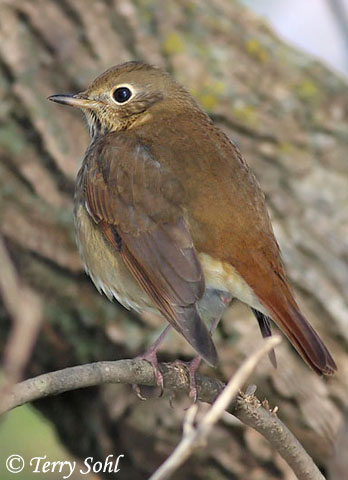
Hardier than many of the other thrushes, the Hermit Thrush is usually the earliest spring migrant and latest fall migrant of the similar thrushes that move through South Dakota. They can be distinguished from the similar Swainson's Thrush and Grey-cheeked Thrush by their distinctive reddish rump and tail. They also possess a distinct light/white eye-ring. Hermit Thrushes are known for their beautiful, haunting song, with several unique musical phrases with slight pauses in between.
Habitat
Nearly any kind of wooded habitat during migration and in the winter. Prefers conifer or mixed-forest during the breeding season.
Diet
Hermit Thrush primarily feed on insects in the summer months, also earthworms, spiders, and occasionally small vertebrates. They often feed heavily on berries during the winter.
Behavior
Often forages on the ground, as well as low in vegetation, searching for insects and berries. They will also occasionally hover and glean insects from foliage or branches, or grab berries while hovering. Hermit Thrushes often have a "nervous" look as they flick their wings and slowly pump their tail.
Nesting
Non-breeder in South Dakota. On their breeding grounds, the nest of a Hermit Thrush is most often placed in a well-protected location on the ground, such as at the based of a conifer tree that provides overhead cover or under a dense shrub. They will also sometimes place their nests low in a shrub or tree, particularly in the western part of their North American range. The female builds a cup-shaped nest, constructed of grasses, weed stems, twigs, leaves, and other plant material, generally with mud, mosses, and lichens on the outside of the nest. The female lays between 3 and 6 eggs, and she alone incubates them. The male will generally bring food to the nesting site however, both for the female and the young when they hatch. The young hatch after about 12 to 14 days, and fledge from the nest about 12 days after hatching.
Song
The song of a Hermit Thrush is a series of beautiful, musical phrases, with pauses in between each phrase. They also have a short tsik call, and other vocalizations that are most often heard around the nest site.
1Click here to hear the song of a Hermit Thrush
2Click here to hear the various calls of a Hermit Thrush
3Click here to hear a "wheezy" call of a Hermit Thrush
Migration
Summers throughout much of Canada, the western U.S., the Great Lakes region, and the northeastern U.S. Winters in the southern U.S., near the west coast, and points south. Hermit Thrushes migrate earlier in the spring and later in the fall than most other thrushes, as they are better at dealing with colder weather.
Interactive eBird Map
Click here to access an interactive eBird map of Hermit Thrush sightings
Similar Species
Hermit Thrush are similar in size and overall structure to several other thrush species that migrate through the state or are found here in the summer. Plumage patterns too have similarities to several species. The following species represent those most likely to be confused with Hermit Thrush. Note one characteristic that differentiates the Hermit Thrush from all of the species listed below...Hermit Thrush are early migrants, appearing quite a bit earlier than most other migrant and summer Thrush species.
- Veery - Some of the other species listed here lack the rich, warm, reddish-brown color found on the lower back and rump of a Hermit Thrush. The Veery shares that warm, reddish brown color, yet on a veery it's not limited to the rump and lower back, but covers most of the bird's upperparts. Veery also tend to have less spotting on their underparts than does a Hermit Thrush, spotting which is also a rich, reddish brown compared to the darker brown spotting of a Hermit Thrush.
- Swainson's Thrush - Swainson's Thrush are generally the most common migrant through the state, particularly in the east. They share the same structure, size, and noticeable eye ring of a Hermit Thrush. However, Swainson's Thrush have a more uniform, duller brown color on their back and tail, compared to the reddish tail and back of a Hermit Thrush that contrasts with duller coloring of the wings, upper back and head. Swainson's Thrushes also tend to show a buffy wash across the face, including a buffy, wide eye-ring, while the eye-ring on a Hermit Thrush is more of a pure white.
- Wood Thrush - Wood Thrush are summer breeders in South Dakota, mostly in the far eastern part of the state. Like the Veery, Wood Thrush have a rich, rusty brown color on most of their upperparts, unlike the rich color restricted to the tail and lower back of a Hermit Thrush. The undersides also distinguishes Wood Thrush from other species on this list, as the bright white underside and crisp, bold dark spots tend to show significantly more consistent contrast than the other birds listed here.
- Gray-cheeked Thrush - Gray-cheeked Thrush aren't as common as Swainson's Thrush as migrants through the state, but they are often seen in spring migration. Gray-cheeked Thrush have the dullest, grayish-brown plumage of any of the birds listed here, without any hint of the warm, rusty brownish tones found on a Hermit Thrush.
Conservation Status
Hermit Thrush are found across a very broad geographic area, and are common in many parts of that range. Recent systematic surveys indicate overall populations are rising. The IUCN thus considers the Hermit Thrush to be a species of "Least Concern".
Further Information
- eBird - Hermit Thrush
- Audubon Field Guide - Hermit Thrush
- Cornell Lab of Ornithology - All About Birds: Hermit Thrush
Photo Information
October 13th, 2008 - Beaver Creek Nature Area near Brandon, South Dakota
Audio File Credits
1Doug Hynes. Recorded on June 30th, 2011 in Newfoundland. Original recording and information available from xeno-canto.
2Christopher McPherson. Recorded in Hillsborough County, New Hampshire on August 9th, 2020. Original recording and information available from xeno-canto.
3Ed Pandolfino. Recorded in Colusa County, California on April 14th, 2014. Original recording and information available from xeno-canto.
