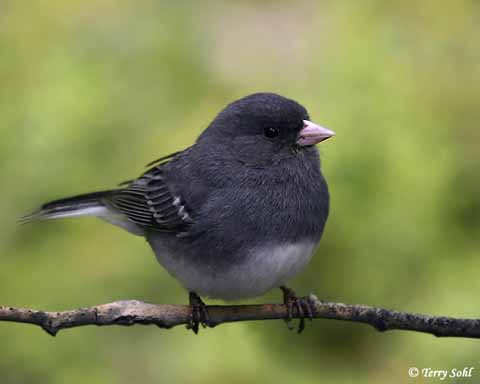
ID Keys: Dependent upon race. See photos at bottom of page of
several different races.
The Dark-eyed Junco is one of North America's most familiar sparrows, recognized by its crisp plumage, pink bill, and flashing white outer tail feathers. It breeds across a wide range of habitats, including boreal forests, mountain conifer forests, and woodland edges throughout Canada, Alaska, and the western United States. During winter, large numbers move south and become common visitors to backyards, parks, shelterbelts, and woodland edges. Several regional forms occur across North America, making the Dark-eyed Junco one of the continent's most geographically variable songbirds. They were once considered five separate species, but are now grouped into one. The five races tend to summer in different locations, but multiple races can be found together in winter. The white-winged race is a South Dakota specialty, nesting only in the Black Hills. They are similar to the much more widespread slate-colored junco race, except they have white wingbars, more extensive white on their tail, and are 10-15% larger than other junco races.
Habitat
The Dark-eyed Junco breeds primarily in coniferous and mixed forests, especially in mountainous and boreal regions with dense understory cover. During migration and winter, it commonly uses woodland edges, brushy fields, parks, shelterbelts, and backyard feeding areas across places such as South Dakota.
Diet
The Dark-eyed Junco feeds primarily on seeds of grasses, weeds, and other herbaceous plants, especially during fall and winter. During the breeding season, it consumes a greater proportion of insects and other invertebrates, including beetles, caterpillars, ants, flies, spiders, and various larvae.
Behavior
Primarily forages hopping or walking along the ground. Even when they come to feeders, they typically will feed on fallen seed below a feeder, or on tray feeders set on the ground.
Nesting
White-Winged race nests in the Black Hills, other races only winter in the state. The Dark-eyed Junco usually nests on or near the ground, often hidden beneath grasses, roots, shrubs, fallen logs, or small banks for protection. The female builds a cup-shaped nest from grasses, mosses, leaves, and fine plant fibers, lining it with softer materials such as hair or feathers. Typical clutches contain 3–5 eggs, and the species often raises two broods during a breeding season.
Song
Dark-eyed Juncos give sharp metallic tick calls that are commonly heard from flocks feeding in forests, brush, and backyard habitats during winter. Their song is a simple musical trill, often delivered from exposed perches during the breeding season, with slight variations among the different regional forms across North America.
Migration
The Dark-eyed Junco is a partial migrant whose movements vary among populations. Birds breeding in Alaska, Canada, and northern mountain regions typically migrate south in fall to winter across much of the United States, while some populations in milder western climates remain year-round. In South Dakota, Dark-eyed Juncos are abundant during migration and winter, often arriving in large numbers during autumn and remaining until spring before returning north to breed. Spring migration is especially noticeable as flocks move through shelterbelts, woodlands, parks, and backyard feeding stations
Generally distinctive, except for the Yellow-eyed Junco. Dark-eyed Juncos are generally gray, brown, or blackish with white outer tail feathers and pale bills, while Yellow-eyed Juncos are warmer brown overall and show striking yellow eyes that immediately distinguish them from all Dark-eyed Junco forms. Yellow-eyed Juncos also tend to inhabit pine-oak woodlands and mountain forests of the Southwest and Mexico, whereas Dark-eyed Juncos occupy a much broader range of forests, shrublands, and winter habitats across most of North America.
Conservation Status
Dark-eyed Juncos remain one of the most widespread and abundant sparrows in North America and are currently considered a species of relatively low overall conservation concern. However, some regional populations have shown gradual declines linked to habitat alteration, climate-driven changes in northern forests, and shifting winter conditions that may affect migration and survival. The IUCN considers the Dark-eyed Junco to be a species of "Least Concern" .
Photo Information
May 30th, 2004 -- Near Sylvan Lake in Custer State Park -- Terry Sohl