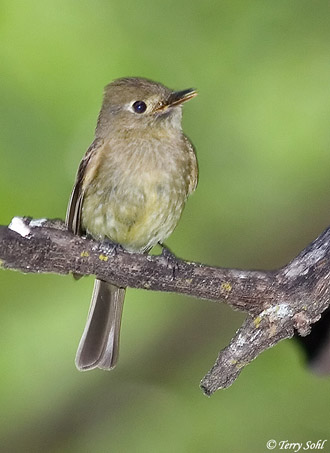
The Cordilleran Flycatcher is yet another confusing Empidonax flycatcher, so much so that it and the almost identical Pacific-slope Flycatcher were once considered to be the same species, called the "Western Flycatcher". They differ only in their normal ranges, and in minor variations in voice. Females of the two species are largely only identifiable by range. The Pacific-slope Flycatcher is not found in South Dakota, however.
Habitat
They prefer deciduous forest in the mountains of the West, preferably along streams and rivers. They will often forage in conifer groves, but aren't nearly as common in pure conifer forests.
Diet
Feeds almost exclusively on insects. Also will eat spiders, and occasionally berries and seeds.
Behavior
Often feeds in typical flycatcher manner, watching from a perch and flying out to capture insects in mid-air. They will feed at nearly any height in the forest canopy. They also may glean food items from foliage, or capture insects from vegetation while hovering.
Nesting
June and July
Song
A broken pit-peet song, with the 2nd note higher than the first.
Migration
Summers in and near mountains of the western United States and Mexico. Winters in Mexico. The Black Hills of South Dakota represent the furthest eastern extent of the species range.
Similar Species
Pacific-slope Flycatcher , as well as other Empidonax flycatchers.
Conservation Status
Appears to be stable throughout most of its range.
Photo Information
July 6th, 2008 - Along Grace Coolidge Creek in the Black Hills - Terry Sohl
Interactive eBird Map
Click to access the eBird species page for Cordilleran Flycatcher
