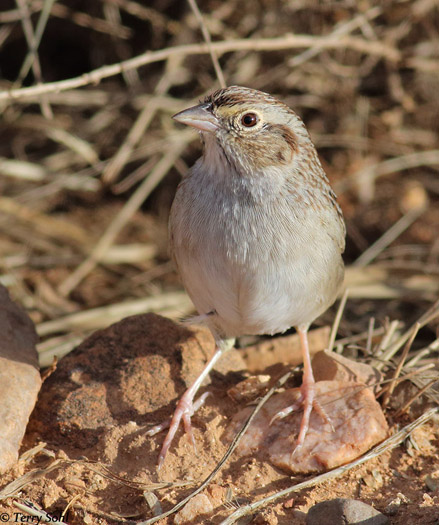
Cassin's Sparrow is a rather non-descript nomadic species of the southern Great Plains. They can be extremely common in some years and largely absent the next, with numbers often being much higher after good rains have resulted in relatively lush grasslands. Their nomadic behavior also includes occasional wanderings far beyond their normal range, as they have been found in states from coast to coast.
Habitat
Found in brushy grasslands, both those composed primarily of thick brush with an understory of grass, and those composed primarily of grassland with a few scattered bushes.
Diet
Cassin’s Sparrows feed primarily on grass and weed seeds, especially during fall and winter when they forage quietly on the ground in open grasslands and desert scrub. During the breeding season they consume more insects—including grasshoppers, beetles, caterpillars, and other small invertebrates—which provide important nutrition for nesting adults and growing young.
Behavior
Cassin’s Sparrows are secretive grassland birds that often remain hidden low in vegetation while foraging quietly on the ground for seeds and insects. During the breeding season, males become much more conspicuous, performing distinctive fluttering song flights high above the prairie where they slowly drift back to the ground while singing continuously.
Breeding
Generally considered a very rare breeder in South Dakota, but with some confirmed breeding records in the far southwestern part of the state. Cassin’s Sparrows build small cup-shaped nests low in grasses or shrubs, usually well concealed within dense vegetation in open prairies or desert grasslands. Females lay 3–5 eggs and handle most incubation duties, while both parents help feed the young after hatching.
Song
The song of the Cassin’s Sparrow is a rich, musical series of whistles, trills, and buzzy notes often described as one of the most beautiful songs of the southern grasslands. Males frequently deliver this song during dramatic aerial display flights, singing continuously as they flutter high above their territory before slowly parachuting back to the ground.
Migration
Cassin’s Sparrows breed during summer across the southern Great Plains, desert grasslands, and arid shrublands of the southwestern United States and northern Mexico. Many birds migrate southward in winter into Mexico and the desert Southwest, although some populations remain year-round residents in portions of their southern range.
Feeders
Will attend feeders for corn and other grains.
Similar Species
Brewer's Sparrow , Botteri's Sparrow. Brewer’s Sparrows are smaller and plainer than Cassin’s Sparrows, with a weaker face pattern, finer bill, and a rapid buzzy song lacking the rich whistled quality and dramatic aerial song flights typical of Cassin’s Sparrow. Botteri’s Sparrows are larger, longer-tailed, and more heavily streaked below, usually favoring taller dense grasslands and giving a deeper, slurred song that sounds much less musical than Cassin’s distinctive cascading whistles. Cassin’s Sparrows are best recognized by their pale face, crisp white eye ring, relatively unstreaked underparts, and especially by the male’s fluttering display flights accompanied by continuous singing high above open grasslands.
Conservation Status
Cassin’s Sparrow has experienced notable long-term population declines and is considered a species of growing conservation concern because of widespread loss and degradation of native grassland and desert scrub habitats across the southern Great Plains and Southwest. Prolonged drought, overgrazing, shrub encroachment, altered fire regimes, and conversion of open rangelands to agriculture or development all threaten the large expanses of sparsely vegetated habitat this species requires for breeding. However, numbers overall do not currently warrant any form of conservation listing. The IUCN considers the Cassin's Sparrow to be a species of "Least Concern".
Photo Information
November 10th, 2015 - Las Cinegas Natural Resource Area, near Tucson, Arizona - Terry Sohl
Interactive eBird Map
Click to access the interactive eBird species sightings page for Cassin's Sparrow
